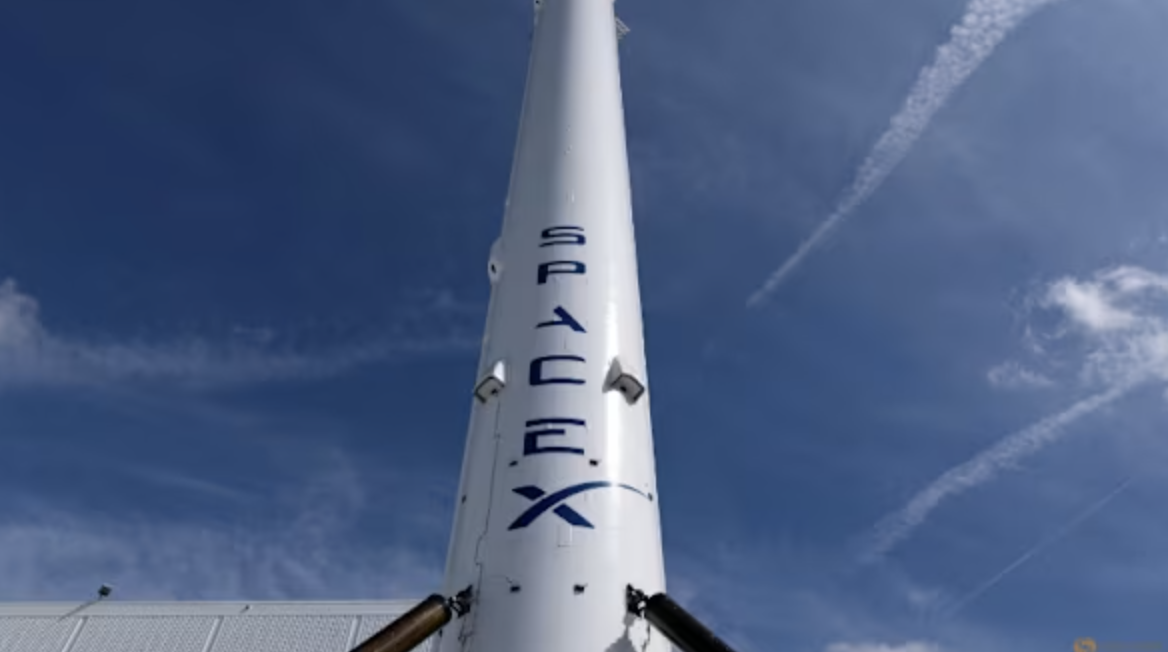
The plan has a code name inside SpaceX: “Project Apex.” Under it, the company filed confidentially with the SEC in early April, and reports this week point to pricing as early as June 11 with trading on June 12 under the ticker SPCX.
A listing on the Nasdaq could become the largest initial public offering in history, according to reports from Reuters, Bloomberg, and the Wall Street Journal. The offering is expected to raise between $40 billion and $75 billion, depending on valuation and share count — a range that would shatter the current record of $25.6 billion raised by Saudi Aramco’s 2019 IPO. At the higher end of the valuation targets reported around $1.4 trillion, SpaceX would immediately rank among the world’s ten most valuable publicly traded companies, alongside Apple, Microsoft, Nvidia, and Alphabet.
The scale of the raise reflects both SpaceX’s position and its ambitions. The company dominates orbital launch, completing 134 missions in 2024 and roughly 170 in 2025, with a booster reusability record no competitor matches. Starlink, its satellite internet business, has more than 7,000 satellites in orbit and has become the economic engine of the company, generating the bulk of consumer revenue and serving customers from rural households to the Ukrainian military.
The xAI merger changes the financial picture substantially. Before the deal, sources familiar with SpaceX’s pre-merger financials indicated the legacy rocket-and-satellite business generated roughly $8 billion in annual profit. After consolidating xAI — the company behind the Grok models and X — the combined entity reported about $18.7 billion in revenue for 2025 but a net loss of $4.9 billion, with xAI’s compute spending driving capital expenditure to $20.7 billion and long-term debt to $29.1 billion at the end of March. The AI business alone posted an operating loss of $2.47 billion in the first quarter of 2026.
That is the central tension of the deal: investors are being asked to pay roughly 95 times trailing revenue for a company that is simultaneously the world’s most profitable launch and satellite business and a heavy AI spender. ARK Invest, one of SpaceX’s most vocal bulls, argues the $1.4 trillion-plus valuation is grounded in a plausible trajectory for Starlink, Starship, and orbital AI combined, projecting a $2.5 trillion enterprise value by 2030. Sellers of risk point to xAI’s roughly $1 billion a month compute burn, an unproven orbital data center business, and governance questions around a founder who simultaneously runs Tesla.
The choice of Nasdaq is deliberate. Musk’s team has pursued the listing venue in part for index mechanics: Nasdaq has a fast-entry rule that can qualify a newly listed company for the Nasdaq-100 after as little as 15 days of trading, triggering automatic forced buying from every exchange-traded fund and index fund that tracks the index. A listing of this size would be among the largest index additions in market history, and the demand flows that follow would provide a tailwind for the stock in its first weeks.
The offering is also notable for its retail orientation. Reports indicate SpaceX plans to allocate up to 30% of available shares to individual investors — roughly three times the typical Wall Street norm. On a $75 billion raise, that would put approximately $22.5 billion of shares into retail hands through participating brokerages, a structure that mirrors the populist appeal Musk has cultivated across his ventures and that could support strong first-day demand from investors who have been locked out of the company’s private market gains.
The timing reflects a window that may not stay open. The deal comes after Cerebras’s record-setting AI chip IPO in May, which raised $5.55 billion and closed its first day up 68%, and as markets digest a wave of large AI-focused offerings. Musk has also signaled urgency internally: in January he was granted 1 billion performance-based Class B shares with a single vesting condition — establishing a permanent human colony on Mars with at least one million inhabitants. A public listing is the mechanism that makes the capital raise for that ambition possible at scale.
Musk has resisted taking SpaceX public for two decades, saying for years that an IPO would wait until regular flights to Mars existed. The decision to list now — before Starship has flown crews, and while the AI business burns cash — represents a shift that people familiar with the company’s thinking attribute to the scale of capital needed for both ambitions at once.
The prospectus, which will reveal detailed financial statements for the first time, is expected to become public in the weeks before the roadshow. Governance will draw scrutiny: Musk operates Tesla as a public company while running SpaceX and xAI, and reports note the xAI founding team has shrunk from 12 to six key members. Regulatory questions surround the FCC filing for up to one million solar-powered AI satellites, which has not cleared review, and environmental litigation over Starship operations in Boca Chica remains ongoing.
The offering’s success will also test whether public markets can price a company whose valuation rests partly on future industries — orbital data centers, Mars colonization, and AI — alongside an already-proven satellite business. If the deal prices near the top of reported expectations, SpaceX would become the largest company ever to go public, and its first-day performance would set the tone for the rest of the 2026 IPO pipeline, which includes potential offerings from OpenAI and Anthropic.
SpaceX’s accelerating path to the Nasdaq is both a commercial milestone for space and the largest capital raise ever attempted. The company pairs a profitable launch-and-satellite business with an AI operation that is currently losing money at scale, and it is asking investors to fund the most ambitious engineering program in history. The June listing, if it proceeds as reported, will test whether public markets can absorb a $1.4 trillion-plus valuation built on Starlink’s present and Mars’s future.