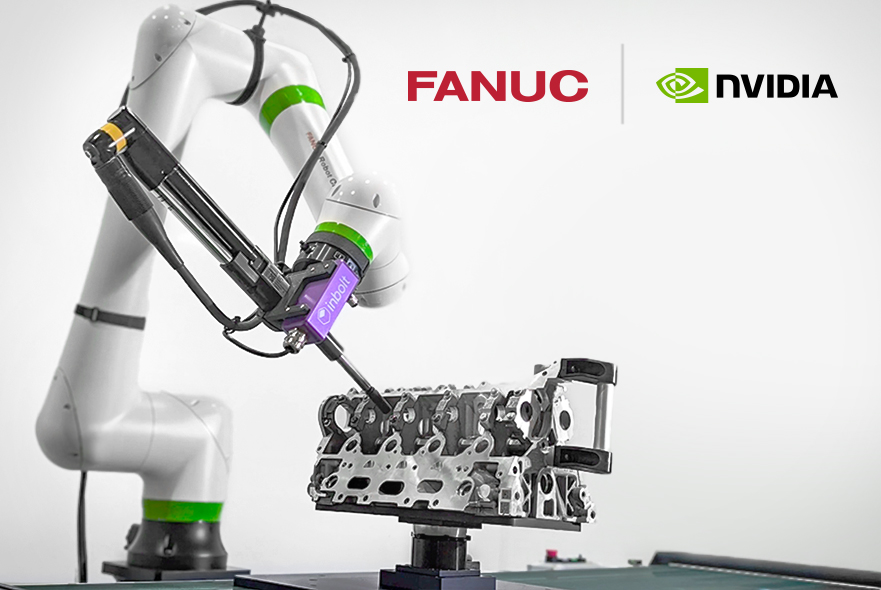
OSHINO, Japan — On a factory floor at the foot of Mount Fuji, a robot arm recently learned something new: how to pick oddly shaped parts out of a bin, one at a time, without a human programming the motion. The skill came not from FANUC’s own control software but from artificial intelligence running on Nvidia chips.
The two companies want more of that. FANUC announced on May 15 that it will deepen its strategic partnership with Nvidia, using the chip maker’s Isaac robot platform and computing power to speed up development of next-generation autonomous mobile robots and collaborative robots capable of learning highly complex tasks.
The announcement is a small piece of a larger shift in industrial automation. For decades, robot makers sold machines that followed instructions written line by line by engineers. The new generation is expected to learn from demonstration, simulation, and trial and error — the same techniques that power chatbots and image generators, applied to moving steel.
FANUC, one of the world’s largest industrial robot makers with more than a million robots installed worldwide, is a natural partner for Nvidia. Its machines bolt cars together in Detroit, stack crates in Chinese warehouses, and weld frames in German factories. Nvidia, which has spent years building tools for what it calls physical AI, wants its software inside those machines.
“Manufacturers do not buy robots to admire them,” said an executive at a Japanese robotics supplier. “They buy them to get work done. The question is whether AI makes that work cheaper and faster.”
Under the expanded agreement, FANUC will build on Nvidia’s Isaac platform, a suite of tools that lets developers train robots in simulated environments before deploying them in the real world. Simulation is the key selling point. Training a robot on a physical factory floor is slow and dangerous; training it in a virtual replica, where failures cost nothing, is fast. The technology transfers what the virtual robot learned to the real one, a process the industry calls sim-to-real.
The stakes are rising across the industry. Japan, FANUC’s home market, is running out of factory workers. The country’s labor force has been shrinking for years, and manufacturers have leaned on automation to fill the gap. Robot shipments to Japanese factories have climbed steadily, and demand from China, where labor costs have risen sharply, has been a second engine of growth.
Competitors are moving in the same direction. ABB, Kuka, and Yaskawa Electric have all announced AI partnerships, and a wave of startups has emerged to sell robot software rather than robots themselves. Nvidia’s push into the space has made it a central figure in the competition: robot makers that once wrote their own control stacks now face a choice between building their own AI tools and buying them from a chip company.
Analysts said the FANUC deal is significant mainly because of scale. FANUC’s robots work in thousands of factories, and every one of them is a potential deployment point for Nvidia’s software. If FANUC ships AI-enabled robots by the thousands, Nvidia gains a distribution channel into the physical world that rivals its reach in the data center.
Details of the agreement were sparse. The companies did not disclose financial terms, product road maps, or a timeline for commercial release. A FANUC spokesman said the first products developed under the expanded partnership would be announced “in due course,” without being more specific.
The cautious tone reflects the distance between promise and delivery. Industrial customers are skeptical of technology that works in demonstrations but fails on factory floors, where dust, vibration, and unpredictable parts defeat systems that performed perfectly in the lab. FANUC’s engineers have spent decades learning those lessons, and the company has built a reputation for reliability over flash.
FANUC’s financial position gives it room to experiment. The company, known for its deep cash reserves, posted strong results in its most recent quarter, powered by demand from chip equipment makers and electric-vehicle factories. Robotics revenue has grown as manufacturers automate tasks that humans once did, and the company’s executives have said they see AI as the next chapter of that growth.
For Nvidia, the partnership is one more step beyond the data center. The company has signed deals with robot makers, warehouse operators, and car factories in recent years, betting that the next wave of AI revenue will come from machines that move. The FANUC agreement adds a marquee name to that list.
Neither company is calling the partnership exclusive. FANUC can work with other AI suppliers, and Nvidia can court other robot makers. But both have an interest in making the relationship work: FANUC wants to stay ahead of rivals that are adopting the same tools, and Nvidia wants proof that its robot software can run the world’s factories.
The robot arm in Oshino is a start. Whether it becomes a template for millions of machines depends on whether the lessons it learned in simulation hold up on real factory floors, where the parts do not always sit where they should and the clock is always running. FANUC’s customers, analysts said, will be watching closely.