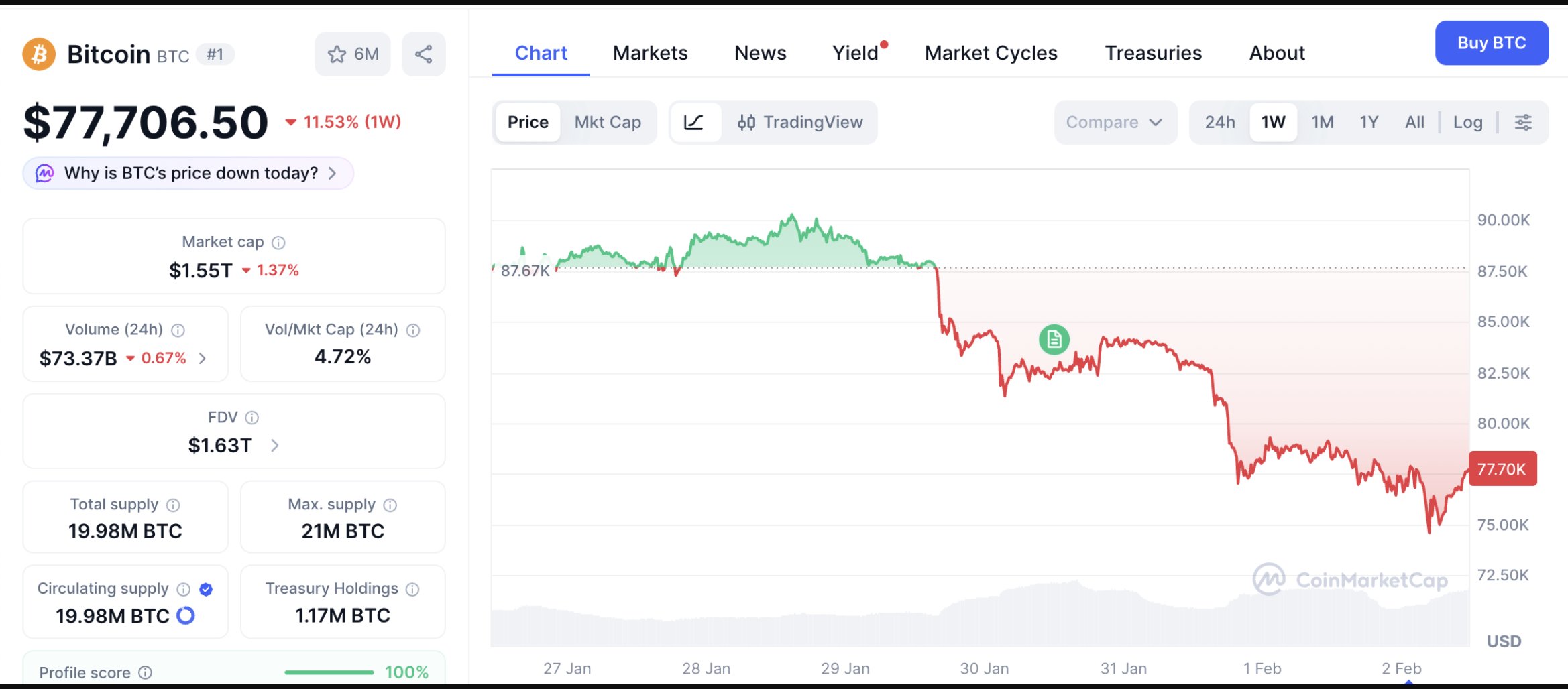
NEW YORK — The sale was small, thirty-two coins, worth a few million dollars, and it would have been invisible in any other week. But the seller was Strategy, the company that built its entire identity on buying bitcoin and never selling, and the sale was its first, breaking the market’s longest-running assumption. Within days, bitcoin had fallen close to half its record high, more than 250,000 traders had been liquidated in a single session, and the cryptocurrency’s bull market was being described in the past tense.
The decline from the peak near $126,000 has been brutal by any measure, and the four forces behind it are not new, just newly aligned. The Strategy sale punctured the market’s confidence in the biggest holder. Exchange-traded funds that track bitcoin have seen money leave for eleven consecutive trading days, with cumulative outflows reaching nearly $3.5 billion. Macroeconomic data has turned against risk assets. And geopolitics has put a floor under oil prices that nobody wants.
The Strategy sale deserves the attention it got, not because thirty-two coins matter to the market’s supply but because they matter to its psychology. Strategy, formerly MicroStrategy, spent years telling the market that its bitcoin holdings would never be sold, that the treasury strategy was buy and hold forever, and investors bought the story along with the stock. The first sale, however small, proved the story had an exit, and a market built on a promise of eternal holding is vulnerable the moment the promise bends.
The ETF outflows are the mechanical version of the same fear. Eleven straight days of redemptions, nearly $3.5 billion in total, is the longest sustained withdrawal since the funds launched, and it represents the institutional money that drove bitcoin’s rise to its peak. When the largest, most liquid holders of a risk asset decide to leave, the price follows, and the flows feed on themselves: falling prices push more investors to redeem, which pushes prices lower.
The macro picture has been moving against bitcoin all spring. April’s job openings came in at 7.62 million, far above what economists expected, a sign that the labor market remains too strong for the Federal Reserve to justify the rate cuts that risk assets have been priced for. Cleveland Fed President Beth Hammack has said in recent weeks that if inflation keeps climbing, a return to rate increases cannot be ruled out, a statement that lands on bitcoin with particular force, since the asset’s entire investment case rests on the dollar losing purchasing power.
Oil adds the geopolitical layer. Conflict in the Middle East has pushed crude higher repeatedly this spring, and higher energy prices feed directly into inflation, which feeds into the Fed’s rate decisions, which feed into the discount rate applied to every risk asset. Bitcoin’s sellers do not need to know the mechanics; they only need to see the direction: each new escalation raises the odds that rates stay high or rise, and each tick of the odds lowers the value of holding a volatile asset with no yield.
The liquidations are the market’s way of cleaning the ledger. More than 250,000 positions were wiped out in a single day as the decline accelerated, the kind of forced selling that marks the end of a debt-fueled cycle. The numbers have a particular cruelty: traders who borrowed to buy near the peak are being closed out at prices they never imagined, and their exits are adding to the selling pressure that closed them out in the first place.
None of this means the cycle is over, and the market’s history argues for caution on both sides. Bitcoin has fallen by more than half from peaks before, including a decline of more than 75 percent in the last bear market, and each time it eventually recovered to new highs. The current decline is a halving from the peak, a large move but not yet a historic one, and the holders who bought years ago are still deeply in profit. The pain is concentrated among those who borrowed and those who bought late.
What is different this time is the composition of the market. The ETF era brought a new class of holders, institutions that treat bitcoin as a portfolio allocation rather than a belief system, and those holders respond to macro data and flows rather than to narratives. Their presence makes the market less romantic and more mechanical, and it means the four pressures now acting on the price, the strategy sale, the outflows, the Fed, and the oil market, are likely to keep acting until the data changes.
For now, the market is doing what it has always done at moments like this: marking prices down, liquidating borrowed positions, and waiting for a reason to turn around. The trigger may come from the Fed, from a shift in ETF flows, or from nowhere at all, the way it always does. The traders watching their screens this week learned again the oldest lesson in the asset class: bitcoin does not move in a straight line, and neither do the people who own it.