ASML has become the most valuable company in European history. The Dutch maker of lithography machines, whose equipment is required to produce every advanced AI chip, has seen its market value climb past $674 billion, surpassing the previous records held by European energy and luxury giants, with shares up roughly 60 percent this year.
The rise reflects a simple dependency. No company can build a modern AI processor without ASML’s extreme ultraviolet lithography machines, the only tools that can print the tiny circuits inside today’s most advanced chips. Each machine costs hundreds of millions of dollars, takes months to assemble and is sold out years in advance. ASML is, in effect, a toll booth on the only road into the AI era.
The stock’s rise has been relentless. ASML shares have gained about 60 percent since the start of the year, and analysts see little sign of the momentum fading, with order books full and customers lining up for capacity that will not exist for years. The company’s backlog, executives said at a recent investor event, extends well into the decade, and the pace of orders has accelerated as chipmakers build out AI-focused factories in the United States, Europe, Japan and Taiwan.
The valuation crest now places ASML above the companies that once defined European capitalism. It has overtaken the region’s oil majors, luxury houses and pharmaceutical groups, a shift that executives and economists read as a statement about where industrial value now sits. Europe’s technology sector, long derided as a collection of also-rans next to Silicon Valley, has produced the most valuable company on the continent by making the machines that every AI company on earth depends on.
The dependence runs in both directions. ASML’s customers, the world’s largest chipmakers, have little choice but to pay whatever the company asks, because there is no alternative supplier of EUV technology. That pricing power has made ASML one of the most profitable industrial companies in the world, with margins that rival software businesses. It also makes the company a chokepoint, and governments have taken notice: the Dutch government restricts where ASML’s most advanced machines can be sold, and the company has become a central piece of the geopolitical competition over advanced chips.
The AI wave has sharpened the company’s position. Every new data center filled with AI accelerators begins, years earlier, as an order for lithography machines. The surge in AI investment has translated directly into ASML orders, and the company’s executives have said they expect demand to remain strong for as long as the industry keeps building fabs. The company is also selling more advanced machines per fab, raising the value of each sale.
There are risks beneath the rally. ASML’s technology is so capable that its machines last for decades, and a slowdown in fab construction would hit the company harder than almost any chipmaker, because its revenue depends on new capacity rather than on the chips themselves. Some analysts have cautioned that the stock now prices in years of uninterrupted growth, leaving little room for a downturn in AI spending or a breakthrough in alternative lithography.
The company has also become more entangled in politics. Export controls restrict shipments of its most advanced machines to China, cutting off what was once its fastest-growing market, while governments on both sides of the Atlantic push for local chip production that requires ASML’s equipment. The company has responded by expanding service operations globally, but the constraints on where it can sell remain a live issue for investors.
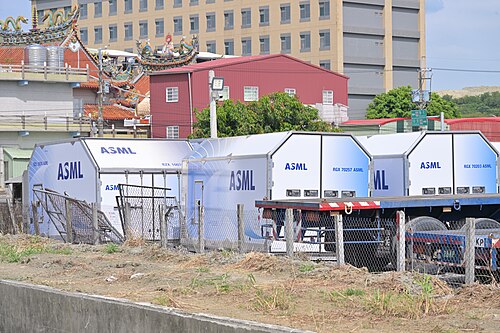
The machines behind the valuation are unlike anything else in manufacturing. Each EUV system weighs about as much as a bus, requires a building of its own to house, and sells for hundreds of millions of dollars, with the newest high-NA models priced higher still. The company ships only a few dozen of its most advanced machines a year, and the combination of scarcity and indispensability is what lets ASML command pricing power no other capital-equipment maker approaches. The backlog, executives said, extends far beyond what current factories can absorb.
Analysts caution that the rally has priced in years of uninterrupted growth. ASML’s revenue depends on customers building new fabs, and fab construction is cyclical by nature, tied to chip prices, demand forecasts and the willingness of governments to subsidize capacity. A downturn in AI spending, or a longer-than-expected delay in the fab buildouts now planned in the United States and Europe, would hit ASML harder than most chipmakers, because its machines are the first purchase in a multi-year construction program. The company’s own executives have warned, gently, that order books are not the same as shipments.
The rise also puts the company at the center of export politics. ASML’s most advanced machines are subject to Dutch and allied export restrictions, limiting sales to China, once its fastest-growing market, while Washington and Brussels push for local fabrication that requires the company’s equipment. The result is a balancing act: ASML sells to the governments that regulate it, and its customers’ factories are increasingly shaped by policy rather than pure economics. The company’s position, essential to every side, has made it a rare industrial firm that is simultaneously a supplier, a chokepoint and a diplomatic asset.
For now, the market’s verdict is clear. ASML’s rise to the top of Europe’s corporate rankings is a direct measure of how central its machines have become to the global economy’s most important industry. The company that prints the circuits inside every AI chip now carries the highest valuation in its continent’s history, a position that reflects not just its own success but the extraordinary price the world is willing to pay to compute at the frontier.