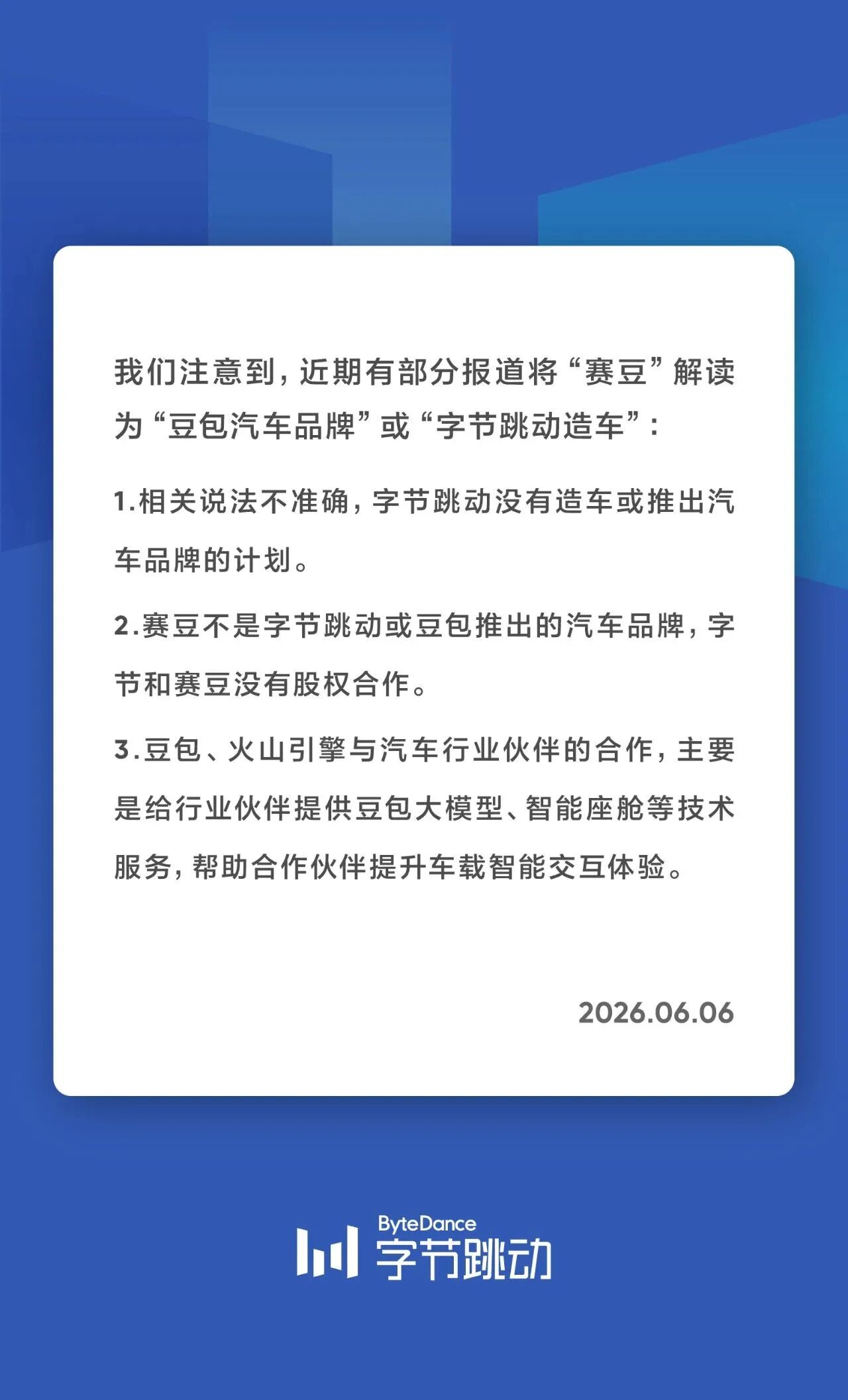
The name sounded like a corporate marriage announcement: Saidou, a blend of Seres and Doubao, ByteDance’s AI assistant, and the market drew its own conclusions. Reports spread that ByteDance, the parent of TikTok and Douyin, was entering car manufacturing through a new brand built with Seres Group, the Chinese automaker behind the AITO line it makes with Huawei. On Saturday, ByteDance issued a statement that was notable mainly for its brevity: no plans to manufacture vehicles, no plans to launch an automotive brand, no equity relationship with Saidou Technology.
The background to the denial is a rebranding with timing that invited speculation. Seres Group restructured its loss-making budget brand Landian into a new entity called Saidou, which announced it would launch a new automotive brand on June 9 under the banner of exploring the possibilities of AI-defined vehicles. Landian, which sold electric models at prices from roughly $15,000 to $25,000, had been struggling, and the rebrand appeared designed to attach itself to the AI wave. Because the name echoed Doubao, and because Seres already works with Huawei on AITO, the market read Saidou as a second tech partnership in the making.
ByteDance’s statement closed the door on that reading. The company said Saidou is not a car brand launched by ByteDance or by Doubao, and that it holds no stake in Saidou Technology. It acknowledged its actual automotive business in the same breath: through Doubao and its Volcano Engine cloud platform, ByteDance supplies artificial intelligence models and smart cockpit software to automakers. The company is a toolmaker for the car industry, not a carmaker, a distinction its statement drew sharply.
That position has become a minority view among China’s biggest technology companies. Xiaomi entered the car business in earnest with its SU7 sedan, which became one of the best-selling electric models in China after its 2024 launch, and it is expanding production. Huawei has gone further, building its AITO and other brands through partnerships with automakers, supplying everything from chips to driving software, and its vehicles now sell in significant volume. Baidu has invested in robotaxis, and Alibaba has backed automakers. The gravitational pull toward cars is strong enough that ByteDance’s restraint reads, in this market, as an unusual choice.
The logic of restraint is easy to see in the numbers. Car manufacturing is a capital-intensive business with thin margins, brutal price competition and long product cycles, and China’s electric vehicle market is among the most crowded on earth, with dozens of brands fighting for share and prices under constant pressure. Xiaomi and Huawei can absorb those costs because cars serve a larger strategy of ecosystem lock-in. ByteDance’s core business, short-form video, advertising and, increasingly, AI services, has higher margins and fewer factory floors, and its AI assistant Doubao has become one of the most used assistants in China without the balance-sheet weight of a car plant.
The company has also found a quieter path into the industry. Automakers increasingly want AI features in the cockpit, voice assistants that understand Chinese well, and the kind of recommendation infrastructure ByteDance has spent a decade perfecting. Supplying those tools through Doubao and Volcano Engine puts ByteDance inside the car business, which has its own risks, including being squeezed as automakers build in-house AI teams, but it does so without the hundreds of millions in capex, the assembly plants, and the regulatory exposure of vehicle production.
ByteDance’s AI ambitions are real even if its car ambitions are not. Doubao has grown into one of China’s most used AI assistants, with tens of millions of daily users, and Volcano Engine has become a serious challenger in cloud services, selling computing and AI tooling to enterprises. Supplying intelligence to the automotive industry is a natural extension of that business, and it is already happening through smart cockpit deals and in-car AI features powered by Doubao and Volcano Engine.
The company’s refusal to follow Xiaomi and Huawei into vehicle production also reflects a different corporate culture. ByteDance has expanded into hardware selectively, and its statements about cars have been consistent for years. In a market where the cost of entry is measured in billions and the failure rate is high, the company has chosen the role that lets it sell to every automaker rather than compete with most of them. For investors, the denial clarifies what ByteDance actually is: a company that owns the intelligence layer, and that has decided the car is a customer, not a factory.
Analysts said the denial is likely the final word, at least for now. ByteDance has shown discipline about expanding into hardware, and its statements have been consistent. The episode is a useful illustration of the boundary lines in China’s AI race: the companies that own the models and the content do not automatically become the companies that own the metal. For Seres, the Saidou launch proceeds on its own; for ByteDance, the statement restores the focus to what it actually wants to be in the automotive world, a supplier of intelligence to the people who build the cars.