
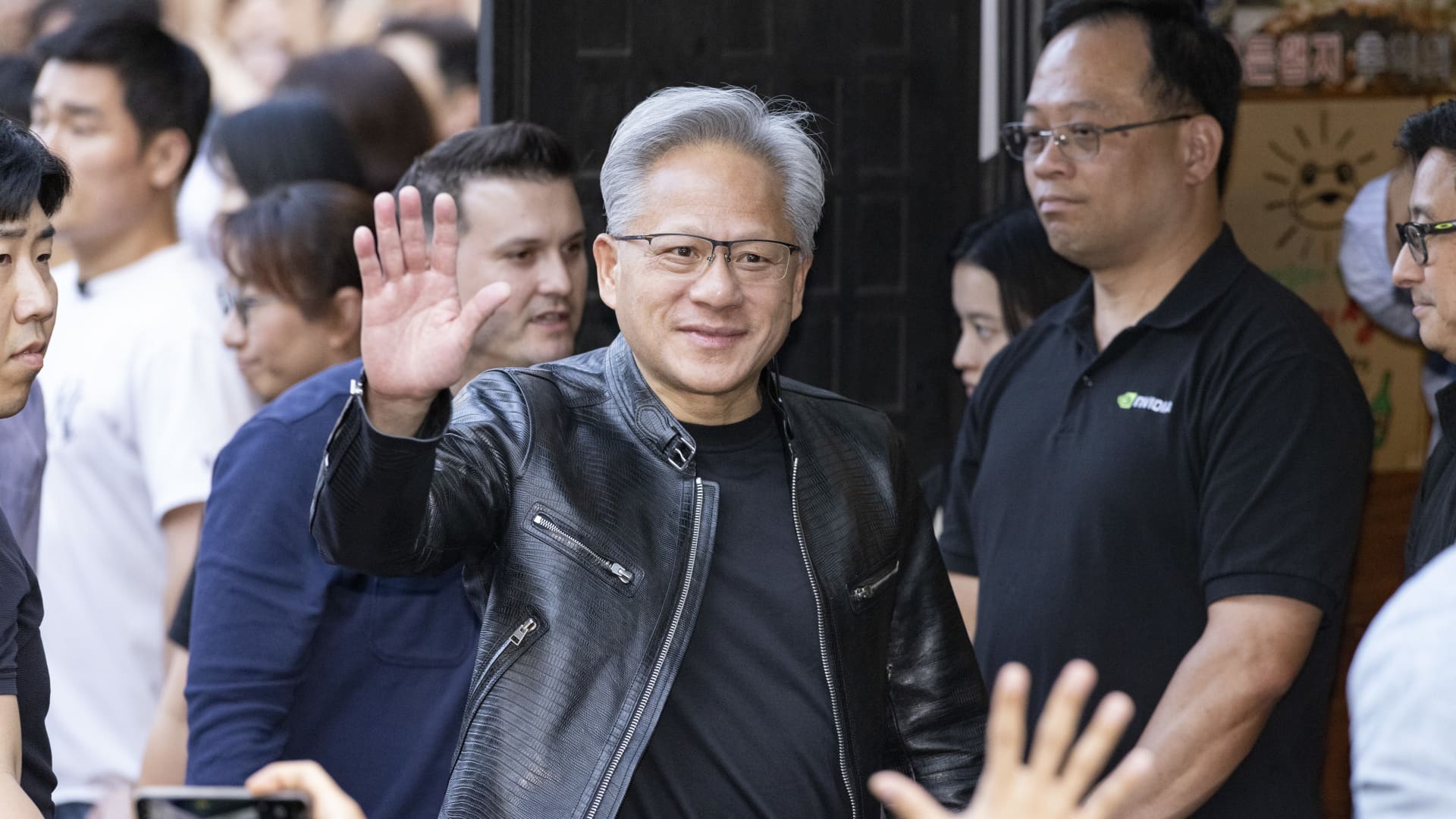
The dinner in Seoul ended with a promise of substance to follow. On Monday, Jensen Huang, chief executive of Nvidia, and Chey Tae-won, chairman of SK Group, are scheduled to announce a broad cooperation plan covering AI supercomputers, central processors, new personal computers and robotics, according to a person familiar with the plan.
The announcement caps a weekend of meetings in the South Korean capital, where Huang pressed a warning that has unsettled the market for AI hardware. Memory chip supply will remain tight for “several years,” he said, citing shortages that run from raw wafers through advanced packaging to the silicon photonics components that link accelerators together. Reuters reported the comments, and CNBC relayed them to a market that had been hoping for relief.
The warning cut against growing optimism that chip supply was on the mend. Shares of memory makers had been buoyed by expectations that new capacity would ease shortages by late this year; Huang’s remarks suggested the constraints reach deeper than any single product line and will outlast the current buildout cycle.
SK Group is the parent of SK hynix, the world’s second-largest memory chip maker and the dominant supplier of high-bandwidth memory, the specialized chips stacked beside Nvidia’s accelerators. HBM has become the most contested component in AI servers, and the two companies have spent years coordinating production schedules, delivery timelines and next-generation specifications. The relationship deepened in 2024, when Huang pressed SK hynix to pull deliveries forward, a request the company met by reworking its production calendar.
The cooperation plan spans four areas. In AI supercomputers, the two companies are expected to align road maps so that Nvidia’s next accelerators ship with memory built to match. The CPU and PC pieces extend the relationship beyond the data center into a market where SK hynix already sells broadly; a new class of AI personal computers, running local models on their own memory, is a category both companies have identified as the next large consumer of their products. Robotics is the newest frontier, a field that promises heavy demand for both computing and memory.
The timing matters. Nvidia is racing to hold its share of the AI computing market as Advanced Micro Devices, cloud providers and a wave of custom chip efforts press from every side. Securing memory supply has become as strategic as designing the accelerators themselves, and the alliance locks in a partner whose factories are already tuned to Nvidia’s requirements.
For SK hynix, the arrangement cements its position at the center of the AI buildout and complicates life for rivals Samsung Electronics and Micron Technology. The company has invested heavily in HBM capacity and advanced packaging, betting that demand would follow; Huang’s forecast of years of tight supply suggests that bet is paying off, though the price of admission is a growing dependence on a single customer’s technology choices.
Huang’s warning has broader implications for the industry’s finances. If supply stays tight for years, prices for AI hardware stay high, the capital bills of hyperscalers keep climbing, and the economics of AI services face sustained cost pressure. It also helps explain the scramble visible in the financing markets: Alphabet’s $85 billion equity raise, Meta’s plan to sell new shares, and the extraordinary steps such as temporary data center structures that companies are taking to get compute online faster.
Analysts said the real bottleneck has migrated from logic chips to the ecosystem around them. Advanced packaging capacity, test and assembly lines, and the optical modules that move data between accelerators are all running at the edge of their limits. Huang’s list of shortages maps almost exactly onto that shift, which is why he and his suppliers are now planning years ahead rather than quarters.
Customers are already feeling the effects. Server makers report that lead times for AI systems have stretched, and some cloud providers have told clients that capacity allocations will stay rationed through next year. The shortage has also pushed some companies to sign unusual multi-year supply agreements, locking in volumes years in advance at prices that would have seemed steep a year ago.
The market’s reaction to Huang’s comments was muted by the standards of recent volatility, but the direction was clear: shares of memory makers held their gains while investors digested the idea that the shortage would last longer than many had modeled. Nvidia’s own stock has been caught between record demand and the constraints that keep it from selling more, a tension that has shaped the company’s valuation debate for months.
The Seoul visit also carried a diplomatic dimension. South Korea has worked to anchor more of the AI supply chain on its own soil, and hosting the world’s most valuable chip designer for a weekend of meetings suits that ambition. Chey’s SK Group has been expanding across energy, semiconductors and now AI services, and a formal alliance with Nvidia gives it a claim to a central role in the industry’s growth.
For the industry, Monday’s announcement is a signal of intent. The question is whether the two companies can convert a handshake into products fast enough to ease the constraints Huang described. Neither side is betting that shortages will simply resolve themselves; the breadth of the plan suggests both expect the supply squeeze to be a defining feature of the next several years.



