In the late summer of 2008, SpaceX had about a week of cash left, and the company’s engineers privately put the odds of the next launch succeeding at roughly 10%. Three Falcon 1 rockets had already failed. The fourth sat on the pad in the Pacific, and with it the future of a company Elon Musk had founded six years earlier with the proceeds of his PayPal fortune.
The fourth launch worked. On Sept. 28, 2008, Falcon 1 reached orbit, the first privately developed liquid-fueled rocket to do so, and the trajectory of the company changed in the space of a few minutes. NASA, which had watched the failures from a distance, came through with a contract to carry cargo to the International Space Station, and the money bought SpaceX the time it needed. CNBC reported this week on the full arc of that rescue and what followed: a $2 trillion listing, the largest in stock-market history, told through the voices of the engineers who lived through the failures.
Mr. Musk has said in interviews that the company came within weeks of bankruptcy in that period, and the numbers support the memory. The first Falcon 1 flight failed in March 2006, seconds after liftoff. The second, in March 2007, reached space but failed to orbit. The third, in August 2008, failed on separation. Each failure consumed months of work and the patience of the small team that had stayed. After the third, investors had largely written the company off, and the payroll was burning through what remained.
The rescue contract, awarded in December 2008, was worth about $1.6 billion for a series of cargo flights, and it transformed SpaceX from a startup surviving on founder capital into a government contractor with a revenue line. The contract was part of NASA’s broader bet on commercial space, a program designed to let private companies take over the routine work of reaching orbit, and SpaceX was the proof that the bet could pay. Falcon 9, a much larger rocket, flew for the first time in June 2010. The Dragon capsule docked with the space station in 2012.
From there the company’s growth compounded. The market it entered was a duopoly of government-backed contractors with decades-old launch vehicles, and SpaceX’s willingness to fly cheap and often pulled prices down across the industry. In December 2015, a Falcon 9 booster landed itself upright on a pad at Cape Canaveral, a feat that had been dismissed as a stunt and turned out to be the foundation of the company’s economics: a rocket that can be flown again does not need to be rebuilt for every launch. Reuse cut costs, cut prices and pulled the launch market toward SpaceX. The Starlink constellation, launched in batches from 2019, added a subscription business on top of the launch business, and by the mid-2020s the company was generating revenue from both halves of its operation. In December 2015, a Falcon 9 booster landed itself upright on a pad at Cape Canaveral, a feat that had been dismissed as a stunt and turned out to be the foundation of the company’s economics: a rocket that can be flown again does not need to be rebuilt for every launch. Reuse cut costs, cut prices and pulled the launch market toward SpaceX. The Starlink constellation, launched in batches from 2019, added a subscription business on top of the launch business, and by the mid-2020s the company was generating revenue from both halves of its operation.
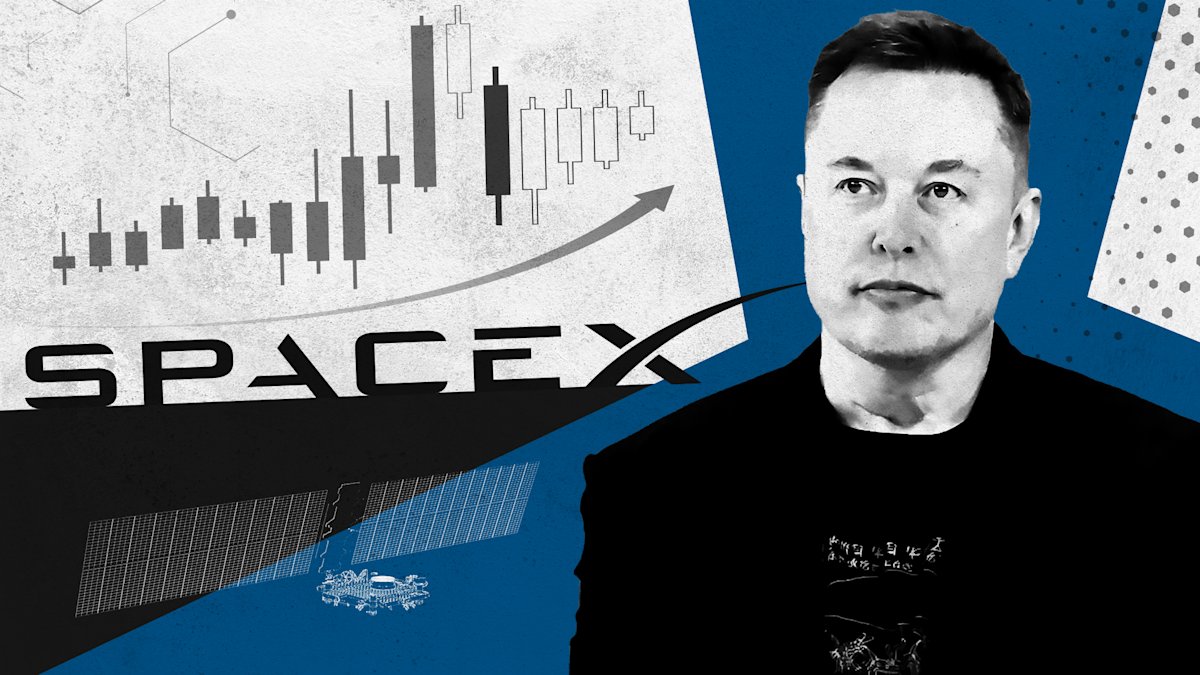
The valuation followed the capability. SpaceX was worth a few hundred million dollars when it nearly died in 2008. Private-market investors priced it at $100 billion in 2020, $350 billion by 2023, and more than $1 trillion before the listing this month. The IPO raised $75 billion at $135 a share, giving the company a market value above $2 trillion on the first day of trading, and the stock has kept climbing since.
The scale of the company’s market presence is visible in the trading data. On a normal day, SpaceX changes hands in volumes larger than most S&P 500 components, CNBC noted, a level of activity that would have been unimaginable for any company that had just listed, let alone one that spent its first decade without a public share. The interest reflects a broader appetite for exposure to space, a sector that barely existed as an investment category when Falcon 1 was failing.
The history matters to investors for a reason beyond nostalgia. SpaceX’s path from near-collapse to the top of the market is the case study for how the company is now valued: not on current earnings, which remain modest relative to the price, but on the expectation that launch capacity and satellite networks will compound the way the rocket’s own capabilities did. The same logic that made the fourth launch a bet worth taking is the logic that prices the stock today.
Analysts caution that the comparison has limits. In 2008, the company was cheap to save; the fourth launch cost a few hundred million dollars and a weekend of risk. Today, SpaceX carries a price tag measured in trillions, and the failures that once taught the company its lessons now move markets. The company that survived on a week of cash is now too big to fail quietly, and the tape on any given day reflects that new reality.