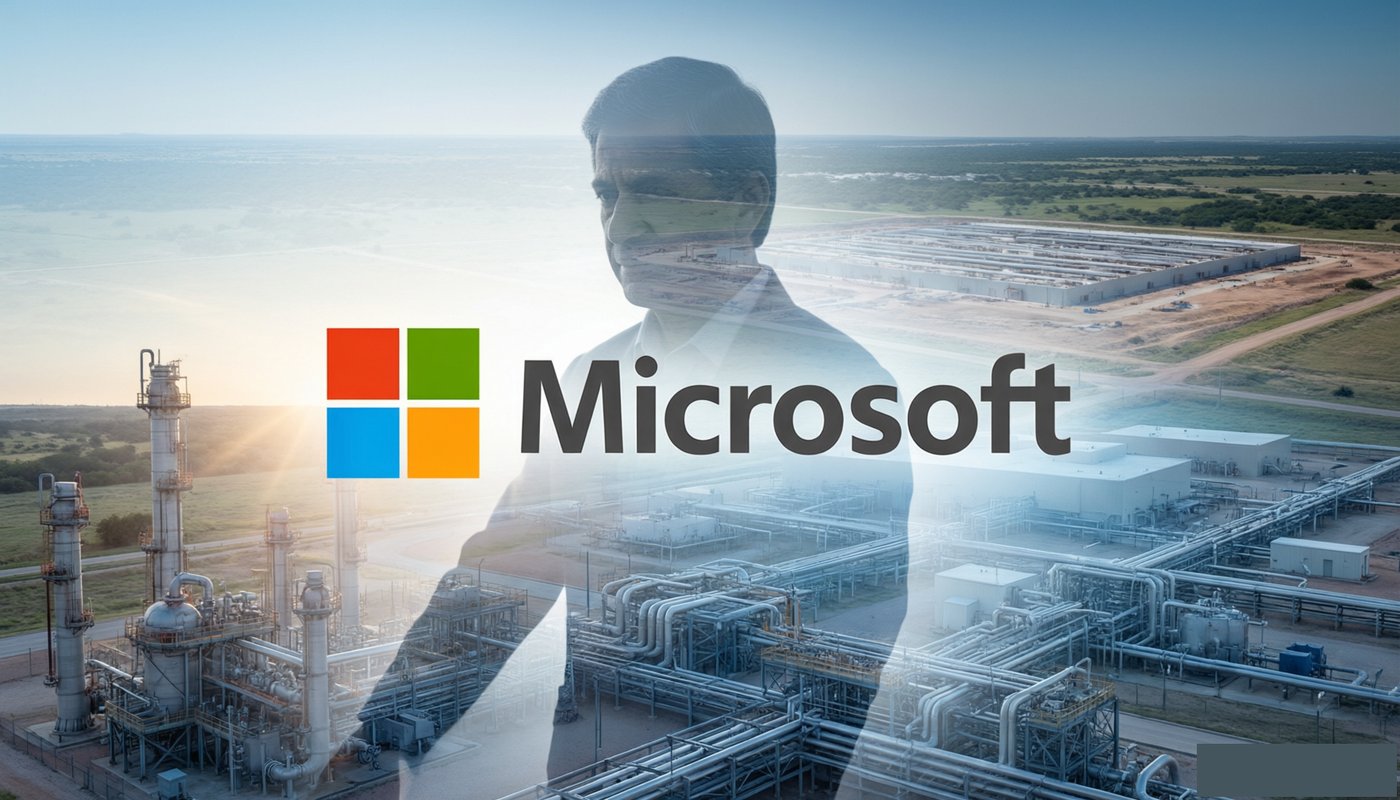
Reeves County, Texas, is empty country: mesquite flats and oil-patch roads in the Permian Basin, the nearest town a half-hour drive away. By 2028, a patch of that desert is scheduled to host one of the largest private power plants in the United States, built for a single customer. Chevron said Monday that a wholly owned subsidiary, Energy Forge One, had signed a 20-year agreement to supply natural-gas-fired electricity to a Microsoft data center campus being developed there, in a project the two companies call Kilby.
The deal is a bet by both sides that the fastest way to power the AI buildout is to bypass the grid entirely. Kilby is expected to deliver about 2.67 gigawatts through a phased, modular buildout, with most generation from GE Vernova turbines and additional capacity from Caterpillar’s Solar Turbines. The power will be dedicated to the Microsoft facility, generated behind the meter and delivered directly to the campus rather than through the regional transmission system. Bloomberg, which first reported the terms, said the output would be enough to power more than 530,000 Texas homes.
For Microsoft, the agreement answers the problem shadowing every major AI expansion: where to find reliable electricity at the required scale without waiting years for grid connections. The company already operates a data center region in the neighboring town of Pecos and has contracted 4.7 gigawatts of renewable electricity in Texas. Kilby gives it a dispatchable, always-on source to run alongside those renewables. The deal came the same week Chief Executive Satya Nadella warned against concentrating AI power in a few companies, urging the industry to focus on competition rather than an endless model arms race. “The rapid growth we’re experiencing in AI and cloud, driven by customer demand, requires energy infrastructure that can scale quickly and reliably,” said Noelle Walsh, Microsoft’s president of Cloud Operations and Innovation.
The structure of the deal is notable for what it says about the electricity market’s newest customers. Data center operators have spent the past two years competing for grid capacity in Virginia, Ohio and other power-hungry corridors, and utilities have warned of years-long interconnection queues. Co-located gas generation avoids the queue, at the cost of locking in fuel supply and accepting the emissions profile of combustion turbines. Chevron said the project is designed to mitigate impacts on the regional grid, and Microsoft said the plant will incorporate emissions controls such as selective catalytic reduction systems to cut nitrogen oxide output.
For Chevron, the contract is a template for a new line of business. The oil major has spent years seeking buyers for its Permian Basin gas beyond traditional utilities, and AI data centers have emerged as the most willing. Chevron is developing Kilby with Engine No. 1, the activist investor known for pushing energy companies toward cleaner strategies. The partnership gives Chevron a route to sell gas at prices tied to data center economics rather than volatile power markets. The company said Kilby is targeting mid-teen returns and expects to reach a final investment decision by the end of 2026, with first power anticipated in 2028.
The scale of the project puts it among the largest co-located power-and-compute developments announced in the United States. By comparison, the natural gas plants that utilities built to serve the shale boom rarely exceeded a gigawatt, and most data center campuses run on purchased grid power. Kilby’s design, generation sized to a single customer and built in stages, reflects an industry where compute operators have effectively become utilities, securing fuel, turbines and interconnection rights as part of capital budgets.
The deal also underscores how quickly energy has become the binding constraint on AI growth. Every major cloud provider has signed power agreements in the past year, ranging from nuclear restart deals to long-term purchases of solar and wind. Microsoft has been among the most aggressive, adding capacity across the U.S. and Europe while keeping its climate commitments. Critics note that gas-fired generation, even behind the meter, adds emissions at a time when the company has pledged to be carbon-negative by the end of the decade. Microsoft said it plans to connect Kilby and the campus to the broader grid over time and keep improving the plant’s environmental performance.
The economics of the arrangement will be watched closely by both industries. Chevron is essentially converting gas reserves into a contracted revenue stream that is independent of oil price swings, a shift investors have rewarded in other energy companies. Microsoft, meanwhile, is trading the flexibility of market power purchases for certainty of supply, a calculation that makes sense when every megawatt of capacity is spoken for years in advance. Neither company disclosed the price of power under the agreement.
For West Texas, the project is the latest sign that the Permian Basin is becoming a two-economy region: one built on oil and gas extraction, another built on the data centers that consume the region’s cheap land, tax incentives and abundant energy. Reeves County is one of the least populated counties in Texas, and a multi-gigawatt computing campus will reshape its tax base and infrastructure needs. Local officials have generally welcomed the projects, seeing jobs and revenue in a region long dependent on drilling.
The broader question hanging over Kilby is whether the co-location model scales beyond a handful of projects. Gas turbines can be ordered and installed faster than transmission lines, but they still take years to build and require long-term fuel commitments. If the AI buildout continues at its current pace, analysts said, the industry will need dozens of Kilby-scale projects, and the limits will shift from turbine supply to gas deliverability. Chevron’s answer, and Microsoft’s, is that the Permian has both, and a 20-year contract is a fair price for certainty in a market where power is the scarce input.