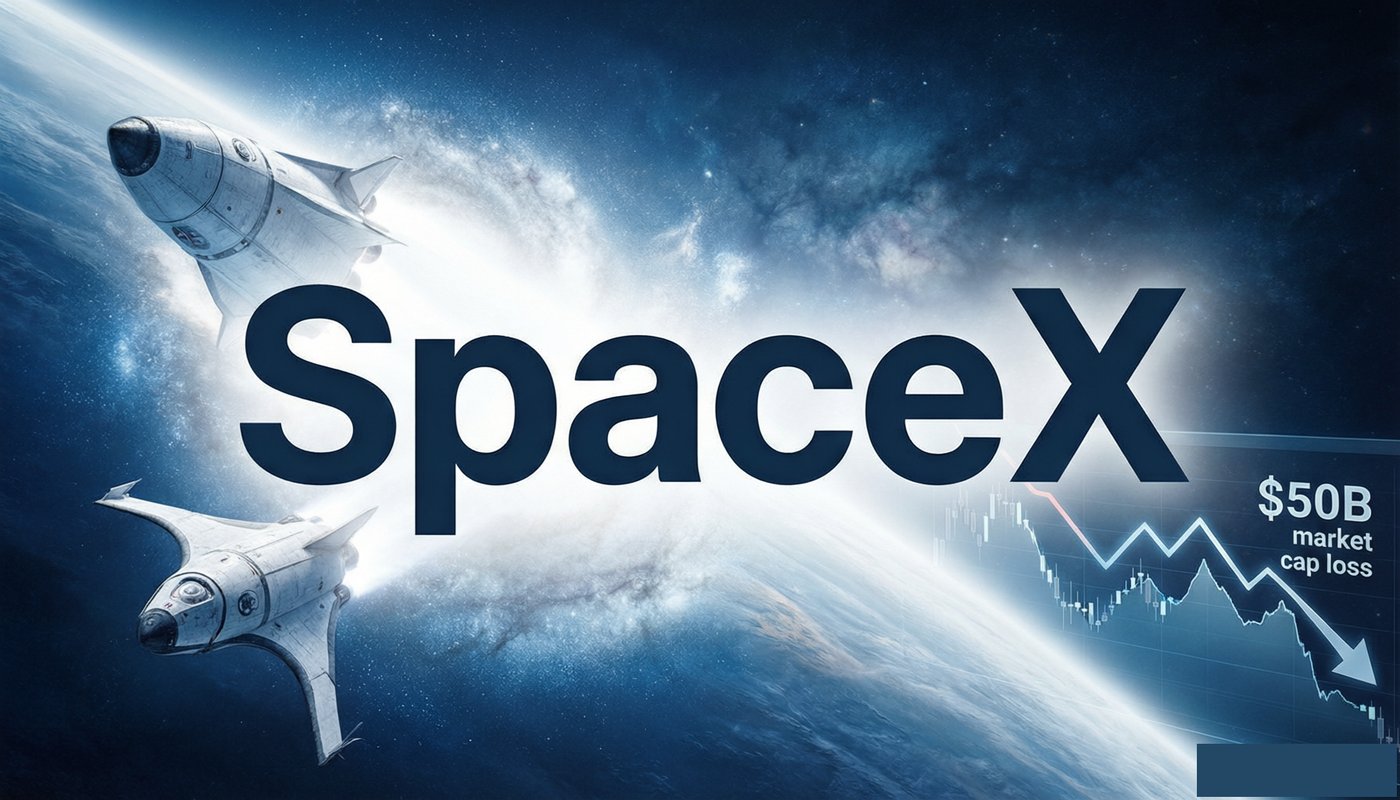
The stock that investors queued for months to buy is now teaching them a lesson about gravity. SpaceX, trading on the Nasdaq under the ticker SPCX, fell more than 3 percent in premarket trading Monday, capping a first week in which the company that staged the largest initial public offering in U.S. history saw roughly $50 billion of market value evaporate. The decline followed a record-breaking debut that briefly made the rocket company the most talked-about stock on Wall Street.
The pattern is familiar to anyone who has watched a heavily hyped IPO: opening-day euphoria, followed by a week of profit-taking as momentum traders exit and index funds wait for calmer prices. What makes SpaceX’s case unusual is the size of the swings and the scale of the company behind them. The offering, which priced in June, raised more than any IPO in American market history, according to people familiar with the matter, and the stock’s first-day surge set records of its own before the pullback began.
Investors are now trying to value SpaceX on something other than narrative. The company’s core businesses — launch services for government and commercial customers, the Starlink satellite broadband network, and a resurgent cargo and crew franchise — are real and profitable, but their combined earnings are small relative to a market capitalization that briefly approached half a trillion dollars. Analysts said the stock is searching for a price that reflects the actual pace of revenue growth rather than the ambitions of its founder.
Supporting the stock is a balance sheet few newly public companies can match. SpaceX disclosed more than $100 billion in cash reserves as part of its offering documents, according to CNBC and Reuters, and on the same day the stock wobbled, the company launched an investment-grade bond sale. The combination of a fortress balance sheet and access to the debt markets gives SpaceX the financial firepower to keep funding Starlink’s expansion and the Starship development program without returning to equity investors for capital.
The bond offering was itself a statement. Investment-grade ratings are rare among space companies, most of which have burned through equity capital for years without generating meaningful cash flow. SpaceX’s rating reflects the size and contract backlog of its launch business, which has become the dominant provider of launch services to both the U.S. government and the commercial satellite industry. A person close to the company said the debt sale was planned months ago and was not a response to the stock’s slide.
Regulators have added a layer of scrutiny to the debut. South Korea’s financial regulator has opened an inquiry into the allocation of SpaceX shares in the IPO, according to reports, focusing on how the banks that ran the offering distributed the most sought-after stock. The probe is in its early stages, and people familiar with the matter said SpaceX and its underwriters are cooperating. Allocation disputes are common after blockbuster listings, when the gap between the offering price and the first-day trading price makes every withheld share a source of complaint.
The week’s trading has also exposed the mechanics of a very large float. SpaceX sold a relatively small slice of its equity in the offering, leaving most shares in the hands of insiders, employees and early funds, and the thin public float has amplified moves in both directions. The stock’s first-day surge owed something to that scarcity, and the subsequent decline owes something to the same dynamic in reverse, as sellers found few natural buyers at elevated prices.
For the broader market, SpaceX’s first week is a test of appetite for a new category of mega-cap technology. The company sits at the intersection of space, telecom and AI infrastructure, and its Starlink network has become a critical piece of the communications stack for everything from remote oil platforms to military drones. Bulls argue that SpaceX, like Tesla before it, is being priced on what its network will earn a decade from now rather than what it earns today.
Bears point to the same facts and reach the opposite conclusion. The launch market, while growing, is far smaller than the valuation implies, and Starlink’s subscriber growth, though strong, faces competition from terrestrial fiber and other low-orbit constellations. The company’s plans to spend tens of billions on Starship development and next-generation satellites require years of execution without error, and the stock now trades at a premium that leaves little room for disappointment.
Monday’s decline does not change the company’s fundamentals, and a single week of trading says little about where the stock settles. But the first five sessions have done their job in one respect: they have replaced the abstract idea of the largest IPO in history with a concrete price, and the market is still deciding whether that price is right. The next earnings report, the next Starship test flight and the next Starlink subscriber disclosure will all be read more carefully than the opening day’s headlines.