
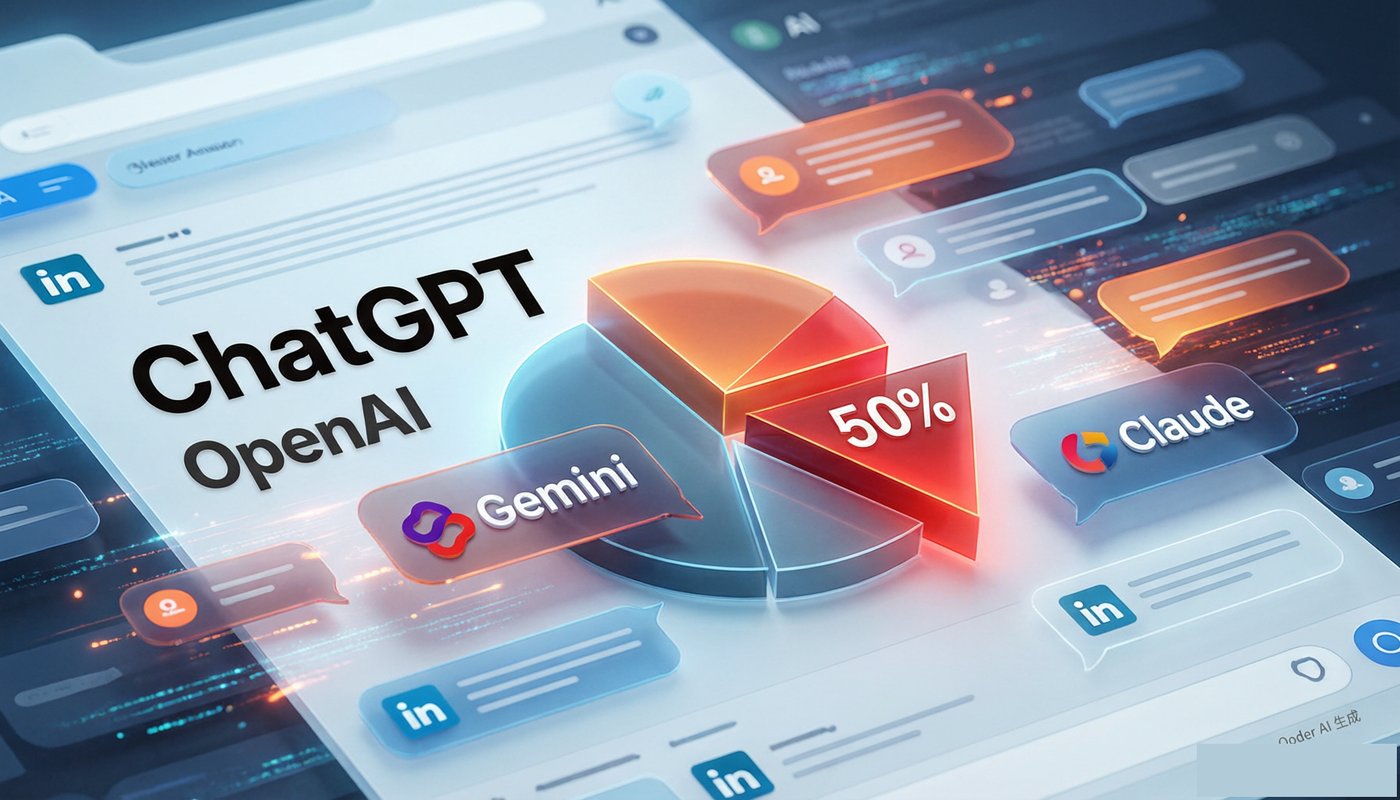
SAN FRANCISCO — Four years after its launch made artificial intelligence a consumer product, ChatGPT’s share of the AI assistant market has fallen below 50% for the first time. Google’s Gemini and Anthropic’s Claude have together climbed to nearly 40%, according to industry data compiled by analytics firms, ending OpenAI’s long run as the category’s undisputed leader.
The shift has been building for months. Gemini has gained ground through Google’s decision to bundle the assistant across search, Android and Workspace, reaching users who never think to download a separate app. Claude has grown through a different route, winning enterprise customers with a reputation for careful, well-structured responses and a distribution deal that puts it inside Amazon’s cloud.
Fast Company, which tracked the numbers, described the moment as a transition to multipolar competition, in which no single company can set the terms of the market alone. For OpenAI, the change is existential in a practical way: its revenue and its valuation both rest on the assumption that ChatGPT remains the default destination for AI users.
The company’s response has been to push into enterprise software and to broaden the assistant’s capabilities, adding tools for coding, data analysis and image generation that go well beyond chat. Chief Executive Sam Altman has said OpenAI’s future is as a platform, not just a product, and the company’s recent developer conferences have emphasized the application programming interfaces that let other businesses build on its models.
The market share erosion nevertheless carries consequences. Advertisers and publishers route budgets to the platforms where users actually are, and the emergence of three roughly equal rivals changes how those budgets are allocated. Venture investors, who poured money into OpenAI at a valuation that assumed dominance, are asking what the company is worth if its consumer product serves a minority of the market.
The competitive dynamics differ by segment. In enterprise, Claude has made inroads among companies that prize reliability and are wary of OpenAI’s ties to Microsoft. In consumer, Gemini’s free distribution through Google’s ecosystems has made it the default choice for millions of users who never paid for an assistant before. ChatGPT retains the strongest brand recognition, analysts said, but brand alone has not stopped the slide.
Pricing is becoming the battleground. OpenAI’s premium tiers cost $20 to $200 a month, while Google has kept Gemini’s advanced features inside existing subscription bundles and Anthropic has undercut both on enterprise per-seat pricing. The result, analysts said, is a market in which the marginal user is deciding on price and convenience rather than on model quality alone.
The underlying technology race continues to move the numbers. Each lab has released a new flagship model in the past year, and each release has produced a temporary shift in usage before settling back into the three-way distribution. Users, it appears, have become more willing to switch between assistants for different tasks, a behavior that undermines the winner-take-all logic that drove the market’s early valuations.
For investors, the takeaway is that the AI assistant market has begun to resemble the browser wars of the 1990s: a large, contested market in which distribution and bundling matter as much as technology. OpenAI’s challenge is that it lacks a distribution channel of its own the size of Google’s search page or Amazon’s cloud. Its partnership with Apple, which put ChatGPT inside iPhones, was an attempt to borrow one.
The numbers need context. The AI assistant market has grown rapidly even as ChatGPT’s share of it has fallen, and a smaller share of a much larger market is not the same as a decline in usage. ChatGPT’s user base and revenue have continued to grow in absolute terms, according to company disclosures, and OpenAI’s enterprise business has expanded as businesses build applications on its models. The share figure matters because it measures the balance of power, and the balance has shifted: four years ago OpenAI was the market, and today it is the largest of three roughly equal competitors.
The next stage of the competition will be defined by products rather than model releases. OpenAI has been shipping agents, tools that perform tasks across applications, and it has said its next models will be more capable at planning and executing work. Google has integrated Gemini deeply into its hardware, from Pixel phones to its data center chips, and Anthropic has won loyalty among developers through the quality of its coding tools. The three companies are now competing across every layer of the stack, and the winner of the assistant market may be the company that owns the most layers. For users, the competition has produced a familiar pattern: better products, more choices and, increasingly, subscriptions to more than one assistant.
None of the three companies is in danger of disappearing, and all three are spending heavily on the next generation of models. But the first four years of the AI consumer market rewarded the pioneer, and the next four are shaping up to reward whoever can hold share through distribution, price and habit. ChatGPT’s slide below 50% marks the moment that contest began in earnest, analysts said.



