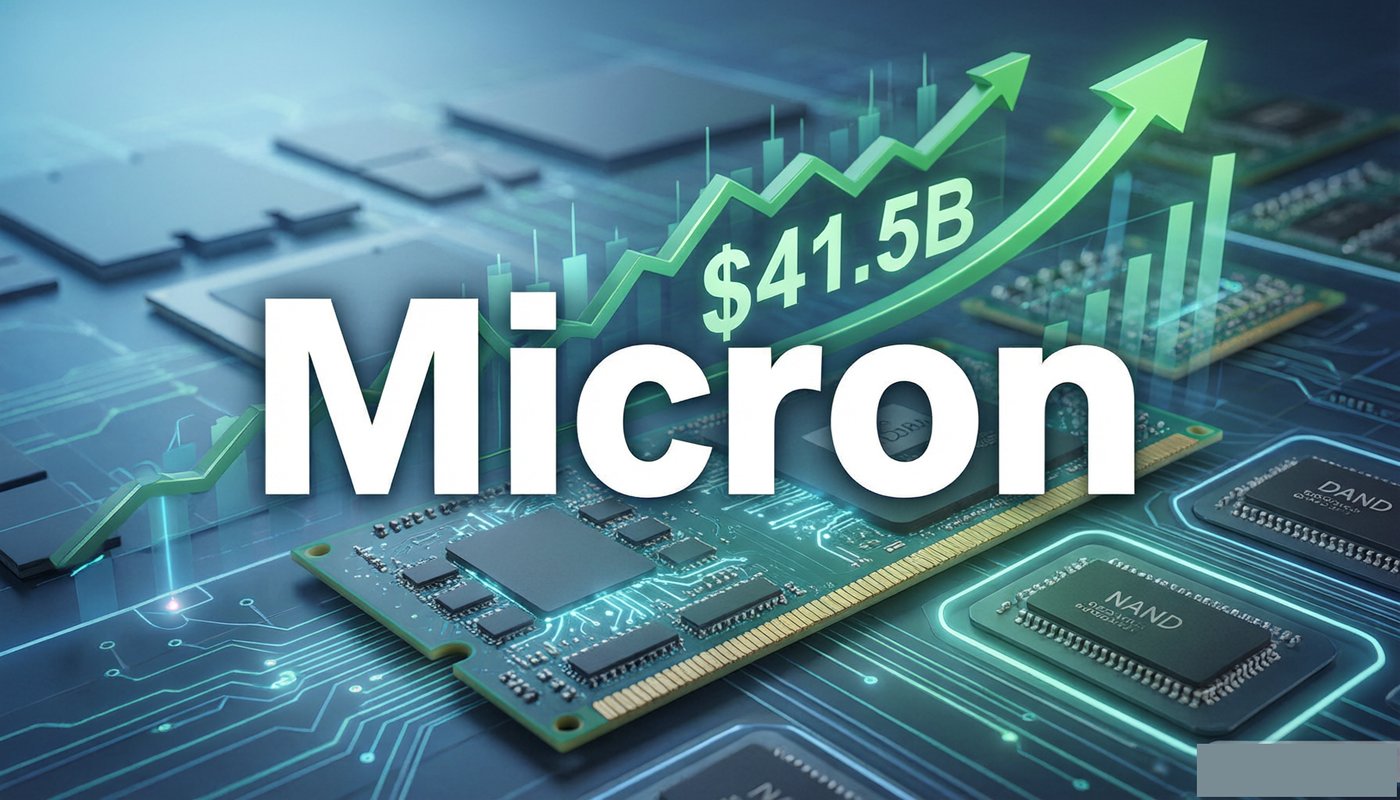
Micron reported record quarterly revenue of $41.5 billion, up 74% from the preceding quarter and 34% from a year earlier, driven by AI infrastructure’s appetite for memory, according to Reuters. After the results, Micron’s market value briefly overtook that of Meta Platforms, a striking measure of how the memory shortage has elevated an industry long treated as a commodity business.
Micron is the world’s third-largest memory maker, behind SK Hynix and Samsung, and the largest U.S. producer of DRAM. Its results are a bellwether for the memory cycle because it reports earlier than its rivals and sells to a broad customer base spanning data centers, phones, cars and industrial equipment.
The driver is AI. Data centers building AI infrastructure need high-bandwidth memory, the specialized chips that sit beside accelerators, and Micron has ramped production of HBM alongside its conventional DRAM lines. The company said demand for AI memory is the core driver of its results, according to Reuters.
The market-value crossover was symbolic but telling. Meta is one of the largest companies on earth, worth well over a trillion dollars, and for a memory maker to overtake it, even briefly, shows how completely the AI boom has rewritten the semiconductor pecking order. Storage has moved from a cheap input to the scarce resource that determines whether AI systems can ship.
The quarter was a step change, not an increment. Sequential growth of 74% is the kind of number memory companies post once in a decade, if that, and it reflects pricing power that the industry has not possessed since the last great shortage. DRAM contract prices have climbed for several consecutive quarters, and HBM commands prices several times those of conventional memory.
The results also sharpen the tension running through the AI economy: memory is scarce, and its price is being paid by everyone downstream. Chinese tech media greeted the report with a wry verdict—”Micron’s excellent earnings, bad news for the gold”—a play on the idea that the richer memory makers get, the more it costs the companies that buy their chips. The point landed the same week Apple raised MacBook and iPad prices, citing memory costs.
Analysts said the question now is durability. Micron and its rivals are pouring money into new capacity, and the industry’s history suggests that today’s shortage becomes tomorrow’s glut. What is different this time, supporters argue, is the structure of demand: HBM is built to order, qualified for specific accelerators and sold out years in advance, which smooths the boom-bust pattern that once defined the business.
Capital spending is the number to watch. Memory makers are committing tens of billions of dollars to new fabs and advanced packaging lines, and their ability to finance that expansion depends on prices staying high. SK Hynix announced a $29 billion U.S. share sale this week, in part to fund exactly this kind of growth.
For Micron, the challenge is execution. The company lagged SK Hynix in the first rounds of HBM qualification and has spent years trying to close the gap. Its current results suggest it is succeeding, but the race is continuous: each new accelerator generation demands a new memory design, and there is no rest between cycles.
The results carry implications beyond the memory industry. Every AI company that rents computing power pays memory’s price, and every device maker that ships a phone, laptop or server absorbs the increase. The shortage has become a tax on the entire technology economy, collected by a handful of companies in South Korea, the U.S. and Taiwan.
Investors have responded by revaluing the sector. Memory stocks have outperformed the broader semiconductor group this year, and the earnings report is likely to extend that run. The brief moment when Micron’s market value passed Meta’s will be remembered as the moment the market acknowledged how central memory has become.
The results also carry a geopolitical dimension. Memory has become strategic infrastructure: the U.S. government has funded Micron’s new fabs in New York and Idaho, Japan is backing a domestic advanced-chip project built around IBM’s designs, and South Korea treats its memory industry as a national asset. Governments that once left the memory business to the market are now among its most active patrons, and the funding flowing into new capacity will shape the cycle’s next turn.
The next test comes with guidance. Micron’s outlook for the current quarter, and its plans for capital spending, will tell investors whether the company believes the cycle has room to run. If history is any guide, the current mood will overshoot in both directions before it settles.
For now, the numbers speak loudly enough. A memory company that reports a $41.5 billion quarter, overtakes Meta in market value and still cannot make chips fast enough is not a commodity business anymore. It is the infrastructure of the AI economy, and it is pricing accordingly.