In June, shipments of the Vera processor left Nvidia’s suppliers bound for three of the largest consumers of AI compute in the world. The company disclosed this week that OpenAI, Anthropic and SpaceX were among the first customers to receive the chip, the latest signal that its Vera Rubin platform is moving from announcement to deployment faster than the cadence of recent product cycles. The disclosure came alongside new performance data that Nvidia hopes will define how data center operators think about the transition.
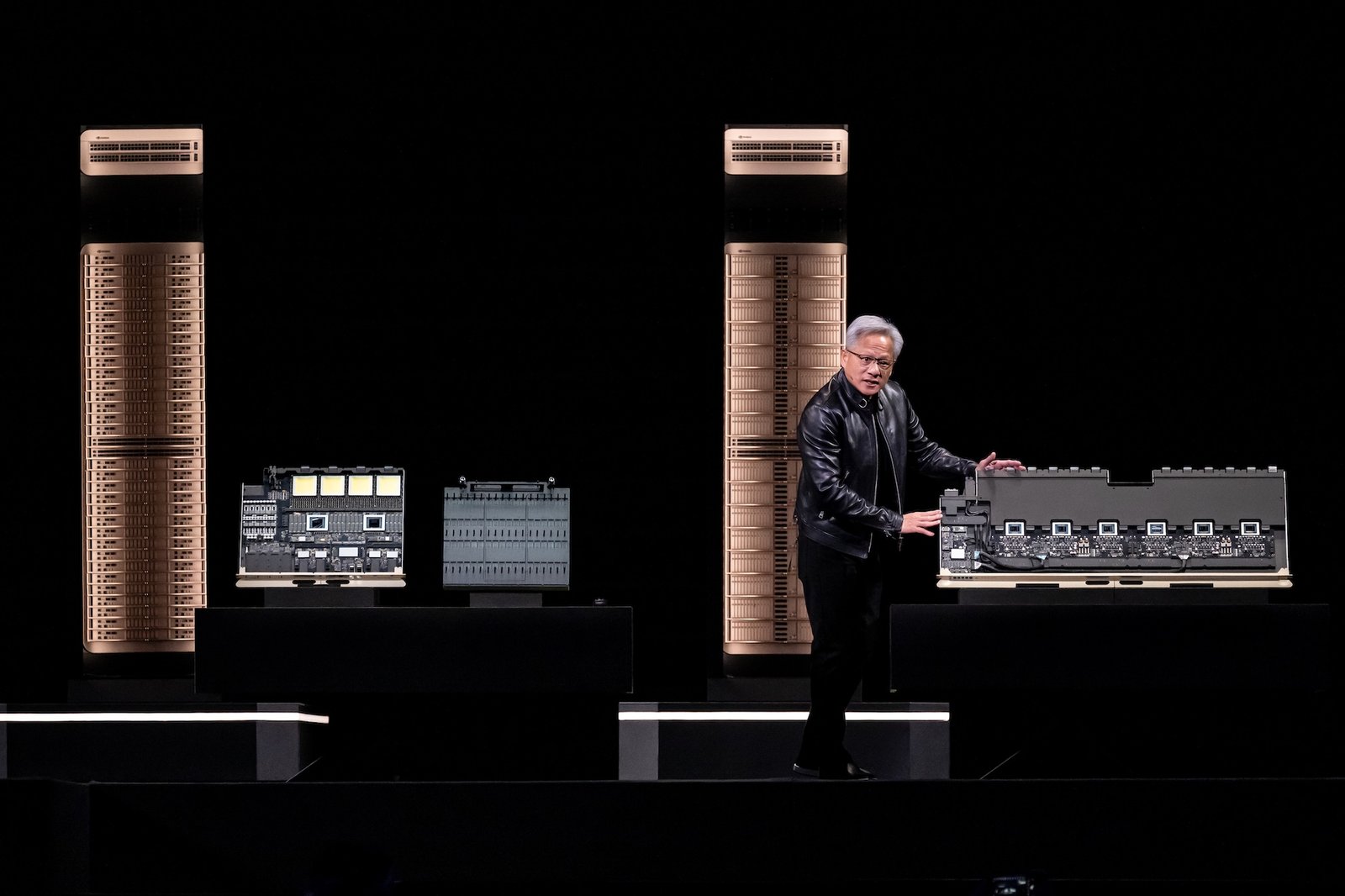
Vera Rubin is the platform Nvidia calls its most ambitious. The company said the system integrates seven chips and five rack designs, with manufacturing spread across 350 facilities in 30 countries, a footprint it described as the largest rack-scale supply chain it has ever assembled. The scale reflects a shift in Nvidia’s business model: the company now sells entire racks of computing, not just chips, and its supply chain has become a global logistics operation that spans circuit boards, power systems and liquid cooling.
The performance claim is the centerpiece of the announcement. CoreWeave, the cloud provider that has become one of Nvidia’s largest customers, measured the Vera Rubin NVL72 against its predecessor, the Grace Blackwell NVL72, and found roughly ten times more tokens generated per megawatt of power. For operators whose growth is constrained by electricity, not by server availability, that ratio is the number that matters, and Google Cloud, Microsoft Azure and Oracle Cloud have all begun adopting the platform, according to the company.
The efficiency gain reflects the platform’s design. The Vera CPU is paired with Rubin GPUs built for inference and training workloads, and the system is engineered around power delivery rather than raw peak performance. Analysts said the tokens-per-megawatt metric is a direct response to the constraint that now defines the industry: data center operators cannot get enough power fast enough, so the value of a platform is increasingly measured by what it produces per watt, not per dollar.
The rollout comes as Nvidia manages one of the most complicated transitions in its history. The company sold Blackwell systems at unprecedented volume over the past year, and customers are now weighing whether to buy more Blackwell capacity or wait for Rubin allocations. Nvidia’s answer, delivered through the Vera Rubin disclosures, is that waiting pays: the efficiency gain is large enough to change the economics of a data center buildout, and the company has structured its supply chain to deliver the platform at a scale Blackwell never achieved in its first year.
On the same day, Nvidia announced a collaboration with Google on robotics projects, an area both companies have identified as the next large market for AI. The announcement drew less attention than the hardware disclosures, and the stock barely moved, a sign that investors have begun to treat Nvidia’s partnerships as routine. Analysts said the robotics work will not show up in revenue for years, while the Vera Rubin ramp affects the numbers in the quarters immediately ahead.
The competitive context sharpens the stakes. AMD is closing its own agreement with Anthropic, Google designs its own TPUs, and Amazon is pushing its Trainium line, all attempts to loosen Nvidia’s grip on AI accelerators. Nvidia still commands the overwhelming share of the market, but the Vera Rubin cycle is the moment rivals are most likely to win customers who are unhappy with price, availability or lock-in. The efficiency data is partly an answer to those rivals: this is what the incumbent can do when it designs a platform around the one thing every data center lacks.
The financial stakes are visible in Nvidia’s own numbers. The company’s data center business has grown into the largest revenue stream in the semiconductor industry, and analysts said the Vera Rubin transition will determine whether that growth continues at the same pace. Customers who wait for Rubin capacity delay purchases, which shows up in near-term revenue, while customers who buy ahead create an order book that stretches years into the future. Nvidia has managed similar transitions before, and each time the new platform’s efficiency gains pulled demand forward rather than pushing it back.
For customers, the near-term question is availability, not demand. Every hyperscaler and every AI lab wants more compute than it can get, and the constraint chain runs from Nvidia’s manufacturing partners through memory suppliers like SK Hynix to the power grid. Vera Rubin’s 350-site supply chain is Nvidia’s attempt to widen the bottleneck at every stage at once.
The platform’s success will ultimately be measured in watts, not units. Nvidia has positioned Vera Rubin as the system that lets operators do more with the power they already have, and the early customer list, OpenAI, Anthropic, SpaceX, plus the cloud giants, suggests the message is landing. Whether the efficiency holds at scale, and whether the supply chain delivers, is the test now underway in data centers around the world.