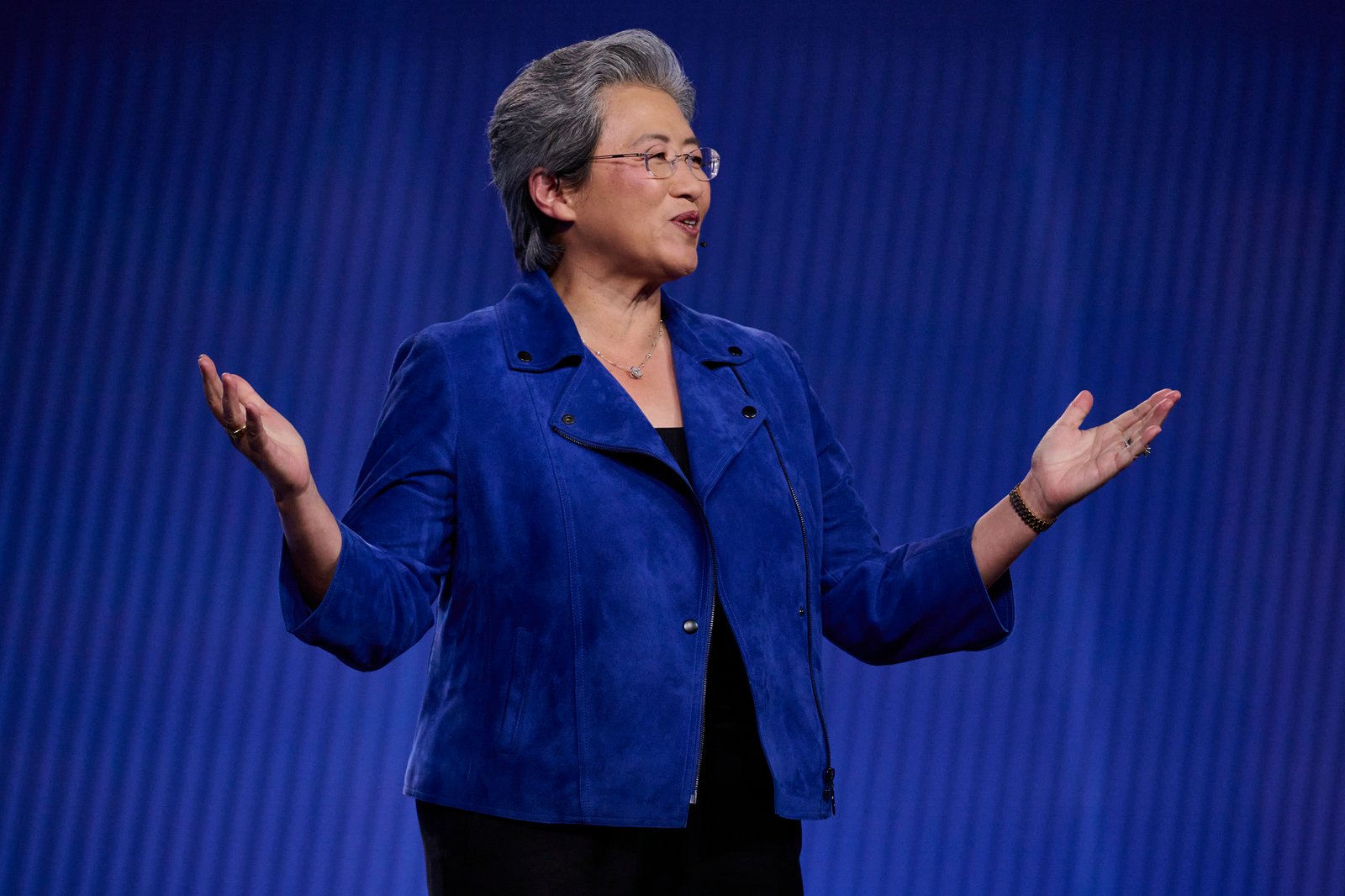
At AMD’s Advancing AI event on July 24, Lisa Su pulled back the curtain on the company’s answer to the industry’s most important hardware question: what does an AI data center look like? The answer is Helios, AMD’s first rack-scale AI system, built around its Instinct MI455X accelerators and sixth-generation EPYC processors, designed to plug directly into the large AI clusters that hyperscalers are building.
Helios puts AMD into a segment of the market that Nvidia has dominated: the fully integrated, liquid-cooled rack system. Nvidia’s rack-scale products have become the default building block for large AI deployments, bundling accelerators, networking, and power management into a single unit. AMD has spent years competing on individual chips; with Helios, it is competing on the system.
The MI455X accelerator is the compute engine, and AMD paired it with EPYC CPUs to manage the data flow. Samsung, meanwhile, announced it will supply HBM4 memory for AMD’s accelerators, giving the company a second major memory supplier alongside SK Hynix and Micron. The HBM4 qualification is a win for Samsung, which has lagged in the high-bandwidth memory market that the AI boom created.
Su framed the launch in deliberate contrast to Nvidia. AMD’s path, she said, is built on an open ecosystem and power efficiency rather than a contest over raw peak performance. The distinction matters to customers: large AI operators have complained that Nvidia’s integrated systems lock them into a proprietary stack, and AMD’s pitch is that its components and software work with industry-standard interfaces.
Helios is already in full production, Su said, with shipments expected within months. The timeline is important. AMD has been criticized in the past for announcing products long before they reached customers, and the company has lost AI deals because it could not deliver in volume. A rack-scale system that ships on schedule would be a change in pattern.
The event, AMD’s annual showcase for its data-center roadmap, came at a moment of rising expectations. The company’s share price has rallied over the past year as investors warmed to the idea that AI spending would not flow to a single supplier, and Su used the stage to argue that the industry’s scale demands more than one vendor. Helios, she said, is the proof that AMD can play at the system level.
The competitive stakes are high. Nvidia controls roughly 80 percent of the AI accelerator market, according to analysts, while AMD’s share has been in the single digits. But the market is growing so quickly that even modest share gains translate into billions of dollars in revenue, and AMD’s data-center GPU business has become its fastest-growing segment. Executives have said demand for the company’s accelerators outstrips supply.
The system-level competition is the industry’s next chapter. As AI models grow larger, the unit of deployment has shifted from the chip to the rack to the building: customers no longer ask how many GPUs they can buy, but how much compute they can deploy per megawatt of power. Efficiency, cooling, and networking now matter as much as silicon, which is why AMD built Helios around those constraints rather than around peak performance alone.
Analysts said AMD’s open-ecosystem argument has real appeal. “Customers want a second source, and they want one that does not dictate the rest of their stack,” one analyst said. “AMD’s opening is not raw performance. It is flexibility.”
The HBM4 news is significant in its own right. Memory has become a constraint on AI accelerator production, and HBM supply is allocated years in advance. Samsung’s entry into AMD’s supply chain gives the chip maker more room to grow production without being hostage to a single memory vendor, and it pressures the incumbents to sharpen their pricing.
Helios also signals AMD’s ambitions beyond chips, into the full data-center stack. The company has been building software and networking capabilities for years, and the rack system is the point where those investments converge. The accompanying software stack, which AMD has worked to make compatible with the industry’s most widely used AI frameworks, is the piece customers weigh most heavily.
The immediate test is delivery. AMD has a history of strong announcements and weaker execution, and investors will be watching whether Helios racks actually reach customers this year. Su said the company has signed up multiple hyperscalers for the system, though she did not name them.
For the industry, the launch confirms that the AI hardware race has moved from single-card competition to system-level competition. Nvidia’s advantage in integrated systems is real but not permanent, and AMD, with Helios, has put itself in a position to test it. Whether that test succeeds will depend on the one variable AMD has struggled with most: shipping in volume, on time.