
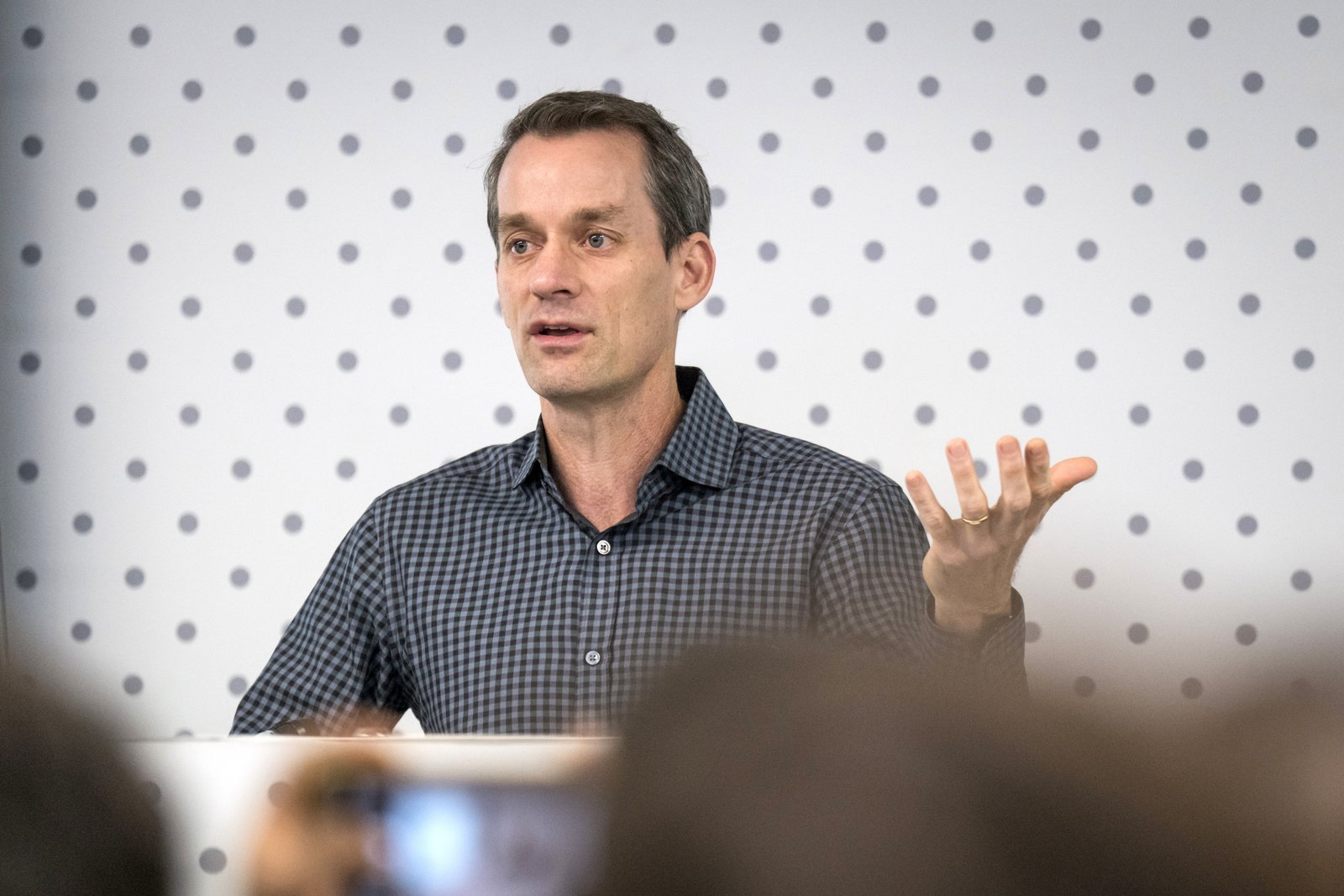
Google’s shares fell 4% on Tuesday, wiping out about $186 billion in market value, after the company said Jeff Dean, the engineer who helped build its artificial-intelligence program, would leave to start a company of his own.
Dean’s new venture, Discovery Loop, is organized as a public benefit corporation with a mission of automating machine learning, science and engineering, according to the announcement. He is being joined by Sanjay Ghemawat, a Google fellow and longtime collaborator. The two wrote some of the papers that established Google’s early dominance in distributed computing, including the 2004 study that introduced MapReduce, a method for processing data across thousands of machines at once.
The departure landed on the same day Google disclosed a broader reshuffle of its AI leadership. Demis Hassabis, chief executive of Google DeepMind, will become chairman of that unit and chief scientist of parent Alphabet. Koray Kavukcuoglu, Google’s chief AI architect and a long-serving deputy to Hassabis, will take over most of the day-to-day leadership as a senior vice president. Google did not name a successor to Dean as chief scientist.
The stock slide showed how much of Google’s value investors now attach to the company’s position in artificial intelligence. The company has spent two years racing to answer OpenAI and Microsoft in generative AI, shipping chatbots, coding tools and new search features at a pace that has at times strained its own engineering ranks. Tuesday’s announcement removed two of the people most associated with that effort, at least in the eyes of investors. A person familiar with the matter said Dean’s decision had been in the works for months and was not tied to the leadership changes announced the same day.
Dean joined Google in 1999, when the company was still a search startup run out of a garage in Menlo Park, California. Along with Ghemawat and a small group of engineers, he built systems that allowed Google to index a rapidly expanding web. He later led Google Brain, the research group that pushed the company into deep learning, and oversaw the development of TensorFlow, an open-source library that became the standard tool of machine-learning researchers around the world. As chief scientist, he guided work on large language models, including the Gemini program that now underpins many of Google’s consumer and cloud products. He also became one of the industry’s most visible technical executives, testifying before Congress about the promise and risks of artificial intelligence.
His exit extends a pattern in which senior AI researchers have left the largest technology companies to found labs of their own. Ilya Sutskever, a co-founder of OpenAI, left that company to create Safe Superintelligence, a startup that has raised billions of dollars from prominent venture investors. Dario and Daniela Amodei left OpenAI to start Anthropic, now one of the most valuable private companies in the world. Discovery Loop enters a similar stream, though Dean framed the mission in broader terms. Rather than building a product for consumers or enterprises, the company aims to make the work of scientific discovery itself faster and cheaper, by training models that can design experiments, run simulations and interpret data across fields such as physics, chemistry and biology. Researchers in that area have already used models to propose new battery materials, predict protein structures and shorten drug-development timelines.
The announcement gave few details about Discovery Loop’s products, financing or early customers. The choice of a public benefit corporation structure, a legal form that OpenAI adopted after its 2025 restructuring, signals an intention to balance profit with a stated social purpose, in this case accelerating science. Analysts said the structure would do little to soften the competition for talent and capital. The market for senior AI researchers is brutally efficient, one industry analyst said; a well-funded startup with an inspiring mission can pull people out of any company, including Google.
The bigger question for Google, analysts said, is whether its bench runs deep enough to absorb the loss. The company retains Hassabis, who will keep a hand in research as Alphabet’s chief scientist, and Kavukcuoglu, who worked directly on Gemini and other flagship models. Google has also moved to integrate AI across its product lines, from Search to Android to its cloud business, which reported accelerating growth through the first half of the year. Some investors said Tuesday’s selloff looked oversized for a personnel change and noted that technology stocks broadly have been volatile since a sharp pullback in July. Still, the episode underscored a risk that has nagged Google for years: its most celebrated engineers are among the most sought-after people in the industry, and the door out has rarely been wider.
For Ghemawat, the move closes a remarkable run. He joined Google in 1999, worked alongside Dean on MapReduce, Bigtable and Spanner, and helped build the infrastructure that carried the company from a search engine to one of the world’s largest computing enterprises. The two are expected to bring a core team with them, though Google did not say how many employees would leave.
Discovery Loop, for now, is little more than a name, a mission and two of the most accomplished computer scientists of their generation. Whether that is enough to move Google’s stock again depends on what the company actually builds. For Google, the immediate question is simpler: how fast the next generation of researchers can fill the space Dean and Ghemawat occupied for more than a quarter century.



