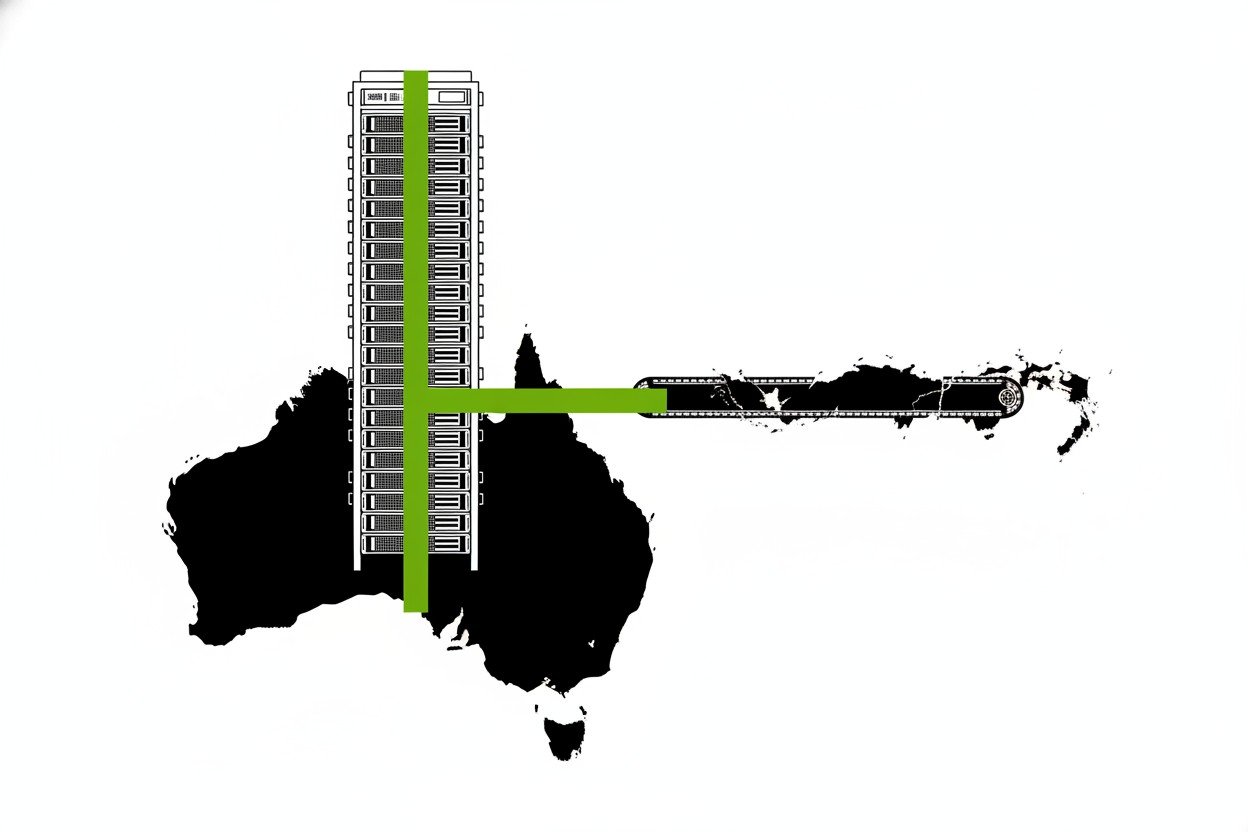
SYDNEY—The pitch that Firmus makes to governments is simple: your data, your compute, your country. The Australian company builds cloud infrastructure designed to keep artificial-intelligence workloads inside national borders, a model that has become known as sovereign AI and that has made Firmus one of the most valuable private technology companies in the region. On Aug. 7, the company said it has raised $2 billion in strategic equity financing to accelerate that mission, with investors that read like a who’s who of the AI supply chain. Nvidia participated, as did the hedge fund Coatue, funds managed by Blackstone and other Blackstone vehicles, and the trading firm Jane Street.
The round more than doubled Firmus’s valuation to above $10.5 billion, according to The Next Web, which reported the figure on Thursday. The company said the proceeds will fund the buildout of its Southgate AI Factory in Australia and prepare the ground for expansion into other Asia-Pacific markets. Southgate, a data center campus planned on the country’s east coast, is designed to host tens of thousands of accelerators for both government and private-sector tenants, with power and cooling engineered for the dense racks that modern AI clusters require. Firmus has described the project as the anchor of its pitch to governments that want AI capability without surrendering control of the underlying infrastructure.
The investor list illustrates the unusual economics of the sovereign AI market. Nvidia is simultaneously the sector’s most important supplier and one of its most active investors, a position that lets the company capture value at both ends of the transaction: it sells the chips that go into sovereign clouds and it owns a share of the companies that buy them. Blackstone’s presence reflects the broader wave of infrastructure capital moving into data centers, which have become one of the most sought-after asset classes for long-duration investors. Jane Street, a quantitative trading firm with a large technology team, is a more unusual participant, though it has invested in AI infrastructure before. The mix of strategic and financial investors is itself a signal of how hot the segment has become.
The concept behind Firmus is straightforward and politically potent. Many governments, particularly in Asia and the Middle East, have concluded that the AI buildout of the next decade is too strategically important to leave entirely to American cloud providers. They want domestic data centers, domestic model deployment and domestic control over the data those models consume. The market for that proposition has grown quickly: sovereign cloud programs now exist across the Gulf, Southeast Asia and Europe, and several countries have mandated that government workloads run on locally hosted infrastructure. Firmus’s bet is that Australia and its neighbors will follow the same path, and that being first with a purpose-built factory will matter more than being biggest.
The competitive field is thickening. Microsoft, Amazon and Google have all announced sovereign cloud offerings, and local champions in countries such as Japan, India and Indonesia are building their own capacity. What distinguishes Firmus is its focus on AI workloads specifically, rather than general-purpose cloud computing. The company’s founders have said they designed the Southgate campus around the power density and networking requirements of accelerators, not servers, a distinction that matters because AI data centers are fundamentally different from the data centers of the past decade. They consume several times more power per rack, generate more heat and need direct connections to high-bandwidth networks.
Power is the constraint that will determine whether the model works. Australia has abundant land and strong solar and wind resources, but its grid has struggled to keep up with industrial demand, and data center developers have faced years-long waits for grid connections in some regions. Firmus has said it is pursuing dedicated power arrangements for Southgate, including on-site generation, and the company’s ability to deliver power will be as closely watched as its ability to deliver compute. The country’s government has signaled support for the sector, treating AI infrastructure as part of its economic-security agenda and offering fast-track approvals for major projects.
For Nvidia, the investment serves a purpose beyond returns. The company has made clear that its long-term growth depends on broadening the market for its chips beyond the handful of American hyperscalers that currently buy most of them. Sovereign AI clouds are one of the most promising avenues: every government that builds a national AI factory needs accelerators, and Nvidia would rather those orders come from entities it has a stake in. The same logic has driven Nvidia’s investments in data center developers from Europe to the Middle East, and Firmus gives it a platform in a region where the company has historically been less dominant.
Analysts said the valuation jump reflects the scarcity of well-capitalized sovereign AI platforms in the Asia-Pacific. The region’s demand for AI compute is growing quickly, driven by local-language models and government digitalization programs, and few companies have both the capital and the political access to serve it. Firmus’s existing contracts, which the company says include commitments from government-linked tenants, gave investors confidence that the factory will fill quickly once operational.
The longer-term question is whether sovereign AI remains a distinct market or collapses into the general cloud business. If the technology stays expensive and the capacity scarce, governments will pay a premium for local control, and Firmus’s model works. If AI hardware commoditizes and cross-border data rules loosen, the premium shrinks. For now, the money is flowing in the direction of sovereignty: $2 billion at a doubling valuation, with the world’s largest chipmaker and biggest asset managers on the cap table. That is a statement about where the industry believes the next decade of compute will be built, and who will own it.