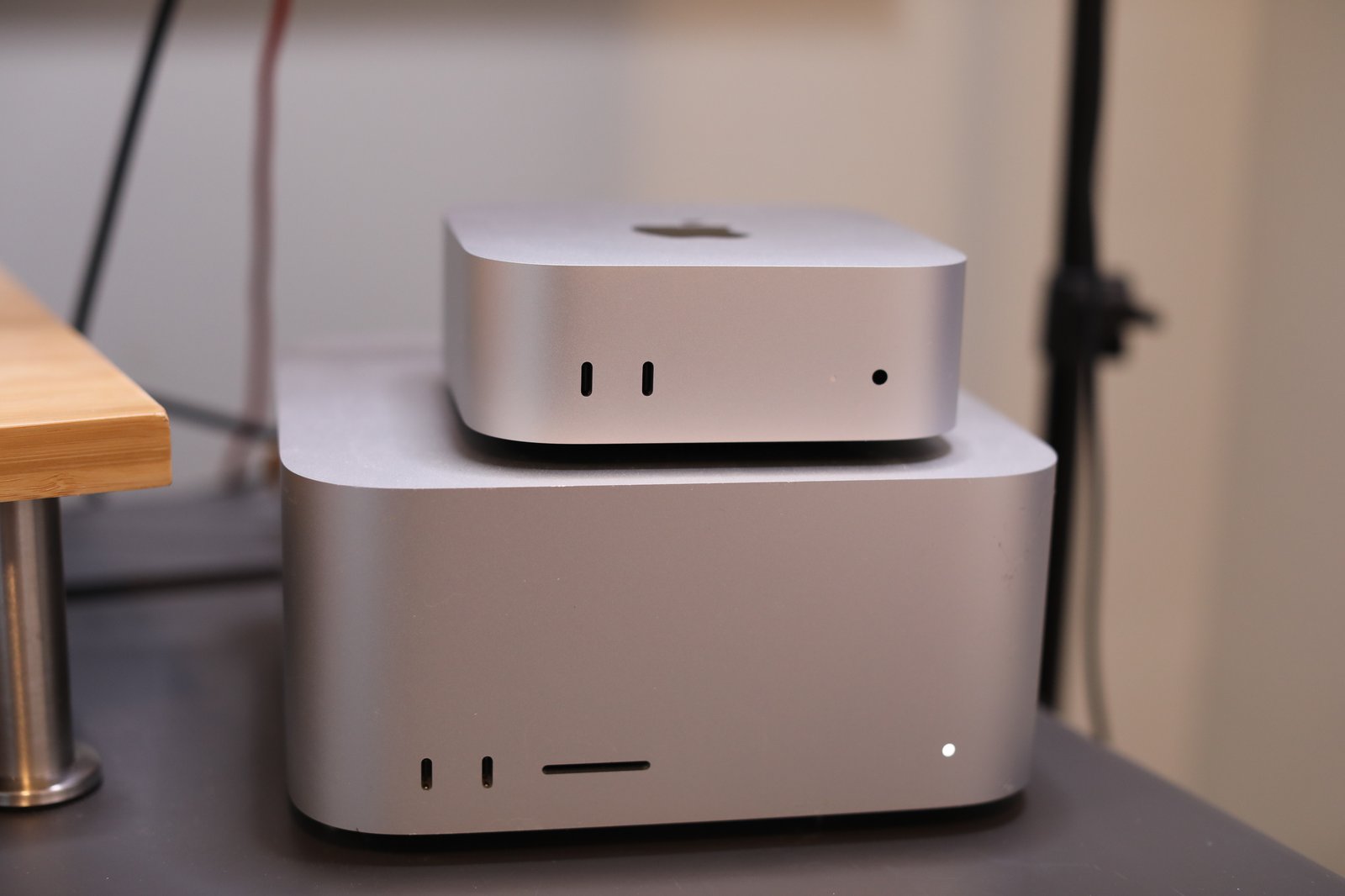
They arrive without screens, keyboards or mice, bare aluminum boxes stacked on pallets in warehouses near AI laboratories. The machines are Mac minis and Mac Studios, and OpenAI and other labs have bought tens of thousands of them, according to The Information, which reported the purchases on Sunday. OpenAI is seeking more machines, according to people familiar with its plans.
The machines are not for display and not for inference in the usual sense. They are for training software agents, the systems that act on their own inside browsers, code editors and chat interfaces, attempting tasks, failing, retrying. Agent training, it turns out, does not need the ultra-low-latency interconnect of an H100 cluster. It needs many medium-powered machines, each running its own sandboxed session, churning through scenarios in parallel.
The pattern has been building for months. Anthropic rents Mac minis from Amazon Web Services, according to people familiar with the arrangements, and a handful of startups are building Mac-only clouds, offering Apple Silicon instances by the hour to developers running agent workloads. One such service markets itself as the anti-GPU cloud: no rack-scale networking, no cooling towers, just rows of desktop machines doing thousands of small jobs at once.
The buying spree has quietly turned Apple’s desktop line into a piece of compute infrastructure. Nvidia, which dominates AI training hardware, privately regards Apple as its biggest rival in local AI compute, according to people familiar with the companies’ thinking. The private assessment is telling: Apple does not sell to AI labs, does not market its chips for training, and still commands the hardware layer where a growing share of agent work now runs.
The timing matters. Apple in late August unveiled a new Mac mini built on a 2-nanometer process, priced from $899, and the AI labs’ appetite is one reason supplies of the machine have tightened quickly, according to retailers and distributors. The new machine’s unified memory architecture lets a single desktop run models far larger than its price would suggest, and it sips power relative to a GPU server that draws kilowatts.
The economics explain the rush. A single high-end GPU node costs six figures and demands datacenter-grade power and networking. A Mac Studio costs a few thousand dollars and plugs into a wall. For workloads that tolerate latency, spawn a browser, attempt a task, record the outcome, clusters of Macs can deliver training throughput at a fraction of the cost per unit of useful work. Analysts said the approach is well suited to reinforcement learning for agents, where the bottleneck is environment simulation rather than matrix multiplication.
The trend has created a niche hardware market that did not exist two years ago. Mac-only cloud providers buy machines in bulk, often negotiating directly with Apple’s enterprise sales team, and resell access by the hour. The economics work because utilization is the scarce resource: a Mac that sits idle costs money, and agent workloads, which run in bursts, fit the shared model.
Apple has said little publicly about the purchases, which is consistent with how the company treats its hardware: it builds the machines, and what customers do with them is their business. But the demand signal is hard to ignore inside Cupertino. A product line designed for consumers and creative professionals has become a training platform for the most expensive technology industry in the world.
The strategic implications extend beyond Apple. Nvidia’s view of Apple as a competitor reflects the shifting center of gravity in AI compute: as models get smaller and tasks move to the edge, the machines that run them matter as much as the machines that trained them. Apple controls the local computing layer on more than a billion devices, and the Mac buying spree is evidence that even in the training phase, its silicon can substitute for the standard kit.
The long-term question is whether Apple capitalizes on the moment. It has the silicon, the memory architecture and now the demand signal. What it lacks, analysts said, is the software stack for distributed training and the sales organization for data center customers. Apple has shown no appetite for either.
The shift is visible in the numbers that labs report to investors. Agent workloads, measured in task completions and environment steps, have grown faster than any other category of AI usage over the past year, according to people familiar with industry data. Training those agents requires generating millions of interactions, and the cost of that generation is dominated by how cheaply a lab can run a sandboxed environment. On that metric, a Mac cluster is often the cheapest option available.
The machine’s appeal extends to inference for agent deployments. When an agent needs to act locally, running on hardware it shares with nothing else, a desktop-class machine with large unified memory can host a model that would otherwise require a server. Labs are finding that the same machines that trained the agent can run it, which simplifies deployment and cuts the cost of the agent products they sell.
Apple’s own position in this market is ambiguous. The company has marketed the Mac for creative work and consumer use, and its enterprise sales team has been fielding an unusual volume of inquiries about bulk purchases. Apple has not built a rack-mount Mac, a server version of its desktop, and has shown no interest in selling directly to data centers. The buyers work around this by buying desktop units and stacking them, which is inefficient but apparently cheap enough to be worth it.
For now, the machines keep arriving. Pallets of headless Macs, destined for racks in buildings that look nothing like Apple stores, have become a fixture of the AI buildout. The world’s most expensive compute infrastructure, it turns out, is not the only way to train a model.