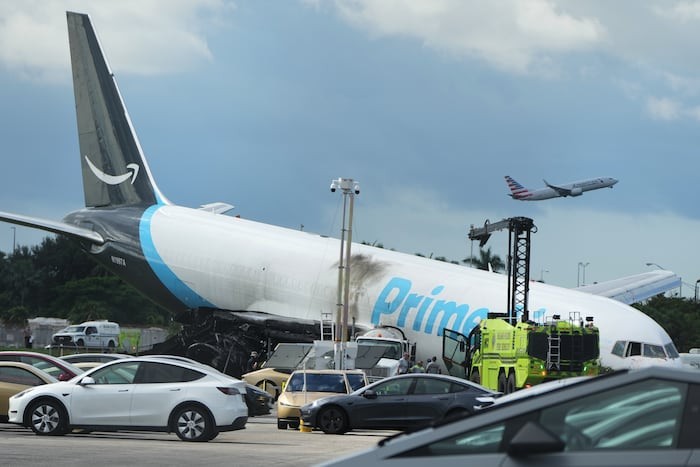
The landing began as routine. An Amazon Prime Air freighter arriving from San Juan, Puerto Rico, touched down at Miami International Airport shortly after 2 p.m. Sunday on runway 30, a diagonal strip at the southern end of the field. The Boeing 767 did not stop. It overran the runway, crossed a road alongside the airport, struck vehicles and erupted in flames, leaving five people dead and five injured, three of them critically, according to Miami-Dade Mayor Daniella Levine Cava.
More than 60 fire units and roughly 200 firefighters responded, and crews found the aircraft outside the airport’s operational area, engulfed in fire and streaming black smoke. The pilots, who were briefly trapped in the cockpit, were rescued. The plane came to rest near Northwest 67th Avenue, a public road where the morning’s ordinary traffic had been rolling past the airport fence.
The aircraft was an old machine doing a young airline’s work. The 32-year-old Boeing 767, built in 1994, began life as a passenger jet and was converted to carry freight in 2015, after earlier service that included operation by a Russian carrier. The flight was operated for Amazon by 21 Air, a cargo airline based in North Carolina that joined Amazon’s transport network in late 2024, one of a handful of contract carriers that fly under the Prime Air banner.
The accident shut down the airport’s operations at one of the busiest moments of the week. More than 160 flights were canceled and roughly 325 delayed as Miami International closed its runways and imposed a ground stop, with partial operations resuming hours later. Travelers across the country, not just those bound for Miami, felt the ripple as aircraft and crews ended up out of position.
The National Transportation Safety Board has taken charge of the investigation, with the Federal Aviation Administration joining, and the agency’s chair, Jennifer Homendy, was scheduled to address the public Monday about how the inquiry will proceed. Investigators will examine the aircraft’s systems, the runway, the weather and the pilots’ accounts, and the cockpit voice and data recorders will be central to the early work.
The runway itself is likely to become part of the discussion. Miami International does not have the engineered-material arresting system, the crushable beds installed at the ends of many U.S. runways, that can stop an aircraft that overshoots the pavement. Federal regulators have encouraged such systems at airports where land is scarce, and the absence of one here means the safety question will not end when the wreckage is removed.
The accident is the second fatal crash involving a U.S. cargo operator in just over a year. Last year, a UPS cargo jet crashed near Louisville, Kentucky, killing 15 people, in the deadliest accident of its kind in years. Sunday’s crash puts the express-airfreight industry back under scrutiny, with its aging converted freighters, its contract operators and its relentless overnight schedules all in the frame.
Amazon said in a statement that it was cooperating fully with investigators and that the safety and well-being of everyone involved was its foremost concern. The company built its air network to speed deliveries across the country, and it has relied heavily on the Boeing 767, a workhorse that passenger airlines have been retiring for two decades but that freight operators keep flying in large numbers.
The business model adds a layer of complexity to the investigation. Amazon, like other e-commerce and express companies, does not fly most of its own planes; it contracts with carriers that own or lease the aircraft and employ the crews. That structure spreads responsibility across the network, and one of the questions investigators will answer is how the operating carrier and its customer divided the duties of maintenance, training and oversight on this particular airplane and this particular flight.
For Miami, the crash landed in the middle of a busy travel weekend, and the airport’s recovery has been a logistical exercise of its own. Airlines worked through the night to reposition planes and crews, and travelers faced a cascade of cancellations that stretched into Monday. The human toll, however, is what will define the aftermath: five people on the ground, going about an ordinary afternoon near an airport, killed by a plane that never should have left the pavement.
The NTSB’s investigation will take months, and its findings will shape not only this accident’s cause but the industry’s safety debates. The questions it will ask are familiar from past runway overruns: whether the aircraft’s brakes and thrust reversers performed, whether the landing was too fast or too far down the runway, whether the crew had enough runway to stop in. But the answers will land in a different context this time, with a cargo industry that has grown explosively on the back of e-commerce and a fleet of aging jets flying through the night over cities. The crash on Northwest 67th Avenue put that industry’s safety record back on the table, in flames visible to the whole airport.