The number was the centerpiece of the evening. Ashok Elluswamy, Tesla’s vice president of artificial intelligence, told an audience at the company’s Cybercab event in Austin on Sept. 3 that the Robotaxi fleet had passed one million miles of fully unsupervised driving, with no human behind the wheel or in the vehicle. The figure marked a steep acceleration: at the company’s second-quarter earnings call in late July, Tesla had put the total at 380,000 miles. The million-mile mark arrived roughly six weeks later, an increase of about 620,000 miles.
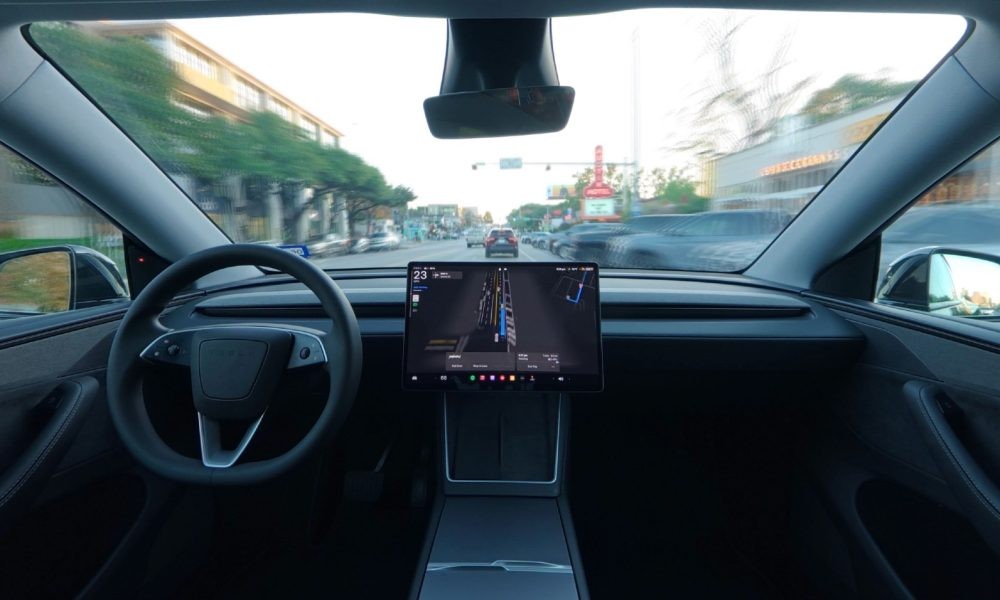
Tesla’s own explanation for the jump is straightforward: it took the safety monitors out of the cars. In most operating regions outside the San Francisco Bay Area, the company has stopped stationing a person in the vehicle to supervise the autonomous system, a step it says its data justified. The Bay Area, where regulations and public scrutiny are tightest, still runs with monitors in place. Remove the supervisor, and the miles that previously required a human in the loop can be logged by the system alone.
The fleet’s geography has widened in step. Tesla now offers driverless ride-hailing in Austin, Dallas, Houston, Miami, Orlando and Tampa, a band of cities chosen for their warm weather, wide roads and accommodating regulators. Each new city opens a fresh source of unsupervised miles, and the six-week jump suggests the company has been adding territory faster than it can count the results.
The comparison that frames the announcement is Waymo. Alphabet’s robotaxi unit has accumulated more than 200 million miles of rider-only driving, a figure that dwarfs Tesla’s and reflects years of operation in Phoenix, San Francisco and other cities. Tesla’s rejoinder is a matter of slope rather than scale: its unsupervised program barely existed a year ago, and its growth curve is steeper than anything Waymo has shown, even if the base is far smaller.
Tesla argues the comparison flatters its approach in another way. Waymo’s cars carry a suite of expensive sensors, including roof-mounted lidar, and its maps are built in painstaking detail. Tesla’s robotaxis use cameras and neural networks trained on the billions of miles its customer fleet has driven, a strategy the company says will scale to any city without new hardware or surveying campaigns. Critics say that same approach, vision-only and map-light, is why Tesla’s safety case rests on statistics that are still thin.
The million-mile figure matters to Tesla’s business plan in a concrete way. The company has promised investors that its robotaxi service will become a source of revenue, and it has built the Cybercab, a purpose-built vehicle without a steering wheel, around that promise. Every mile the current fleet logs without incident is data for the safety case the company will need to expand the service and, eventually, to sell the cars themselves as autonomous machines.
Regulators are watching the count with their own instruments. The National Highway Traffic Safety Administration has scrutinized Tesla’s driver-assistance features for years, and the company’s entry into commercial robotaxi operations has drawn the agency’s attention to a new set of questions: how incidents are reported, how the vehicles behave in conditions the training data did not cover, and whether removing the in-vehicle monitor changed the risk profile in ways the public is being told about.
The pace of expansion is itself a subject of debate. Adding more than 600,000 unsupervised miles in six weeks means the fleet is covering ground far faster than it did in the program’s early months, which is precisely what Tesla wants to show and precisely what its critics want to interrogate. A system that performs well over a million carefully chosen miles in sunny cities is not the same as one proven over decades of driving in every condition, and the distinction is at the center of the regulatory conversation.
The company’s public posture is that the data speaks for itself. Tesla has said it will report incidents transparently, and its executives have argued that the absence of a major accident across the unsupervised fleet is evidence the system is ready for more cities and fewer restrictions. The phrase its critics use is that a million miles is an entry ticket, not a certificate: enough to begin, not enough to conclude.
For the rest of the industry, Tesla’s progress changes the terms of the robotaxi argument. For years the assumption was that lidar-equipped fleets operated by dedicated companies would win the race, with camera-based approaches dismissed as science projects. Tesla’s million unsupervised miles, however accumulated, give the vision-only school a data point it lacked, and the coming months will show whether the company can repeat the feat in harder conditions.
What happens next depends on the incidents that don’t happen. Tesla’s expansion has been built on removing the human from the car, and each additional city without a monitor adds risk that the company says is justified by its numbers. The million-mile mark is a round number that will appear in Tesla’s marketing, its regulatory filings and its arguments with safety officials. Whether it becomes a foundation or a ceiling is a question no announcement from Austin can answer.