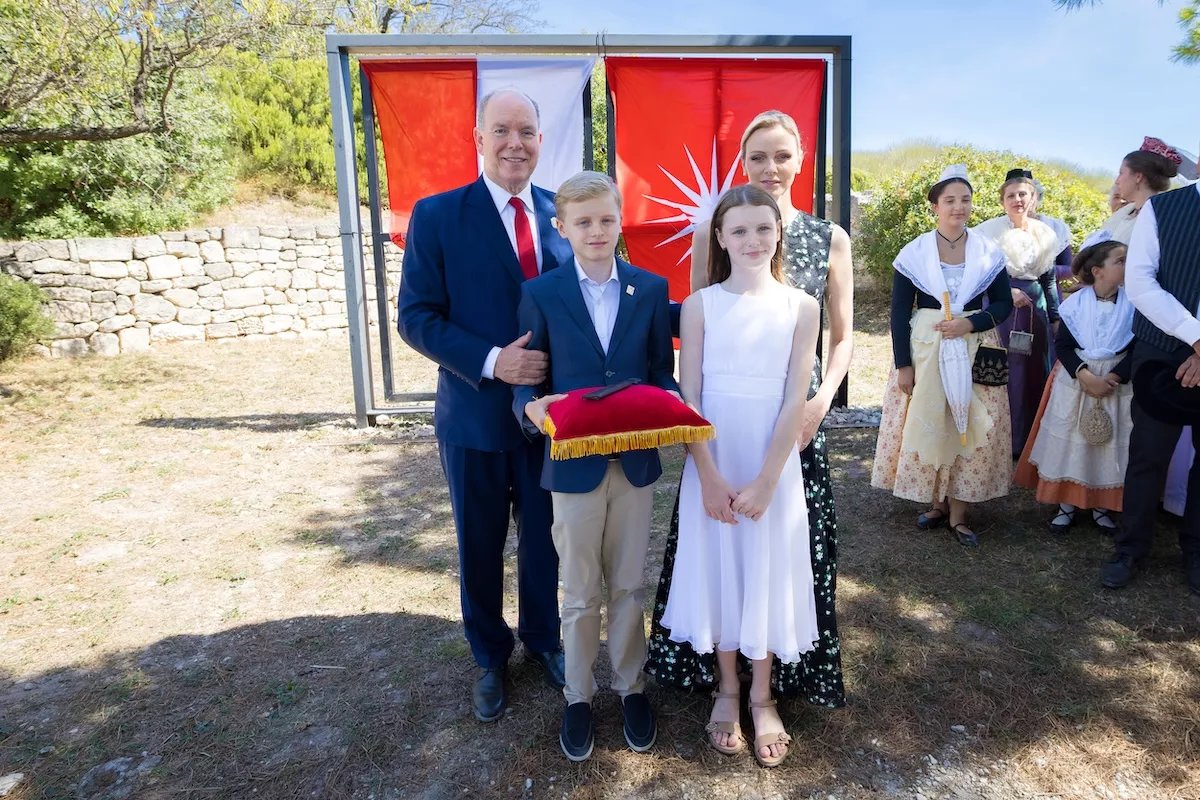
The ceremony took place on a square in a medieval village in Provence, and at its center was an eleven-year-old boy. Prince Jacques of Monaco, the hereditary heir to the throne, was handed a set of keys and, with them, a title that has belonged to the heir to the Monegasque crown for centuries: Marquis of Les Baux.
Les Baux-de-Provence, a hilltop village of stone houses and a ruined castle, has been tied to the Grimaldi family since the seventeenth century, when the lordship passed into the family through marriage. The title of Marquis of Les Baux became the traditional style of the heir to Monaco, a link between a Mediterranean principality of two square kilometers and a French village it has not ruled for centuries but has never stopped honoring.
The occasion for the visit was twofold. The family unveiled a square renamed for Prince Rainier III, the prince who ruled Monaco for more than half a century and who died in 2005. And the heir, Prince Jacques, received the keys to the village and the marquis title that his father, Prince Albert II, once held, in a ceremony that was part pageantry and part family gathering.
Prince Jacques, who is eleven, stood through the proceedings with the composure expected of a future sovereign, while his twin sister, Princess Gabriella, accompanied the family. The twins were born in December 2014, and their public appearances have traced the ordinary arc of childhood against an extraordinary backdrop: school, sports, and, increasingly, the formal duties of a reigning house.
Princess Gabriella’s presence drew its own attention, and her outfit, a Dior ensemble, was noted in the coverage of the day, as the women of the Monegasque family have long been as closely watched for their style as for their substance. The twins have been photographed together since infancy, and their appearances now carry the weight of a dynasty’s future.
The village of Les Baux occupies a place in Provençal history larger than its population. Perched on a limestone ridge, it was the seat of a powerful medieval lordship whose name survives in the aluminum ore first identified nearby. The castle and the village draw tourists in numbers that dwarf the resident population, and the Grimaldi connection is a thread that binds a tiny principality to a famous corner of France.
The relationship is largely symbolic, and it is precisely the symbolism that gives the visit its weight. Monaco does not govern Les Baux, and the marquis title confers no territory and no revenue. What it confers is continuity, a lineage that has kept its names and its rituals intact across centuries, and a family that tends those rituals as carefully as it tends its finances.
Prince Rainier III, whose square was unveiled, is the figure around whom much of that continuity turns. He ruled from 1949 until 2005, transformed the principality’s economy, and married the American actress Grace Kelly, a union that made Monaco a global byword for glamour. Naming a square for him in Les Baux ties the village’s history to the prince’s, and to the dynasty that produced them both.
The visit also carried the quieter purpose of preparing the next generation. Prince Albert II has spoken of the duty of raising an heir to a role that is ceremonial but relentless, and appearances such as this one are part of the education: how to stand, how to accept a key, how to receive a title without appearing to claim it. At eleven, Jacques is learning the choreography of sovereignty.
The principality itself has been through a period of attention to the succession and its burdens. Monaco’s constitution was amended in 2002 to ensure the line of succession could not end, and the birth of the twins in 2014 secured the direct line, with Jacques first in line and Gabriella following. The village ceremony was, in that light, one more rehearsal for a role that will one day be his for life.
For the residents of Les Baux, the day was a civic event as much as a royal one. The square, the speeches, and the unveiling were the village’s own observance of a connection it has maintained for four hundred years, and the crowds that gathered were there for the occasion as much as for the family. The relationship is a two-way inheritance, and both sides tend it.
The images that emerged, the heir in the village square, the keys, the unveiled plaque, will join the long visual record of the Grimaldis, a dynasty that has understood, better than most, that a throne is maintained as much in ceremony as in law. The keys to Les Baux open no doors that matter politically, but they close a loop of four centuries, and the family crossed the square to accept them.