Next week, a SpaceX rocket will lift off carrying a small satellite with an unusual payload: one of Google’s own AI chips, built to survive the forces of launch, the radiation of space and the temperature swings of low Earth orbit.
Google said Sept. 24 that the prototype satellite, built with the Earth-imaging company Planet Labs, will fly on SpaceX’s Transporter-18 rideshare mission as the first in-orbit test of Project Suncatcher, the company’s research effort to explore whether space could one day host large-scale AI computing. The mission’s job is modest: gather data and find failure points, not run a working data center in orbit.
Suncatcher, announced last November, is a moonshot with a specific thesis. Solar panels in low Earth orbit can collect up to eight times as much energy as the same panels on the ground, because in certain orbits they are never shaded by night for long and never blocked by atmosphere. If AI compute could be moved to satellites powered by that sunlight, Google argues, the physical limits on data-center growth would loosen.
The idea rests on Google’s Tensor Processing Units, the chips it designs for AI workloads. The first question was whether they could survive space at all. Google said it tested Trillium-generation TPUs on a proton beam meant to simulate five years of radiation exposure, and the chips came through without damage, though the high-bandwidth memory attached to them proved the most sensitive part.
The mission launching next week tests the rest of the unknowns: the violent vibration of a rocket launch, the hard vacuum that makes heat dissipation difficult, and the extremes of temperature as a satellite passes between sunlight and shadow. The first flight is explicitly a learning exercise, Google said, meant to reveal what breaks before the company spends more heavily.
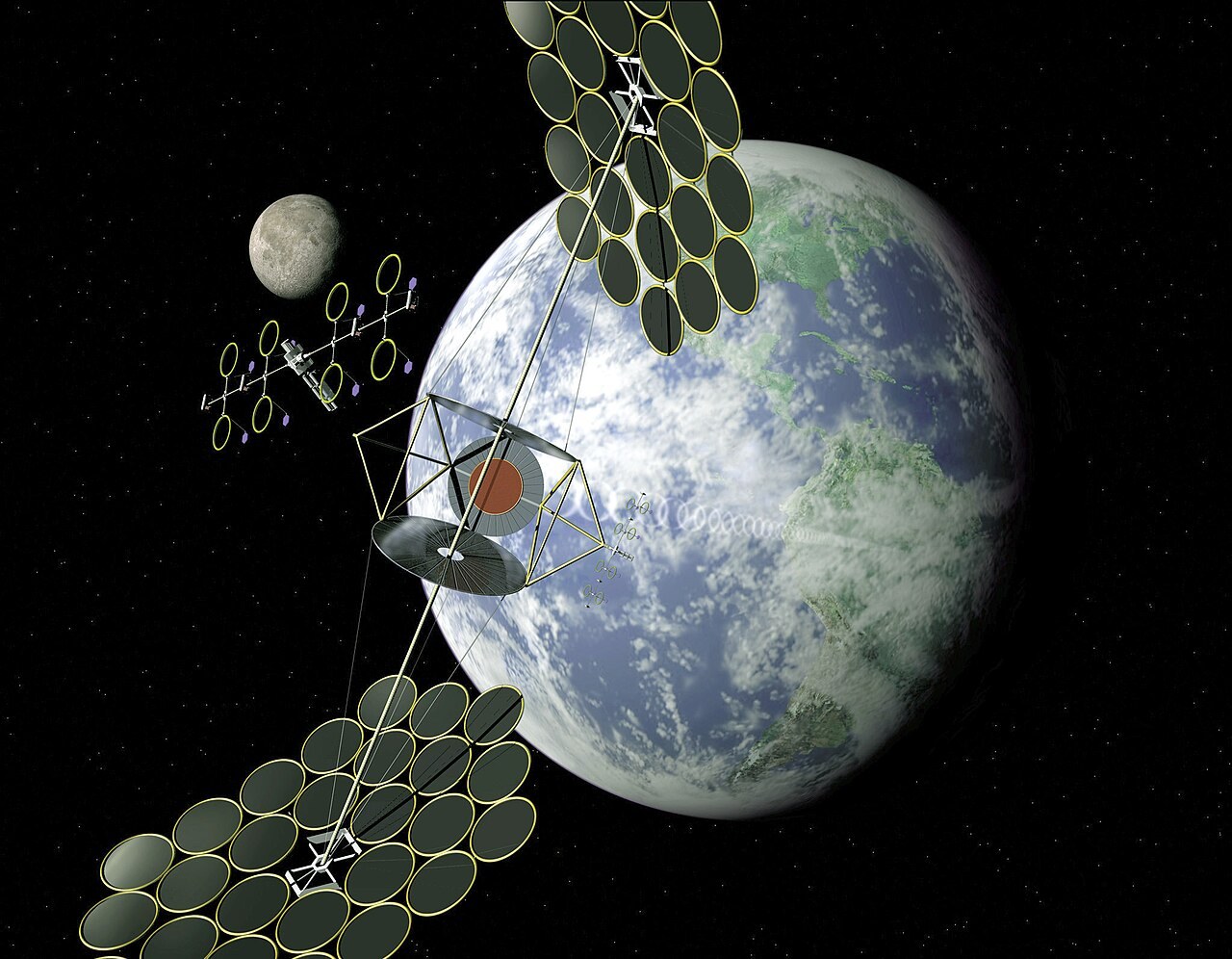
The next step comes in 2027, when two satellites will test the high-bandwidth laser links that clusters of TPU-carrying satellites would need to talk to one another. Google has described that as a joint mission with Planet. The long-term vision involves arrays of small modular satellites flying in close formation in a dawn-dusk sun-synchronous orbit, at a mean altitude of roughly 650 kilometers, linked by free-space optics.
The ambition is extreme. Google researchers have described clusters of 81 satellites spanning about a kilometer, and a path toward terawatts of compute capacity. “Like any moonshot, it’s going to require us to solve a lot of complex engineering challenges,” chief executive Sundar Pichai said. None of the pieces, the power, the cooling, the links, the chips’ reliability, is yet proven in orbit.
The engineering problems are unlike anything a data center on the ground faces. Space is a vacuum, which means there is no air to carry heat away, and a chip that runs hot must be cooled by conduction and radiation alone. The satellite will pass between blazing sunlight and deep shadow many times a day, cycling its hardware through extremes. Google has said the first mission is meant to map precisely these stresses.
The project is a response to a concrete problem on the ground. Data centers have become one of the fastest-growing consumers of electricity, and the largest cloud providers have signed deals for nuclear power and fenced off gigawatts of capacity to feed AI training. If the supply of power and cooling on Earth is the ceiling on AI, the appeal of a place where sunlight is constant and cooling is free is obvious to Google’s researchers, according to the company’s descriptions of the program.
Planet Labs brings the operational half of the experiment. The company builds and flies fleets of small Earth-imaging satellites, and it has agreed to design and operate the spacecraft for Suncatcher, using the same satellite bus it is developing for its own next-generation Owl mission. The arrangement gives Google a partner with flight heritage without requiring it to build a satellite program from scratch.
The ride comes from SpaceX, whose low-cost rideshare launches have made such experiments cheap enough to attempt. That Google can put a first prototype in orbit as a research project, rather than as a capital program, is itself a sign of how much launch economics have shifted in a decade.
For now, Suncatcher is a research program with a deliberately small first step. The satellite going up next week will carry a handful of TPUs and a set of instruments to measure how they fare. What it learns will determine whether the project scales toward its 2027 goal, or whether the idea of computing in space stays, for now, on the ground.
The orbit choice is part of the bet. A dawn-dusk sun-synchronous orbit keeps a satellite almost continuously in sunlight, which is why Google’s researchers see it as a path to near-constant solar power at a scale no ground installation can match. The proposal, still years from reality, would connect many such satellites with lasers into a single distributed computer.