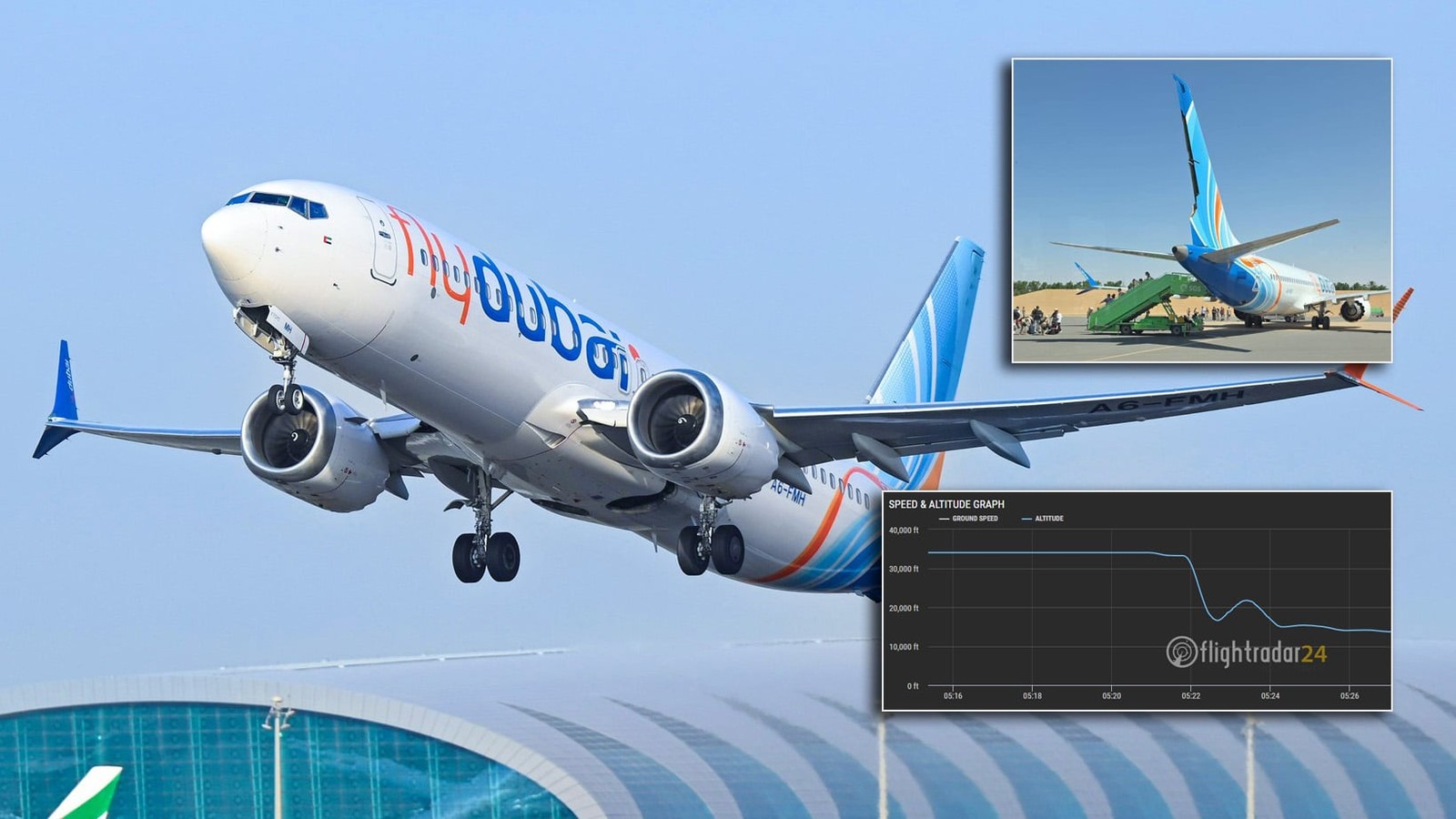
Flight FZ1073 pushed back from Dubai at 7:05 a.m. local time on Wednesday, a Boeing 737 MAX 8 registered A6-FKF, bound for Tel Aviv with roughly 180 people on board, most of them Israeli. It was due to land around 9:30. About an hour and a half into the flight, over Jordanian airspace, the jet transmitted two transponder codes in quick succession: 7700, a general emergency, and then 7500, the signal for unlawful interference. Inside the cockpit, the two men flying the plane had turned on each other.
The captain was reported to be of Russian background and the first officer Ukrainian. Their argument escalated into violence. One of the pilots lost consciousness at one point, and one of them produced a folding knife and stabbed his colleague. Several Israeli passengers rushed forward and pulled the two men apart. Passengers described hearing screams and seeing blood in the cockpit. The aircraft dropped roughly 15,000 feet, about 4,570 meters, in a single minute.
The jet turned away from Tel Aviv and descended toward Saudi Arabia, landing at Prince Sultan bin Abdulaziz Airport in Tabuk, in the country’s northwest. Everyone on board, including 27 children, came away unhurt. A second crew traveling in civilian clothes helped bring the aircraft down safely, according to Indian media reports, and the two injured pilots were taken to hospital.
The landing set off a scramble far from the runway. Israeli Air Force jets took off, and Prime Minister Benjamin Netanyahu convened a security consultation. The military weighed whether to send a C-130 transport to bring the passengers home. Israeli officials said there were growing signs that one of the pilots had tried to seize control of the aircraft and take everyone on board down with it. Investigators were looking at attempted suicide and a deliberate crash as possible explanations.
The flight path itself is a product of a changed region. Flydubai, the budget carrier owned by the government of Dubai, has flown between the Emirates and Israel since the two countries normalized relations under the 2020 Abraham Accords. A jet crossing Arab airspace toward Israel, once unthinkable, is now a daily route, which made the emergency landing in Saudi Arabia, a country with no formal ties to Israel, all the more sensitive.
A squawk code of 7500 is among the rarest things an airline pilot can send. It declares that the aircraft is the subject of unlawful interference, and it sets hijack protocols in motion in every airspace the jet crosses. For a flight from Dubai to Tel Aviv, the codes reached Jordanian controllers first, then Saudi ones, and the decision to accept the jet at Tabuk was made in minutes, according to officials familiar with the handling of the flight.
Saudi controllers accepted the diversion and treated the injured pilots at Tabuk. The passengers were later flown onward to Tel Aviv on a rescue flight. Israeli officials treated the episode as a suspected terrorist attack until the cockpit fight emerged as the likely explanation, a version of events that has still not fully settled.
The aircraft itself carries a difficult history. The 737 MAX was grounded worldwide for nearly two years after two fatal crashes, and its return to service was built on changes to flight-control software and crew training. Wednesday’s incident had nothing to do with the aircraft, by all accounts so far, but the plane type guarantees close attention whenever anything goes wrong.
What happened in the cockpit in the minutes before the squawk codes is now the central question. The flight recorders and the accounts of the two pilots will have to explain how a routine crew turned violent, who reached for the knife, and how close the jet came to the ground before control was restored. Flydubai has said little beyond confirming the diversion and the safe landing. The airline, founded in 2008 with one of the youngest fleets in the region, had no comparable incident on its record before Wednesday.
The episode drew attention to a route that has become routine since normalization. Flydubai, which flies a fleet of Boeing 737s, added Tel Aviv to its network after the Abraham Accords and has carried traffic between the two cities since, a measure of how far regional ties have moved in a few years. An emergency landing in Saudi Arabia, handled without drama by controllers in Tabuk, was itself a sign of that shift, even as the fight in the cockpit threatened to turn a routine flight into something far worse.
The passengers are home. The inquiry is not. What remains unexplained is what two men in the cockpit were doing during that one-minute, 15,000-foot descent, and whether the emergency systems and the passengers in the aisles were the only things standing between the flight and the ground.