Harrison Shih runs a drone program at DoorDash where the aircraft came last. The head of the company’s new air-delivery service spent the early work on packaging, loading systems and the handoff at a restaurant kitchen, then designed the flying machine only after those ground problems were solved. “We didn’t start with a drone and ask what would fit,” Shih said. “We started with what people order and how local businesses actually operate.”
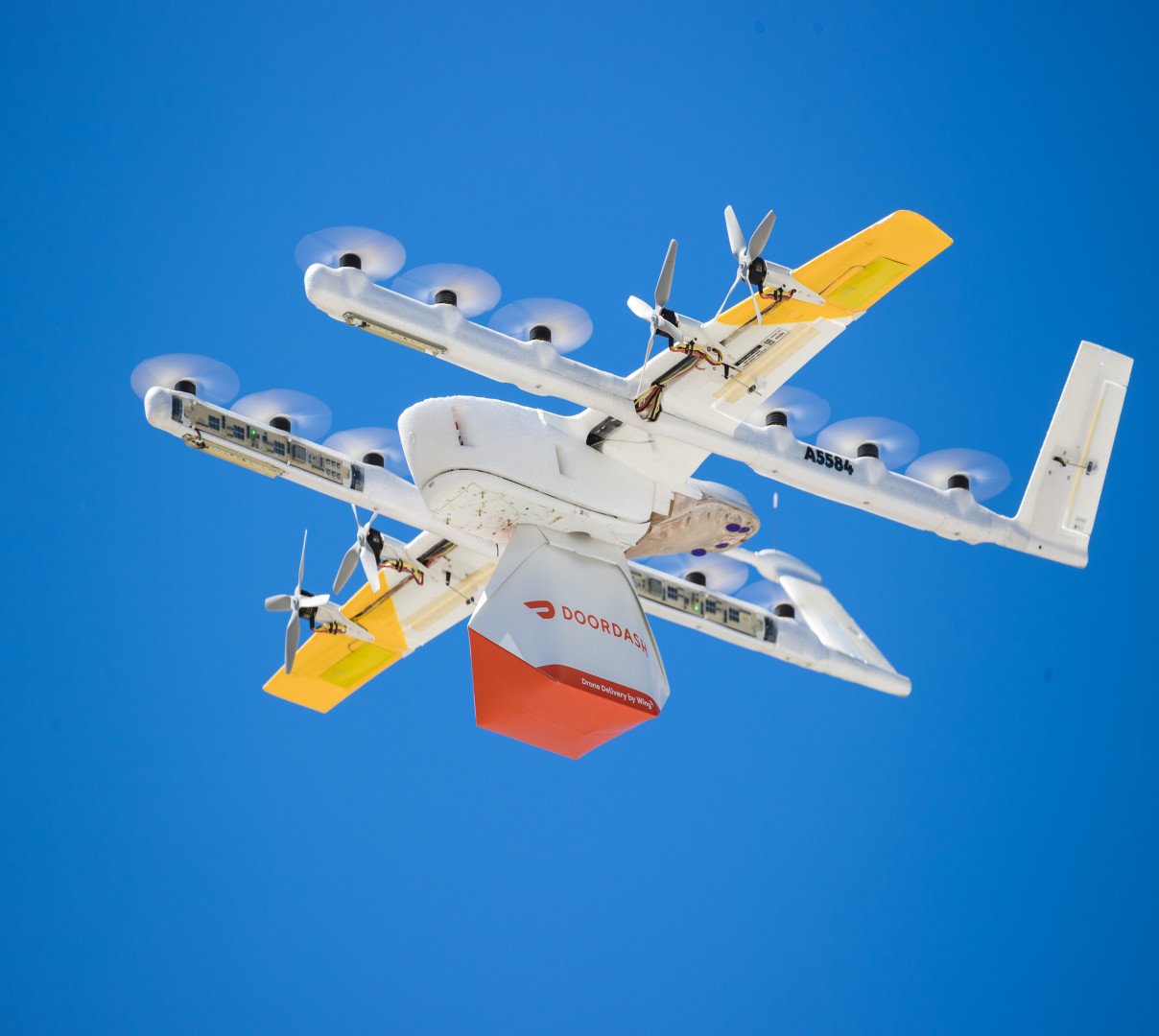
The result, unveiled at DoorDash’s annual Dash Forward 2026 event on Sept. 30, is DoorDash Air, a purpose-built aircraft with six slow-spinning propellers mounted at the ends of its arms. The company said the drone’s cruising noise at delivery height is roughly that of a passing car, and that a winch handles pickup and drop-off, with added failsafe systems to lower the aircraft gently in rare events.
DoorDash Air is the work of DoorDash Labs, the research team that built Dot, the sidewalk delivery robot the company fields for local runs. The same group wrote the Autonomous Delivery Platform, the software that now decides, order by order, whether a human courier, a robot or a drone is the fastest and most reliable way to reach a customer, weighing distance, weight and what is actually in the order.
The company is betting that much of what it delivers can travel by air. DoorDash said roughly 80 percent of its typical restaurant orders are light and small enough for the aircraft to carry safely, and that early tests put delivery times from restaurant to customer door at under five minutes on average. Pilot deliveries will begin in Northern California with Chipotle, Popeyes Louisiana Kitchen and other local restaurants.
DoorDash has been moving toward this for months. In July it announced plans for a drone delivery business after receiving a Part 135 air carrier certification from the Federal Aviation Administration, the license that permits a company to run a commercial drone service in the United States. The company said it has already completed hundreds of thousands of lifetime autonomous deliveries across Dot and its robot and drone partners.
The same day, DoorDash made a second announcement aimed at a different kind of friction. Customers will be able to text their orders through the Messages app on Apple devices rather than opening the DoorDash app, an expansion of its Ask DoorDash assistant. A user who types “the usual” can have an agent recognize a regular Friday dinner order, build the cart, send back photos of the dishes and reconcile several people’s different dietary needs in one request. The feature arrives in the United States first, with a waitlist to join.
The two announcements point the same way. DoorDash is trying to make ordering and delivery feel like background work, whether the request arrives by text or the food arrives by air. For merchants, the company said businesses will be able to connect DoorDash to the apps and AI agents they use internally to order team lunches and restock supplies.
DoorDash is the largest food-delivery company in the United States, a position it built over more than a decade by signing hundreds of thousands of restaurants and moving orders through a network of millions of couriers. Adding an aircraft to that network is less a hardware bet than a logistics one, extending a delivery machine that already reaches most of the country.
Autonomy matters to DoorDash because labor is the biggest line in its cost structure. The marketplace runs on human couriers who pick up orders and drop them at the door; robots and drones promise to do that last stretch without a driver. That is why the company frames Air not as a standalone product but as one more mode inside a system that already coordinates Dashers and Dot.
The drone push also drops DoorDash into a race that has burned money for a decade. Amazon, Alphabet’s Wing and a clutch of startups have tried to make drone delivery economical, and most have scaled slowly against battery range and a patchwork of local rules. DoorDash’s argument is that it already holds the orders, the merchants and the routing software; the aircraft is the last piece, not the first.
That ordering reverses the usual startup sequence, and it is the point. A drone that requires a restaurant to rebuild its kitchen workflow will not get adopted, no matter how well it flies. DoorDash built the aircraft to fit how a Chipotle or a Popeyes already packs a bag, so a store can add air delivery without overhauling how it operates.
Whether the economics work remains open. Drone delivery is cheapest for small, light, time-sensitive orders, a narrow slice of a market dominated by dinners and groceries that weigh more than a few pounds. DoorDash’s 80 percent figure suggests the company has mapped that slice carefully, but it has not said how fast the service will expand.
For now the message at Dash Forward was that the hardest work happens before the rotors spin. DoorDash Air will begin with a handful of restaurants in one region, and the company said it will share more about the ground infrastructure it is building with merchant partners as it scales. The drone got the headlines; the company is betting the ground gets it adopted.