
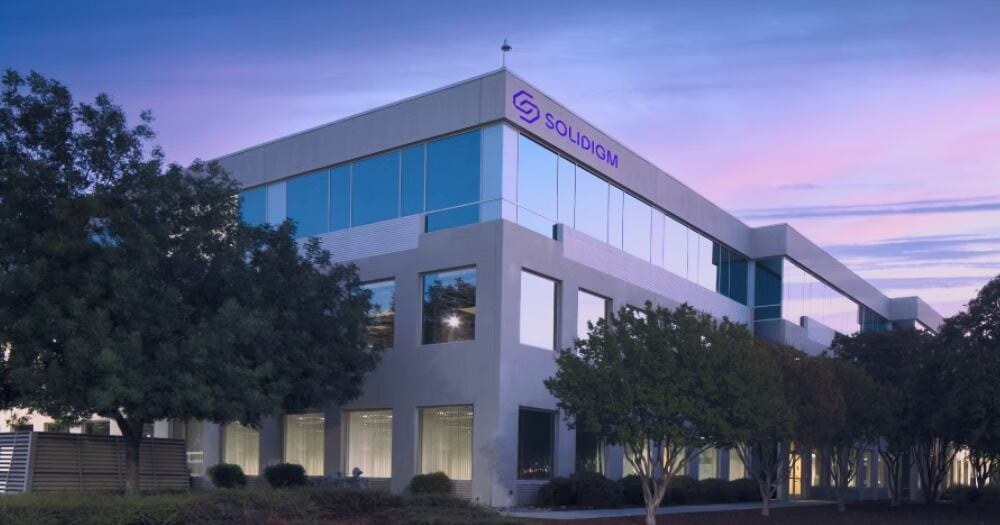
The investment bankers who spent late September pitching for a piece of Solidigm’s initial public offering got their answer this week. SK Hynix’s NAND-memory subsidiary has chosen Goldman Sachs and Morgan Stanley to lead its planned U.S. listing, according to Bloomberg, which reported the decision on October 7.
The company is aiming to list in 2027 at a valuation that could reach $150 billion, a figure that would make it one of the largest technology offerings in years. Neither the timing nor the final valuation is fixed, and people familiar with the process said both will shift with the market.
The selection of the two banks ends a process that began in late September with a bake-off in which several firms competed for the mandate. With the underwriting team now set, the company turns to the long work of preparing a prospectus, a task complicated by a history that Korean media have spent the week revisiting.
That history is the pricing dispute that surrounded the deal that created Solidigm in the first place. SK Hynix acquired Intel’s flash-memory business in a transaction valued at roughly $9 billion, completed in stages, a purchase that Korean shareholders and analysts questioned at the time as overpriced. The memory industry was in a downturn, and the price looked rich for an asset whose fortunes were tied to the volatile NAND market.
The decision now looks prescient. NAND demand has surged with the buildout of AI data centers, and Solidigm has become a meaningful player in enterprise solid-state drives, the storage that sits behind the servers running large models. The $150 billion valuation that bankers are now floating is many times what SK Hynix paid for the business, a turn that has quieted the earlier criticism.
The IPO plans arrive at a moment when memory companies are reporting some of the strongest results in their history. SK Hynix itself, and rivals like Samsung, have ridden the AI storage boom to record earnings, and Solidigm sits at the center of that demand. The timing of the listing is designed to capture that momentum.
Still, the path to the offering is not settled. A valuation of $150 billion would depend on investors accepting a premium multiple for a memory business, and memory is a cyclical industry where peaks have a way of being mistaken for plateaus. The banks and the company will spend the next year testing whether that price can hold.
The listing would also mark a rare U.S. offering from a Korean corporate group, and one whose parent remains its largest shareholder. The structure, a Korean parent listing a U.S.-incorporated subsidiary, is unusual enough that it will draw extra scrutiny from both investors and regulators.
For SK Hynix, the IPO is a way to raise capital and to put a public value on an asset that sits inside a conglomerate, where the market often struggles to price it. A separate listing gives the business its own currency and its own multiple, unclouded by the parent’s other operations.
Enterprise storage is one of the quiet winners of the AI buildout. The data centers that train and run large models need fast, dense storage, and solid-state drives built for servers carry margins far above the consumer flash that fills laptops and phones. Solidigm’s position in that market is the reason a business once written off as overpriced is now being valued in the hundreds of billions.
The NAND market has been through punishing cycles, and investors have learned to price memory companies for the bust even in the middle of the boom. That history is part of why the IPO valuation is not settled. The banks will have to persuade buyers that AI-driven demand for storage is durable enough to justify a price that already assumes several good years.
There is also a question of how much of Solidigm the parent is willing to sell, and at what price. Korean media have spent the week revisiting the original acquisition’s terms, and an IPO is, in part, a referendum on that earlier judgment. The market remembers what was paid for an asset, and it will measure the offering against that number.
The company has offered no comment on the report, and Goldman and Morgan Stanley have not confirmed their roles. The banks’ selection was reported by Bloomberg, citing people familiar with the matter, and the details of the offering remain subject to change.
What is clear is that Solidigm is preparing to test the public markets at a moment when the memory industry’s fortunes are unusually bright. Whether that brightness lasts until 2027 is the question the next year will answer, and it is the question the two lead banks have just been hired to help settle.



