
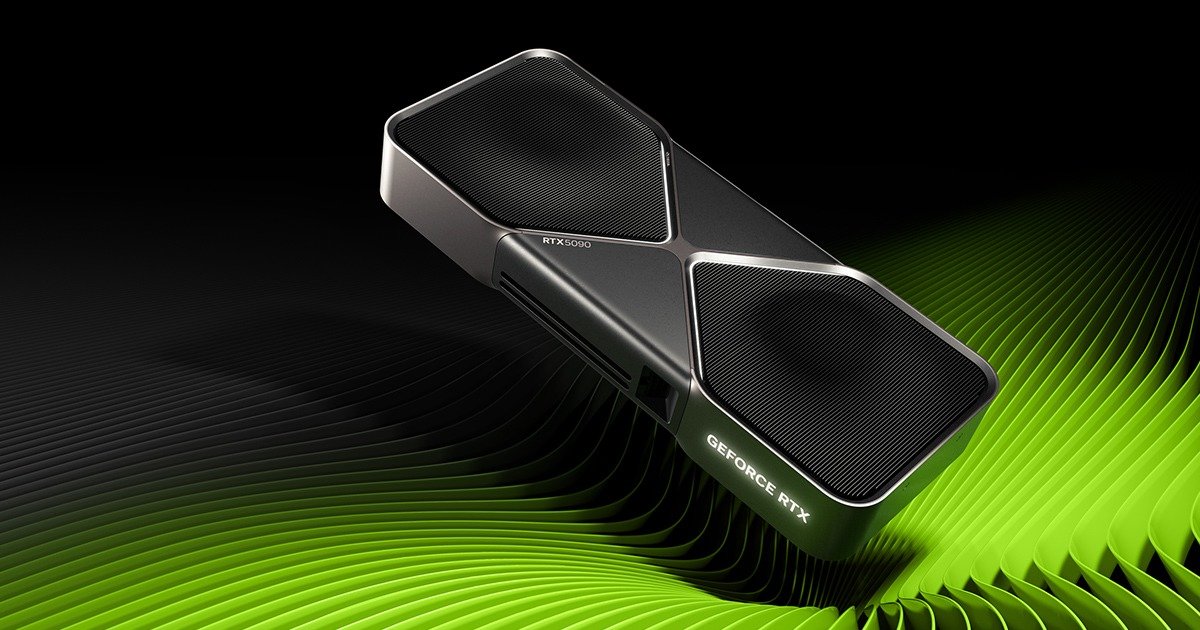
The message surfaced on X over a weekend, the way most news about graphics cards does. “No more GB202 for 5090, confirmed,” wrote the hardware leaker known as MEGAsizeGPU, adding in a follow-up that all future GB202 supplies are reserved for Nvidia’s professional RTX Pro line. A second leaker, hongxing2020, posted a screenshot of what appeared to be a factory notice: Nvidia would no longer manufacture any RTX 5090 models, including the D variants built for the Chinese market.
Neither claim has been confirmed by Nvidia, and the company has pushed back informally, telling at least one outlet that RTX 5090 production continues. No add-in-board partner, not Asus, MSI or Gigabyte, has confirmed or denied the reports. But the story has been picked up by enough independent outlets that retailers and buyers have begun planning around it, and the reasoning behind the reports is not hard to follow.
The RTX 5090 is the fastest consumer graphics card Nvidia sells, a 1,999 dollar part aimed at gamers who want the best frame rates and at a growing number of small AI developers who use consumer cards to run models locally. It is built on a die called GB202. So are several of Nvidia’s professional products, among them the RTX PRO 6000 Blackwell, which uses 24,064 cores and 96 gigabytes of memory, and the RTX PRO 5000 series.
That shared silicon is the hinge. A wafer of GB202 can become a gaming card that sells for close to two thousand dollars, or it can become a professional card that sells for several times that and lands in a workstation or a server. When the same raw material can be sold at two very different prices, and when supply is finite, the manufacturer has an obvious reason to steer it toward the more expensive product.
That reason has strengthened with the AI boom. Demand for computing capacity has been running ahead of supply for more than two years, and Nvidia’s data-center business has grown to dwarf its gaming business in revenue terms. Every chip allocated to a professional or AI product earns more per unit of wafer than one allocated to a consumer card. Analysts said the reported shift, if accurate, would be a straightforward allocation decision rather than a retreat from gaming.
It is worth being precise about what an end to new production would mean. Ending the supply of new GB202 chips is not the same as discontinuing the card. Nvidia and its partners can keep selling boards assembled from chips they already hold, and inventory can move through retail channels for months. If the flow of new chips stops, though, supply tightens over time, and prices for whatever remains tend to climb rather than fall — a pointed development as the holiday shopping season approaches.
The leak also carried a second thread. The same poster, hongxing2020, wrote of a 24-gigabyte version of the RTX 5080 being ready, a card that would slot in below the 5090 and could soften the loss of the flagship. That claim is as unconfirmed as the first, and no partner has said whether such a card exists.
Buyers weighing a purchase face a familiar problem: acting on a rumor. The card remains on sale. But the pattern behind the reports is a real one, and it has been visible across the industry. Memory prices have climbed, advanced manufacturing capacity is contested, and the highest-value customers for a company’s silicon are no longer always consumers. When a chip can be turned into a product that a data center will pay far more for, the consumer version tends to become a lower priority. That pressure has been building for two years, and it has rarely favored the buyer at the bottom of the price ladder.
There is a counterweight worth noting. Gaming remains a large and loyal business for Nvidia, one that built the company’s brand long before its chips went into server racks, and abandoning the top of that line entirely would be a decision with costs beyond the margin on a single card. A person close to the company said earlier this year that gaming stays central to its plans. The reports, if true, describe an allocation choice at a moment of scarcity, not a decision to leave the market.
What happens next depends on Nvidia’s actual allocation of GB202 wafers, which the company has not disclosed. If the reports hold, the practical result for a gamer is not a shortage that appears overnight but a slow thinning of supply and a price that stops coming down. For Nvidia, it is a choice about where the wafer goes. For the person holding a shopping list, the decision has already been made somewhere upstream, and it will show up on a shelf as a card that costs more than it did last year.



