
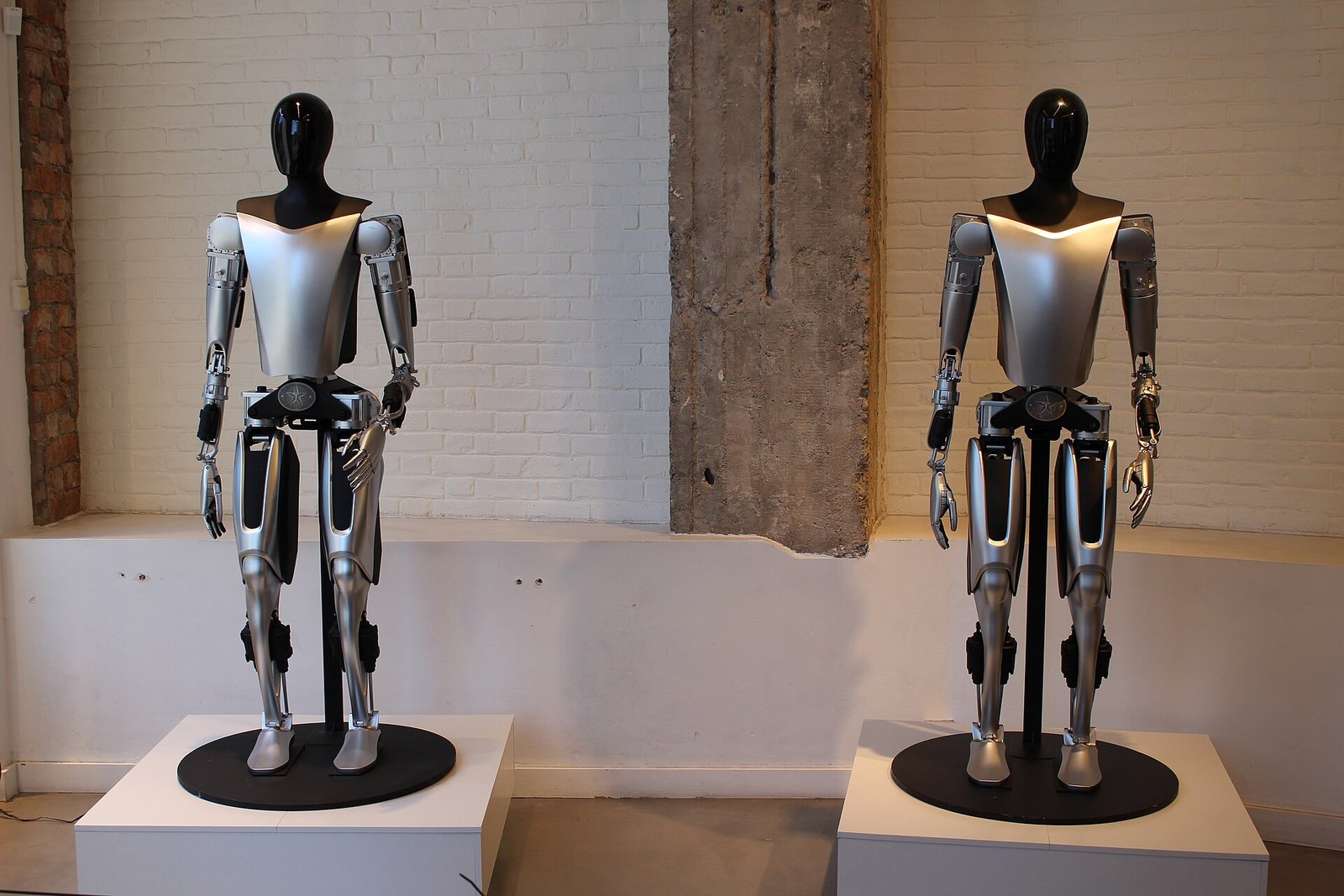
The post that circulated on X this month did what industry diagrams usually do. It turned a sprawling supply chain into a single frame and gave every player a job. Stanford and Berkeley sit on the left, producing researchers and papers. Nvidia sits in the middle, supplying the compute, the simulation software and the developer tools. Tesla sits on the right, converting driving data into a humanoid that works on a factory floor.
Nothing in the picture was a revelation to anyone inside the field. Its appeal was structural: it made the claim that physical AI is not one industry but three, each with its own currency. Universities trade reputation and graduates. Chip companies trade developer loyalty. Manufacturers trade data and, eventually, a product. Once that split is visible, a company’s place on the diagram is easy to read and hard to argue with.
The numbers behind the map are why people keep drawing it. Silicon Valley Robotics, an industry group, counts roughly 1,000 robotics and physical AI companies in the Bay Area, more than any other region, with about $50 billion in cumulative equity funding through the end of 2025. Capital has not dispersed evenly. Figure carries a valuation near $39 billion, Skild AI about $14 billion and Physical Intelligence about $5.6 billion, according to the funding trackers behind the map.
The brain column is where the money concentrates and where the intellectual property is thinnest. Nvidia publishes GR00T as an open model and sells Omniverse and Isaac as the tools a team uses to simulate a robot before it exists, which means the foundation layer most startups build on is owned by one supplier. The academic labs that feed the column, Stanford’s IRIS group and Berkeley’s robot learning labs among them, matter less for their patents than for their output of people.
The body column is crowded and expensive. Humanoids from Figure, Tesla, Agility, Apptronik, Sanctuary and 1X compete for the same early customers, and none has shipped at the volume that would let it buy components at the prices a carmaker pays. A roster of names makes the field look mature. A roster is not a market.
The infrastructure column is the one most readers skip, and it is where the economics live. Sensors, harmonic drives, actuators, batteries, edge chips: the parts a robot needs in quantities that dwarf the prototype stage. That layer is not a Bay Area story. Its largest suppliers are Japanese, German and, increasingly, Chinese, and Unitree’s low-cost humanoid sits on the same map as a reminder that the vertical integration the best-funded American startups are attempting can be undercut from below.
There is a second dependency the frame does not draw, running the other way. Nvidia needs the ecosystem it equips, because the value of its simulation and robotics stack is set by how many teams adopt it. Every startup that trains a policy in Isaac rather than in a homegrown environment adds to the case for buying Nvidia chips, and open releases such as GR00T are how the company keeps that habit from hardening around a rival standard.
A map drawn from funding data also has a seasonality problem. The capital behind these companies was raised in a market that has been generous to robotics for three years, and a chart that shows who has money does not show who can raise again. Valuations near $39 billion for a company with pilot deployments are a statement about the next round, not about current revenue.
Talent is the other number that changes the picture. One recent survey of the humanoid and embodied AI sector counted about 1,044 technical staff across 13 leading players, a small pool for an industry with this much capital behind it. Concentrated talent means concentrated hiring, and it means the arrows in the diagram, which suggest a smooth flow from university to startup to product, describe a pipe narrower than it looks.
None of that makes the map wrong. It makes it a funding chart rather than a cost chart, a record of where capital landed rather than where value accrues. A diagram drawn by investors will put investors’ names at the center, and this one puts the foundation models there for a reason: whoever owns the model that commands the robot keeps a claim on every unit shipped, whether or not they built the hand that grips.
Analysts said the useful test of the map is what it omits. Missing are the companies that will service the machines, the insurers, the safety certifiers, the integrators who install a robot in a warehouse designed without one, and the Chinese manufacturers already selling wheeled robots by the thousand. Missing, too, is any measure of revenue, which for most names in the frame remains close to zero.
The thread’s own framing gave away the honest part. It described a division of labor rather than a race, with each layer doing what it does best. That is a fair description of a supply chain in formation. It also flatters the layer carrying the least capital risk, because brain, body and infrastructure are not equal partners. One sets the standard, one holds the inventory, and one carries the debt.
For anyone using the map to navigate, the practical reading is narrower than the frame suggests. The names in the middle of the picture have cash and no proven product. The names at the edges, the labs and the component suppliers, get paid either way. That is the difference between a strategy and an org chart, and a single image tends to blur it. The thread was worth reading for the same reason it was worth arguing with: it put names where a business plan should be.



