
At Monza last year, Max Verstappen cut a corner while defending his position. On the pit wall, a system built with Oracle recommended that the team hand the place back, on the calculation that the stewards would take it away anyway and add a penalty. The advice ran against every competitive instinct in the garage. Red Bull followed it. Verstappen took the position back a few laps later.
Jack Harington, head of technical and performance partnerships at Oracle Red Bull Racing, described the episode in an interview with CNBC this week. The system began as a search tool for regulations and past rulings, he said, and has evolved into an agentic one that draws on a wider range of sources and recommends actions during a race. “It’s actually making decisions for us,” he said.
He also set a limit. “Formula One is and will always be a human sport.” He does not see the software replacing engineers or strategists, but freeing them to work on the parts of the problem that resist automation, in a sport where a Sunday afternoon holds more variables than any model can carry.
The rest of the grid is moving the same way, and the vendors are not hiding it. Google is working with McLaren on Gemini tools. Mercedes-AMG Petronas has partnered with Microsoft on performance analysis and race strategy. Ferrari is working with IBM on AI-driven experiences for fans. The technology is arriving through the same sponsorship doors that brought in engines and lubricants for decades.
Racing has reasons of its own to be an early customer. Formula One operates under a cost cap and under limits on wind tunnel runs and aerodynamic testing, which means the cheapest remaining place to find lap time is in software and in decisions. Oracle has run roughly six billion simulations for the team. A strategy call that saves a pit stop is worth more than a small aerodynamic gain, and it does not count against the budget that constrains the factory.
The rules dimension is what made the agent possible. Stewards’ decisions are documents. Earlier rulings, technical directives and penalties form a corpus that can be searched and reasoned over, and a team that predicts the stewards correctly gains an edge in the moments when a driver cannot help. That is a retrieval problem before it is a strategy problem, which is how a tool built to answer questions became one that recommends calls.
There is an uncomfortable part of the arrangement that the Monza example makes plain. The recommendation was correct and it felt wrong, which is the definition of advice worth paying for and also the definition of advice that is easy to ignore when the result goes badly. Team principals are dismissed over decisions, not over spreadsheets. A model that recommends the conservative option and is wrong leaves no one to blame, and a model that recommends the aggressive option and is wrong leaves a human holding the outcome.
Analysts said that accountability gap explains how evenly adoption is proceeding. Teams will let software interpret rules, summarize data and simulate strategy. Handing it the radio call, with seconds on the clock and a championship in play, is a step the sport has not taken and shows no hurry to take. The current arrangement is a recommendation engine with a human veto, which is a comfortable place for both sides.
The fan side of the business is moving faster. IBM’s work with Ferrari and Google’s livery design with McLaren are marketing uses with low risk and visible output, and they suggest where the commercial value of AI in motorsport will be booked first. The engineering uses are quieter, harder to measure from outside and worth more inside a cost cap.
For Oracle, the partnership is a reference account in a market where credibility is hard to buy. Formula One traffic does not matter to a cloud contract, but a case study that says the software helped win a race does, particularly when the customer publishes its own simulated laps. The same logic applies to Microsoft, Google and IBM, each of which is buying access to a benchmark that runs every other weekend.
The sport’s history suggests how this ends. Telemetry was once exotic and is now mandatory. Data analysis moved from a laptop in the garage to a room of engineers who outnumber the mechanics. Strategy software is following the same path, from tool to baseline, and the teams that resist it will not be punished for using AI. They will be punished for deciding more slowly than the teams that do.
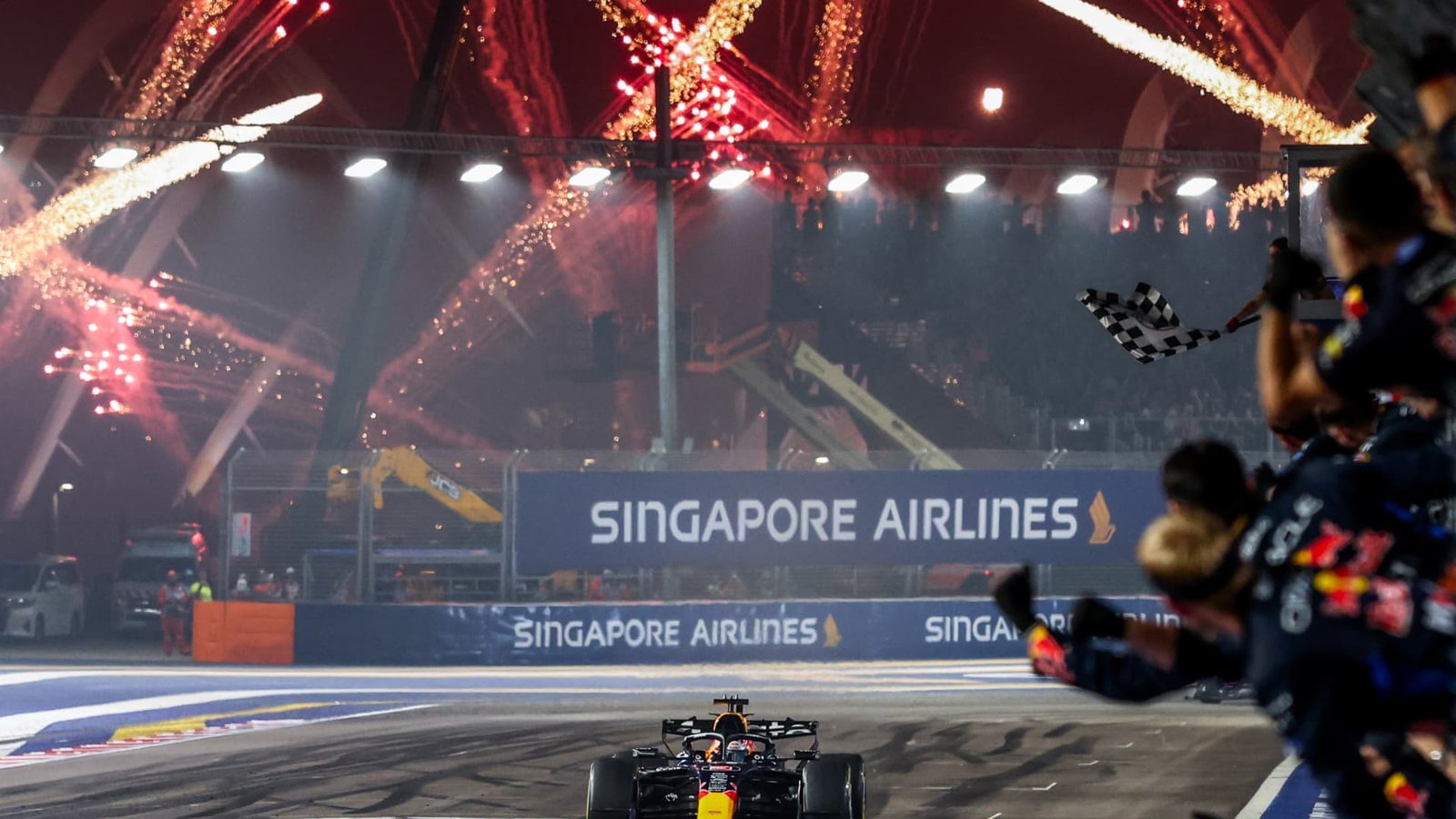
Verstappen won the Singapore Grand Prix on October 11, his first at Marina Bay and the 73rd of his career, in a season where the margins at the front have been small. Whether the agent on the pit wall helped is not something the team can prove. That is true of most tools in racing, and it does not stop anyone from buying the next one.



