
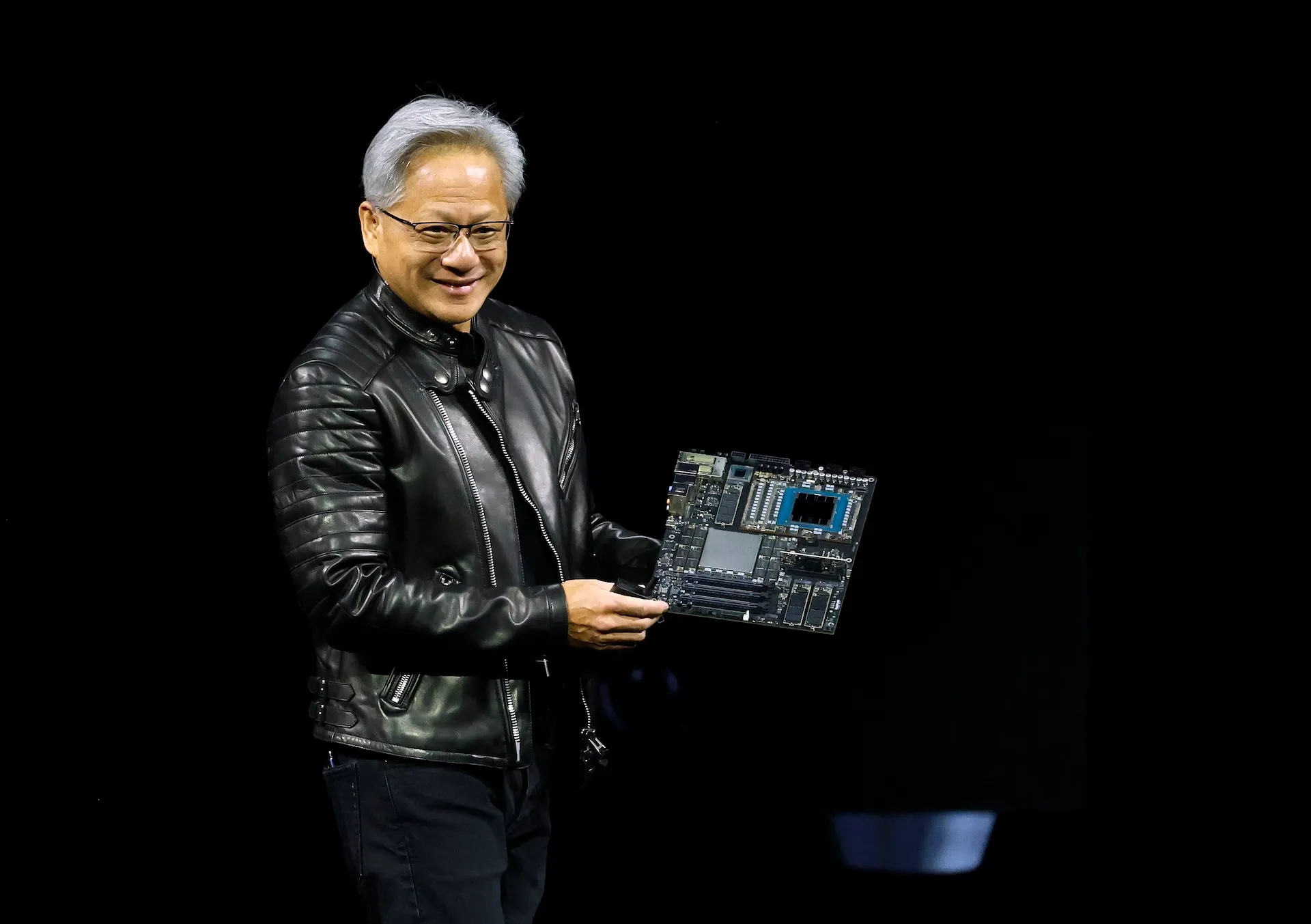
The price tag on the first Nvidia RTX Spark laptop is $2,599, and it buys a machine the company wants developers to run frontier models on instead of in a data center.
Six manufacturers are selling the machines at retail from October 16, including Asus, Dell, Hewlett Packard Enterprise’s consumer line, Lenovo, Microsoft and MSI. Under the lid is a combination of a Blackwell RTX graphics processor and a Grace central processor, with as much as 128 gigabytes of unified memory and one petaflop of FP4 arithmetic. The pitch is local execution of large models and the agents built on them.
The company released three open Nemotron models the same day, two of them aimed at agents running on local hardware. Volvo Cars said its future vehicles will build autonomous driving features on Nvidia’s Hyperion sensor and computing architecture. Adobe connected RTX Spark to Photoshop, Premiere, Substance 3D and Frame.io.
Taken together the announcements describe a strategy rather than a product cycle. Nvidia sells the chips in data centers, where the demand for AI computing has exceeded supply for three years, and it sells the chips in workstations and laptops, where the demand has been thinner. The second market grows if developers decide that some work belongs on the desk rather than in a rented cluster.
The economics of that decision depend on the models. Inferring on a local machine has no marginal cost per token and no data leaving the device, but it requires a model small enough to fit in memory and good enough to be useful. Open weights released by Nvidia give the hardware a purpose, and hardware sales give the models a distribution channel.
Memory is the constraint that defines this class of machine. Running a large model locally requires the weights to be resident, and unified memory is expensive. The 128 gigabyte configuration determines which models qualify, which is why Nvidia describes the laptops in memory terms as much as in compute terms.
Developers have been the target of every local AI push for two years, mostly without the sales following. The reasons are practical: cloud inference is cheap at low volume, the tools are already there, and a laptop that runs a model at a fraction of the speed of a server is a hard purchase to justify. What has changed is the size of the models that can be served locally and the emergence of agent software that makes repeated, low-value calls where latency matters more than quality.
Volvo’s decision matters more than the laptop line for the company’s revenue. Automotive design wins are multiyear commitments that place Nvidia silicon in every vehicle of a model line, and they come with software, training and validation work that keeps engineers involved long after the hardware is designed. The demand is less elastic than consumer hardware, because a car program cannot switch suppliers once production starts.
Adobe’s integration is the software half of the same argument. Creative applications have added AI features that call remote models, and running some of them on the machine changes the latency, the cost and the privacy terms. Adobe has been criticized for the data practices attached to its AI features, and local processing answers part of that criticism without changing the product.
The competitive question is whether Nvidia can hold the local segment as firmly as it holds the data center one. Intel and AMD both sell processors with AI acceleration, Qualcomm has built a business on laptop chips with neural processors, and Apple’s unified memory architecture already does much of what RTX Spark promises, on a smaller memory budget and with a more mature software stack.
The pricing reflects the uncertainty. $2,599 is a professional tool price, not a consumer one, and Nvidia’s own partner network of game and creative hardware sits below it. The company is asking developers to pay a workstation premium for a laptop, and to accept the battery life and weight that come with a desktop-class graphics processor.
Analysts said the open models may be the more consequential release. Weights that anyone can download and run build a community around the hardware, and they let enterprises test agent software without sending data to a vendor. Nvidia has used open releases before to create demand for the silicon underneath, and the two agent-oriented models suggest the company expects the desktop to host software that acts rather than chats.
The six launch partners also reflect how the personal computer business has consolidated around a small number of companies that can absorb the engineering work attached to a new platform. Each of them must qualify the thermal design, the driver stack and the power delivery before shipping, and each is making a bet that buyers exist for a machine that costs more than most workstations sold last year.
What the company did not disclose is how many units it expects to sell, what margins the partners are taking, or how the local models compare with hosted alternatives on tasks a developer would actually pay to automate. Those answers will come from reviews and from the sales figures the manufacturers report in the next two quarters.



