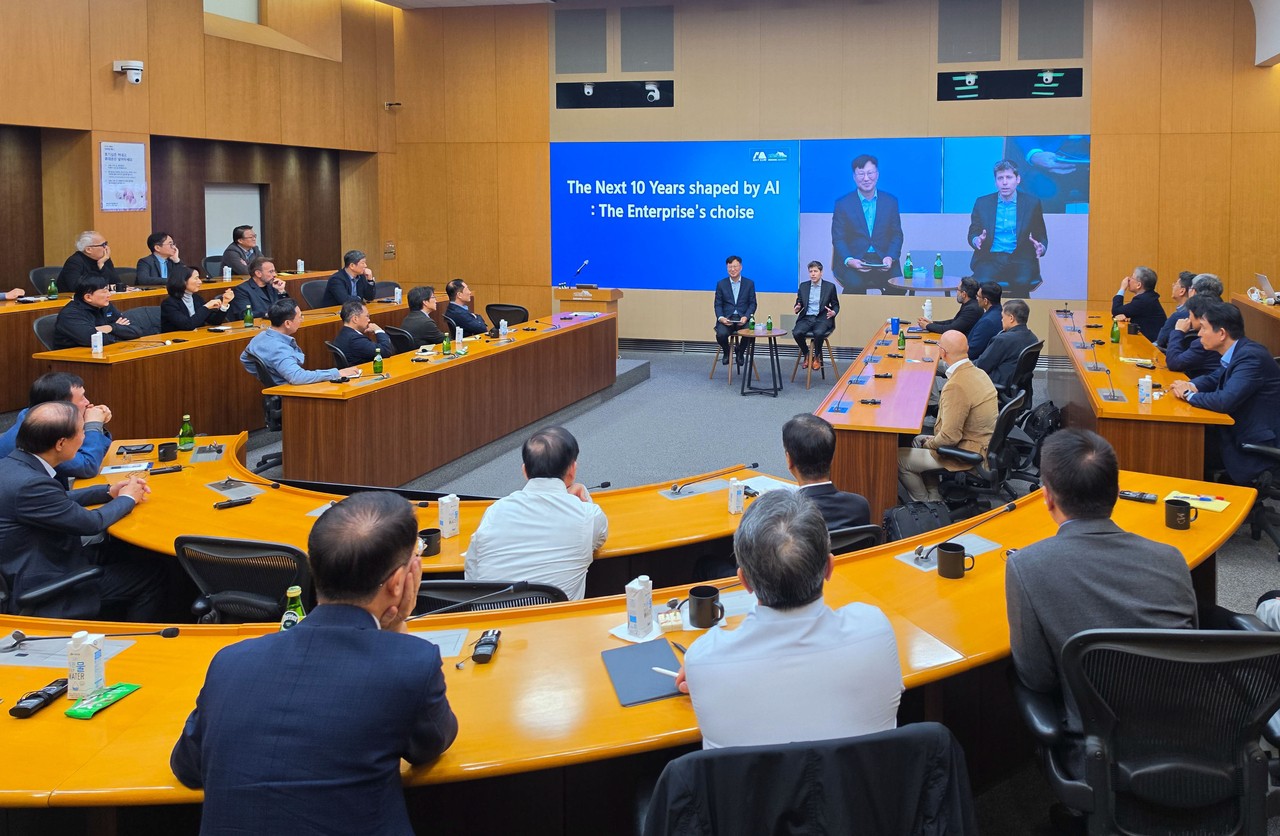
The invitation described an afternoon about how artificial intelligence will reshape industry over the next decade. The room it was held in on Oct. 31 held about 50 executives from Samsung’s electronics, financial and biotech affiliates, gathered at the group’s human-resources development center in Yongin, south of Seoul.
Sam Altman, OpenAI’s chief executive, was the guest. The subject that mattered to both sides was memory.
Samsung disclosed the agenda and the size of the audience. It did not disclose terms, volumes or prices, and OpenAI did not either. The silence is informative in its way. When a model developer and the world’s largest memory maker spend an afternoon together, the useful part of the conversation is rarely the part that gets published.
The backdrop is a market in which memory has become the binding constraint on AI capacity. High-bandwidth memory sits beside every accelerator in a training cluster, and its supply is concentrated among three companies: Samsung, SK Hynix and Micron. Industry estimates put memory at roughly a third of data-center spending, and the largest buyers have raised capital budgets repeatedly this year. The shortage is being transmitted through price rather than through allocation, which is the arrangement suppliers prefer and buyers tolerate only while they must.
OpenAI has spent two years converting announcements into supply agreements. Stargate, the data-center program it announced with SoftBank, Oracle and MGX, set out to build capacity at a scale that requires memory commitments years ahead of delivery. The company’s dealings with Korea go back to the program’s early months, when it struck agreements with Samsung’s data-services arm and with SK Hynix covering memory for the buildout. A visit to the campus where Samsung trains its managers is a normal place for that conversation to continue.
For Samsung the meeting carries a different set of interests. It is the largest memory producer by revenue, and it is also a foundry that has struggled to win AI accelerator customers against Taiwan’s TSMC. Its high-bandwidth memory took longer than rivals’ to qualify with the largest accelerator buyers, a gap it has been working to close. Tying memory supply to the developers who will consume it is one way to make the foundry argument more persuasive: a customer buying HBM at volume has a reason to look at the logic process next door.
Yongin is where that argument becomes physical. The district is the center of Samsung’s planned semiconductor cluster, the ground on which its next generation of memory and logic capacity is meant to be built. Walking a customer through the site is a way of showing him the roadmap rather than describing it.
There are limits to what a visit can settle. Memory contracts are negotiated on price and volume, and neither company has an interest in disclosing either while prices are rising. Samsung’s affiliates include insurance and biotech businesses with little connection to a data center; their presence suggests the agenda was broader than procurement, or that the group wanted its senior managers to hear the case directly from the person making it.
The competitive context extends beyond Korea. OpenAI needs memory from several suppliers, and spreading commitments across them is a way of avoiding dependence on any single one. A stop at Samsung is a data point in that strategy rather than its conclusion. The same logic applies to the Korean side: Samsung and SK Hynix together supply most of the world’s DRAM, and both have reasons to keep a large model developer close without becoming captive to it.
What the meeting does confirm is where the bargaining power has moved. Two years ago the scarce inputs in AI were capital and the chips designed for training. Now the constraint runs through a commodity manufactured in a handful of plants, priced on quarterly contracts and sold out for the periods that matter. The companies that own that capacity have discovered they can choose their customers, and the customers have discovered that being large is not the same as being first in line.
For OpenAI the calculation is straightforward. Every model it trains and every query it serves consumes memory, and the price of that memory is set by a market it does not control. The company’s answers so far have been vertical integration where it can manage it and long-term contracts where it cannot. Neither removes the shortage; both buy position within it.
For Samsung the calculation is about converting a shortage into a relationship that outlasts it. Memory prices have risen for four quarters, and the industry’s history says they will fall again. A contract signed at the top of a cycle is worth less than a customer relationship that survives the bottom, which is the argument a memory maker makes when it is trying to sell more than wafers.
Neither company said what was agreed. The public record will show an afternoon in Yongin, 50 executives, and an agenda about the next decade. The balance sheets will show what the afternoon was actually about, in the contract prices reported over the next two quarters and in how much of OpenAI’s buildout is sourced from Korea. Until those numbers appear, the only confirmed fact is that the most important customer in AI spent a day at a memory plant, and that neither side thought the visit was worth describing in detail.