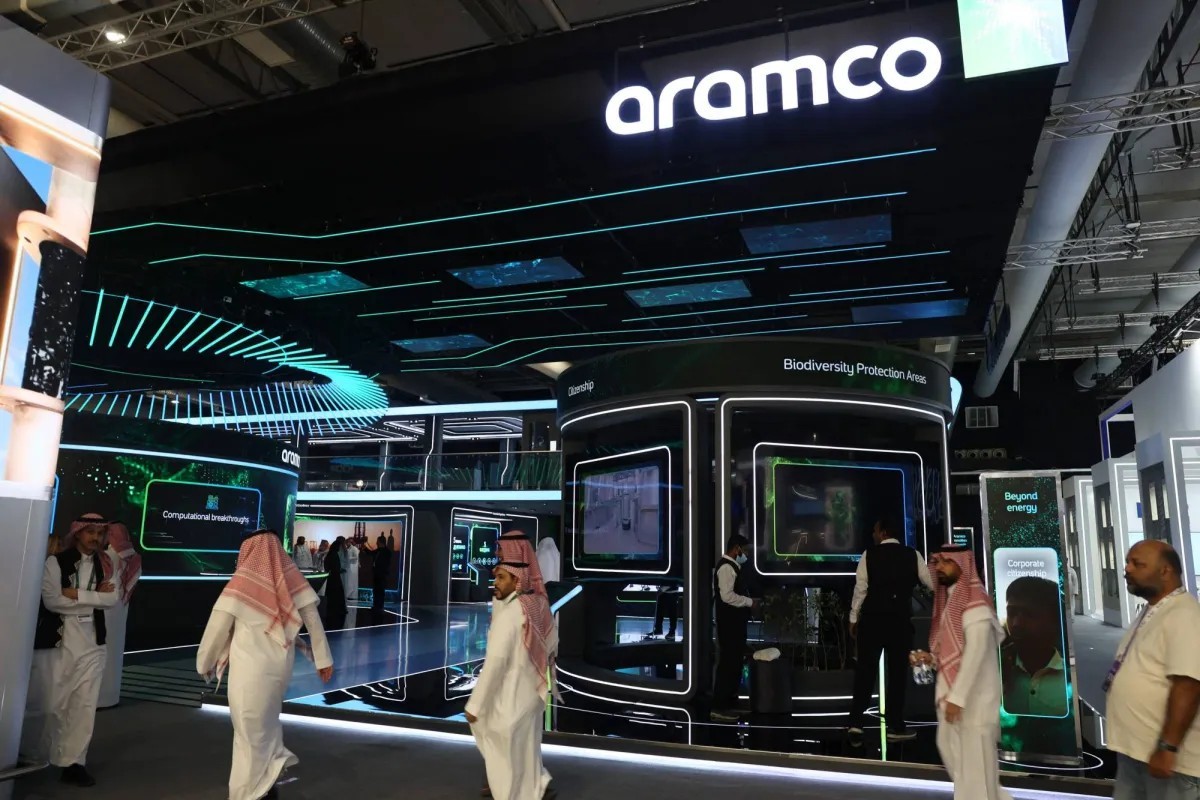
Aramco has spent its existence selling a commodity priced by the barrel. On November 1 it closed a purchase priced by the stake: 49% of HUMAIN, the artificial intelligence company owned by Saudi Arabia’s Public Investment Fund, for $2.6 billion. The fund keeps 51%.
The implied valuation is about $5.3 billion for the whole company. Aramco and the fund did not publish HUMAIN’s revenue, its losses, its contracted capacity or its customer list, and the announcement does not say whether the $2.6 billion is new capital for the company or a payment to its majority owner. Those are the first questions any outside shareholder would ask, and the transaction was not structured to answer them.
HUMAIN was created by the fund in 2025 as the state’s instrument for artificial intelligence: data centres, computing capacity and models, with the crown prince as chairman. Its mandate runs from land and power to Arabic-language models, which makes it less a startup than a national champion with a sovereign balance sheet behind it. The company’s task is to build the physical layer of the kingdom’s diversification plan, and that plan is not a commercial one in the ordinary sense.
That is why the buyer matters more than the price. Aramco brings three things a computing company cannot buy quickly: gas, land and engineering. The kingdom sits on some of the cheapest energy in the world, and a data centre’s largest operating cost after depreciation is electricity. Aramco also brings demand. Reservoir simulation, seismic processing and refinery optimisation are among the most compute-hungry problems in private industry, and the company has been renting capacity abroad to solve them.
The structure deserves attention. The fund owns about 16% of Aramco, and the Saudi state owns most of the rest. A transaction in which one arm of the state sells a minority stake in a national champion to another arm of the same state is not a market test of what the asset is worth. It is a decision about which balance sheet carries it, and about which set of creditors and shareholders absorb the loss if the buildout disappoints.
There is a comparable, and it is instructive. Microsoft paid $1.5 billion for a stake in G42, the Abu Dhabi artificial intelligence group, in 2024, in a deal that came with governance terms, an American security arrangement and a change in the target’s Chinese supplier relationships. Gulf computing has been built on American chips under American licences, and the terms of those licences have loosened over the past two years as Washington has come to treat the Gulf as a counterweight rather than a risk. Aramco’s purchase involves no foreign partner, no technology transfer and no disclosure beyond the equity split.
What 49% buys is the interesting part. It is not control. It is a board presence, a set of minority protections that have not been published, and a commercial relationship that will set HUMAIN’s cost base and Aramco’s revenue line at the same time. Power, land, cooling water and offtake will all be related-party contracts between two companies with the same ultimate owner. Every price in those contracts moves money from one pocket to another, and each will eventually have to be disclosed and defended to lenders who price Aramco’s bonds off its consolidated cash flow.
For Aramco’s own shareholders the amount is modest. Capital spending runs in the tens of billions a year, and $2.6 billion is a rounding item against a dividend that is the company’s central promise to the government that owns it. The stake is better read as a strategic option than as an investment. It gives the oil company a seat in the room where the kingdom decides how its electricity, its land and its capital are converted into computing.
The risks are not subtle. Advanced accelerators move under export controls that can tighten as easily as they loosened, and the political basis for the current leniency is a relationship rather than a treaty. Gas sold to domestic industry at administered prices is a subsidy under another name, and its opportunity cost is measured in exports forgone. Water for cooling in a desert is a constraint that engineering can soften but not remove. Demand outside the kingdom is the open question: Arabic-language models serve a large population, but the customers who pay enterprise rates for computing are concentrated in markets where American and Chinese providers already hold contracts.
The strategic logic still holds, and Aramco is not alone in pursuing it. Oil rent is a flow that ends, and every Gulf state is trying to convert part of it into assets that do not need a barrel to produce. Buying 49% of the domestic artificial intelligence champion does that without sending the money abroad. It keeps the capital inside the sovereign perimeter while creating an industry that did not exist five years ago, and it gives the fund a second buyer for the asset if it ever needs one.
Whether that produces a business or a cost centre depends on a question the equity split cannot answer. A national champion with a guaranteed domestic customer can reach scale quickly. It becomes a company rather than a project only when someone outside the kingdom chooses to buy its capacity at a price that covers the capital, instead of choosing it because a ministry directed the contract.
The ownership now reads 51% for the Public Investment Fund and 49% for Aramco, at a price of $2.6 billion, closed on November 1. HUMAIN’s accounts, its contracted capacity and the terms of its contracts with its two shareholders remain undisclosed.