The headline figure in the National Assembly on Monday was 820.9 trillion won, the largest budget South Korea has ever proposed. The number that will decide whether the plan works sits inside it: 21.3 trillion won, about $16 billion, for artificial intelligence and the three industries President Lee Jae-myung has chosen to build around it.
Lee put the money where the country’s export machine already is. Semiconductors, physical AI and AI data centres will divide the 21.3 trillion won between them, nearly twice this year’s allocation. A further 4.7 trillion won is earmarked for frontier AI, including a domestic model his government describes as the highest-performance sovereign system in the world. Five hundred billion won goes to physical AI trials in manufacturing and defence, 2.1 trillion won to the power, water and industrial infrastructure those projects will draw on, and the government wants 2,000 new specialists trained in chip design.
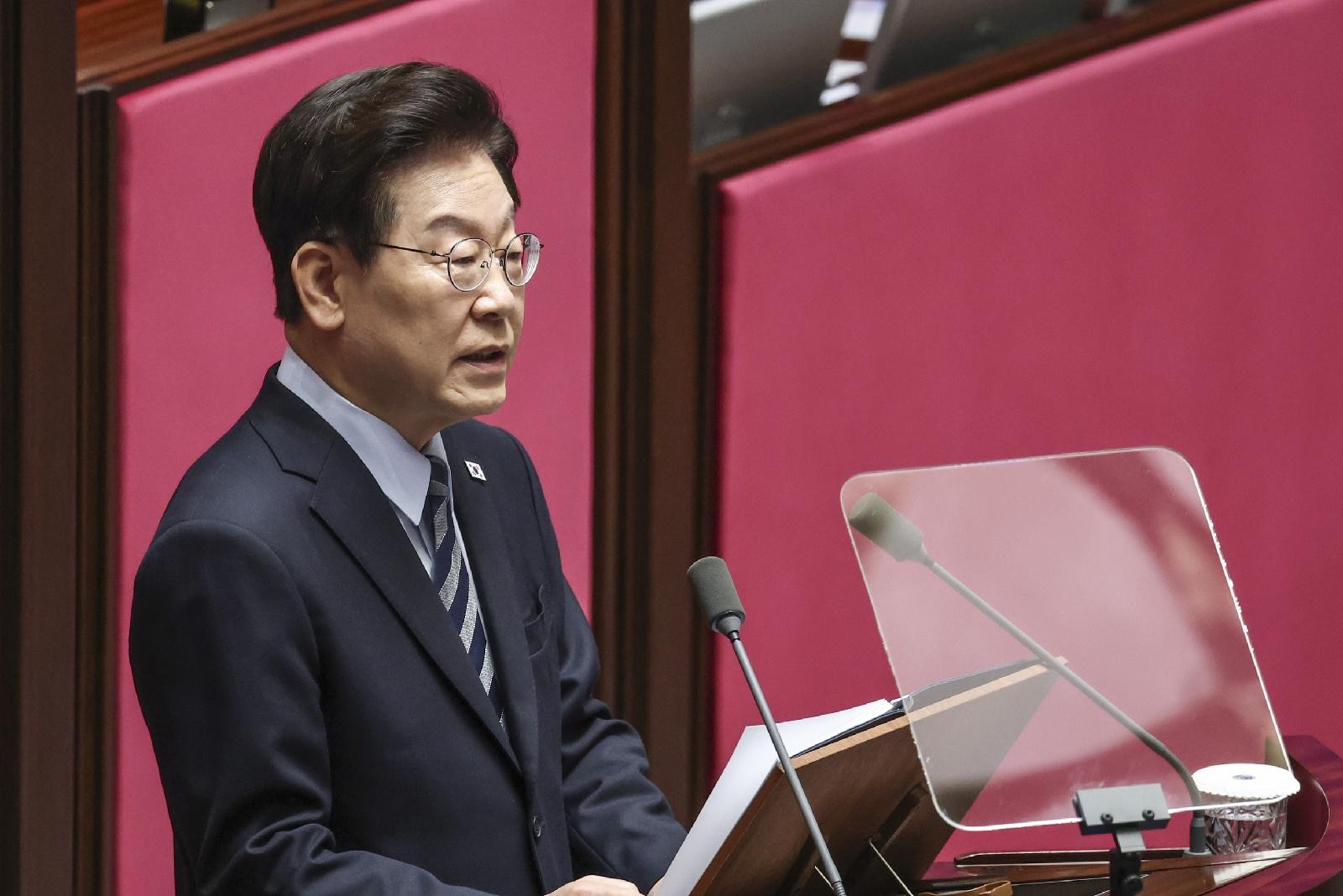
“We will invest 21.3 trillion won, nearly twice this year’s amount, in AI and the three megaprojects of semiconductors, physical AI and AI data centres,” Lee told lawmakers, according to the text of the speech released by his office.
Total spending rises 12.8 per cent from this year, the fastest annual increase in the country’s budget history. The politics of that number are easier to explain than the economics. Lee framed the plan as “growth for all” rather than growth for the few, and paired the technology money with an 8.2 per cent rise in defence spending, to 73.3 trillion won, including funding for nuclear-powered submarines.
The fiscal room comes from memory. South Korea’s economy expanded 3.7 per cent from a year earlier in the second quarter, a pace the Korea Development Institute attributes largely to AI-related semiconductor exports, and the corporate tax that follows. Samsung Electronics reported record quarterly revenue of 195.3 trillion won and operating profit of 107 trillion won for the three months to September; its chip division produced more than 99 per cent of that profit. A budget that redistributes the proceeds of a memory cycle is a different instrument from one that bets on the next cycle arriving on schedule.
That distinction matters most in the two categories with no revenue of their own. Physical AI, the government’s term for robots, autonomous machines and software that acts on the physical world, has an obvious domestic constituency: Korea builds cars, ships, displays and batteries in factories that are already among the most automated on earth, and a government that can point to a domestic testbed has an easier argument for subsidising the next generation of them. The 500 billion won set aside for trials in manufacturing and defence is small against the private capital involved, which is the point. It is meant to buy reference customers rather than capacity.
The sovereign model is the harder sell. Korea’s AI industry is strong in memory, packaging and consumer services and weak at the frontier, and its developers have spent the past two years building on models licensed from American labs. The 4.7 trillion won is intended to change that, and Lee’s phrasing, the highest-performance sovereign model, sets a test that can be checked. Whether the money produces a model that anyone outside Korea wants to use is a separate question from whether the country can train one.
The binding constraint is not money but electricity. Data centres in Korea compete for grid connections with semiconductor fabs that are themselves being expanded, and the 2.1 trillion won for power, water and industrial infrastructure reads as an acknowledgement that the compute budget is worthless without the utility budget. Industrial electricity tariffs have risen for several years running, and the cost of power is now a factor in where hyperscalers place capacity in Northeast Asia.
The 2,000 specialists are the smallest line in the plan and the one most likely to bind. Korea has built a memory industry of unmatched depth and a design industry of modest size, and the gap has been a stated policy problem for more than a decade: the country produces engineers who can run a fab at world-leading yield and too few who can specify a chip worth running. Samsung and SK Hynix have funded university programmes for years to narrow it. A budget line for two thousand more does not settle the argument about whether the shortage can be trained away.
What happens next runs through the floor of the Assembly, where the bill faces a statutory deadline of December 2. The three megaprojects will be examined line by line, and the opposition has already signalled that it wants the fiscal deficit held. Analysts said the more revealing test will be the first supplementary request, if there is one: a government that has committed to doubling a programme in one year either executes it or comes back for more.
Set against private spending, 21.3 trillion won is modest. Samsung and SK Hynix are building fabs and memory lines whose combined cost dwarfs it, and the chip cluster south of Seoul has been valued in the hundreds of trillions of won. The state’s contribution is best understood as the part of the stack that private capital will not fund: testbeds, power, water, and the model that no shareholder would underwrite.
Lee’s speech was long on national capability and short on dates, which is normal for a budget address. The date that matters is in December, and the figure that matters is the one that survives it.