
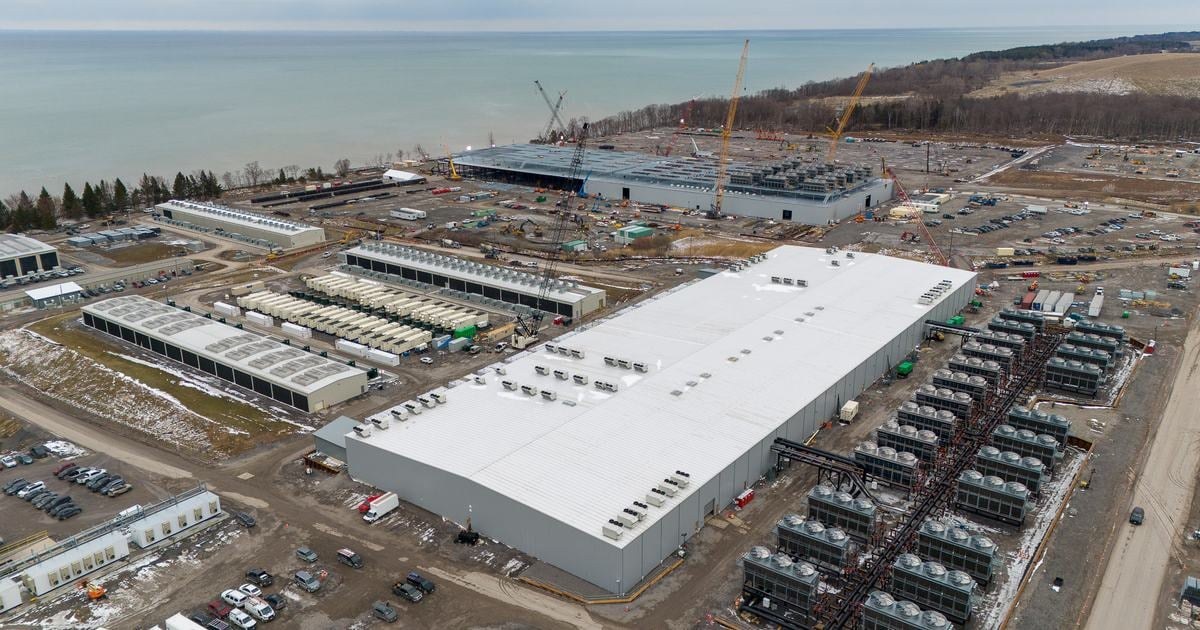
Three buildings, about 401 megawatts of computing load, a 20-year lease and roughly $19 billion of contracted value. Those were the numbers attached on Nov. 4 to a data center campus in Hawesville, Kentucky, where TeraWulf is building for Anthropic. The story underneath the numbers was a set of three credit support agreements signed by Google, which will stand behind part of Anthropic’s lease and performance obligations.
The stated purpose is financing. A guarantee from a company with Alphabet’s balance sheet lowers the cost of the debt that pays for the buildings and lets construction move faster than a lender would otherwise allow. TeraWulf, the operator, disclosed the agreements alongside a fixed-price engineering and construction contract with Fluor, which puts the construction cost risk on the contractor rather than on the developer.
Read the structure and you can see why the guarantee was worth more than any single term sheet. Alphabet’s credit ratings are AA+ from S&P and Aa2 from Moody’s, among the highest assigned to a public company. Lenders who finance a data center price their risk off the weaker party in the chain: the tenant, the developer, or the structure itself. When the parent of Google agrees to stand behind a portion of the tenant’s obligations, the weaker party stops being weak for the part that is covered.
The scale is easier to see in units. At $19 billion over 20 years, the contract works out to roughly $950 million a year, though the payments are unlikely to be flat across the term, since power costs and escalators move. Spread across 401 megawatts of information technology load, the contract is worth about $47 million per megawatt of capacity, a figure that includes the buildings that house the equipment rather than the equipment itself.
Anthropic is the tenant, and that is the part of the arrangement that carries the most information. A company that leases capacity on a 20-year term is making a commitment that outlasts most of its planning horizon, and the guarantee tells you who the landlord’s lenders thought should carry it. The tenant gets capacity without having to post its own credit. The guarantor gets a claim on a site it may want for its own models later.
For TeraWulf, the agreements cut both ways in the market’s first reading. Shares of the company fell 4% on the day the news was announced, a reaction that is worth pausing on because the deal is, on its face, good news for a developer. One reading is that investors had already priced the contract and sold the announcement. Another is that a guarantee from a counterparty with better credit is a guarantee that some of the project’s upside now belongs to someone else.
The economics of build-to-suit data centers explain the rest. A developer rarely has the balance sheet to finance a 401-megawatt campus alone, and a hyperscaler rarely wants to own the shell. The tenant signs a long lease, the developer borrows against the lease, and the lender’s willingness to lend depends on whose name is on the other side. Every structure in this market is an attempt to move credit risk to the party that can carry it most cheaply.
A guarantee is not free for the guarantor, even when no cash moves. It is a contingent obligation, disclosed in the notes to the financial statements, and it consumes a form of capacity that rating agencies watch. Companies with the strongest ratings are careful about how much of that capacity they commit, because the value of the rating is precisely that it is scarce. Three agreements on one campus in Kentucky are small against Alphabet’s balance sheet, but the pattern is what agencies count.
The pattern is the reason this deal matters beyond Hawesville. Artificial intelligence companies need computing capacity faster than their own credit can support, and the companies that sell them cloud services need that capacity to be built by someone. A guarantee bridges the two. If it works, it becomes the standard document in a stack of standard documents, and the ability to obtain one becomes a competitive advantage held by a handful of tenants.
There is a question of disclosure that follows the structure around. A lease obligation that sits with a tenant and a guarantee that sits with the tenant’s backer are not the same liability, and they do not appear in the same place in a set of accounts. Investors comparing two artificial intelligence companies will have to read the notes to see which of them has promised what, on whose behalf, for how many years.
For the county in western Kentucky, the relevant facts arrive more slowly: a site plan, a power interconnection, a construction schedule measured in quarters and a tax base that begins when the first building is energized. A guarantee signed in New York or California does not change the number of trucks on the road, but it does change whether the financing closes on time, which determines when the trucks arrive.
The closing turn is the residual. A 20-year lease with a guarantee behind part of it raises a question that will not be answered for a decade: when the equipment inside those buildings is two generations old and the tenant’s business looks different from the one that signed, who is left holding the obligation, and at what price does the guarantor’s promise get renewed? The documents signed on Nov. 4 cover the beginning. The end of the term is where the risk actually sits.



