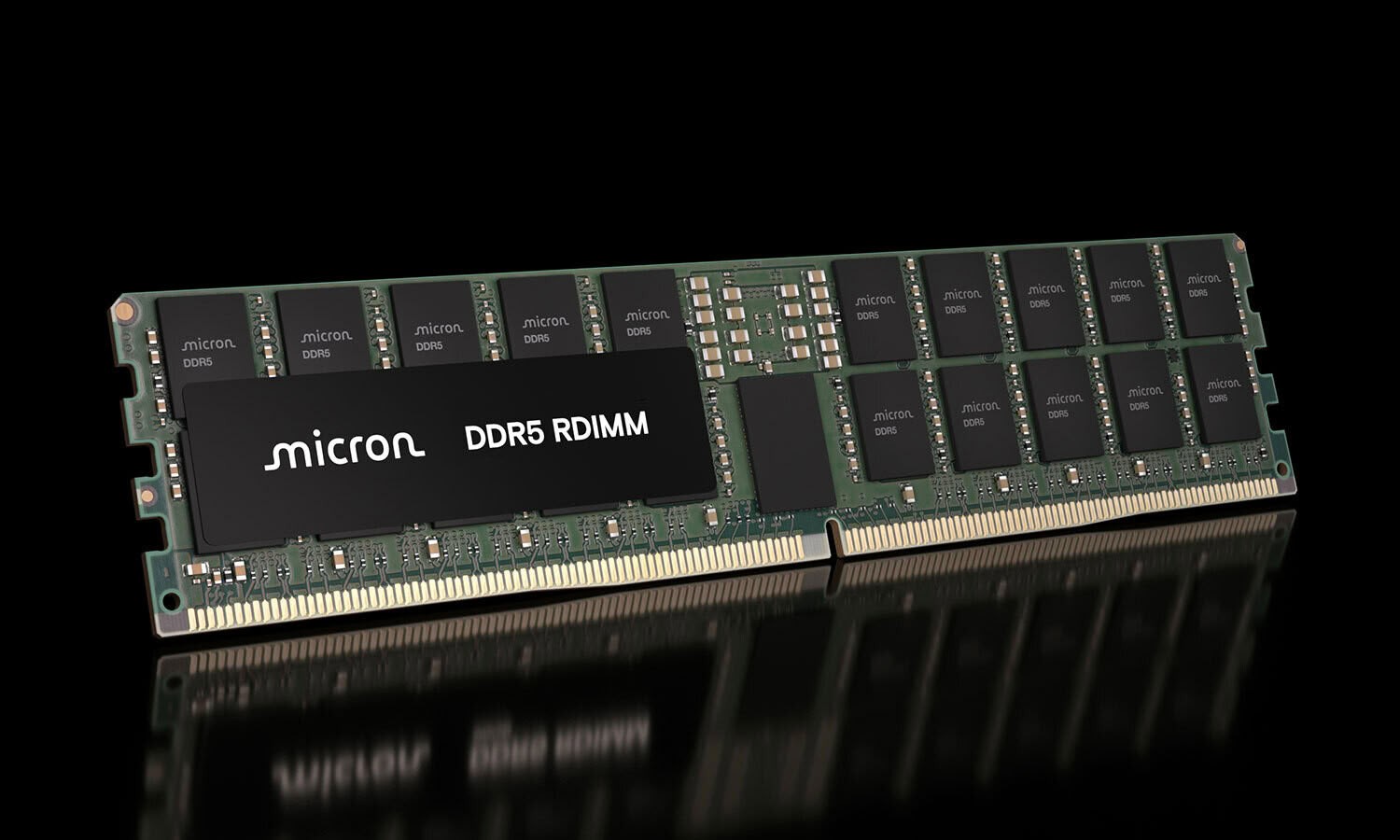
The demonstration Micron ran on Monday did not use a new server. It used machines that already exist: a two-socket system with 24 memory slots, filled with the company’s new 512-gigabyte DDR5 modules and populated to a total of 12 terabytes of main memory inside one chassis. Micron said the modules were shown running on several server platforms, with AMD and Intel both validating them.
The module is the unit that matters. A DDR5 RDIMM is the stick that slides into a slot, and its capacity has been governed for years by how many DRAM dies could be placed side by side on a board of fixed size. Micron stacked the dies instead, using through-silicon vias, the vertical connections that let layers talk to each other without wire bonds running around an edge. Density stops being a question of floor space and becomes a question of height.
Stacking itself is not new. It is how high-bandwidth memory works, the product that sits beside a GPU and is sold by allocation at a price per bit far above commodity DRAM. Micron’s claim is narrower and in some ways harder. The vertical idea can raise the capacity of the ordinary socketed memory that every server takes, and it can do so without changing the board, the socket, or the way the machine is provisioned.
Engineers who work on advanced packaging describe the difficulty as yield rather than concept. A stack is only as good as its worst layer, and every additional die adds a chance that the finished module fails a test after most of its cost has been incurred. That arithmetic is why stacked memory has stayed in the expensive tier, next to the processor, where a high price per bit can be justified.
Speed is the part worth checking. Micron says the modules run at up to 9,200 MT/s, near the top of the DDR5 range. Stacked parts have historically paid for their density somewhere, usually in frequency, power, or price, and a module that holds several times the usual capacity while keeping its data rate would remove one of those trades.
Validation is the gate. A module a memory maker demonstrates is not a module a server vendor can ship, and the qualification work AMD and Intel are doing is the step that turns an announcement into a bill of materials. Until a system builder publishes a configuration that includes the part, the number on the slide is a ceiling rather than a product.
The workloads Micron is aiming at share a common shape. Inference, in-memory databases, graph queries and recommendation systems all consume memory in proportion to the data they hold rather than in proportion to the arithmetic they perform. For those jobs the expensive move is not a matrix multiply. It is fetching state from flash, or from another server, at a moment when the model needs it.
That is why the slot budget matters more than the chip count. A board has a fixed number of slots and a fixed amount of power and cooling to spend on them. Doubling capacity per slot doubles what a single machine can hold before anyone touches the network, and a 12-terabyte box that replaces four smaller ones changes a capital budget in ways a faster processor does not.
The skepticism is straightforward and mostly about physics. A 512-gigabyte module draws more current than a 128-gigabyte one, and a fully populated 12-terabyte system has a power and thermal profile that the chassis was not designed around. Memory makers have announced density records before that arrived in volume a year or two later, at a premium, and only after yields improved. Analysts who follow the memory cycle said the useful disclosure would be a shipment date and a price.
Price is the number Micron left out. The comparison a buyer will run is not between one module and another but between one server and several: the cost of the stacked memory against the cost of additional racks, switches, floor space and the electricity that all of it consumes. If the module premium is smaller than the cost of the machines it replaces, the arithmetic closes quickly.
Supply is the other half of the picture. Wafer capacity at the three large memory makers has been shifting toward high-bandwidth memory, which earns more per wafer and is contracted years ahead by accelerator vendors. That leaves less room for the commodity DDR5 that fills the slots, and it is a reason a capacity announcement lands as a supply question as much as a technical one.
What to watch is unglamorous. Qualification lists, design wins at the large server builders, and the first published configurations that carry the part at volume. A density figure that appears only in a demonstration, and never in a price list, tells you what the process can do rather than what the market will pay for it.
The interesting number in Micron’s announcement is not 12 terabytes. It is the premium a customer will accept for each slot it no longer has to buy, and that figure will be set by the price of everything else in the rack.