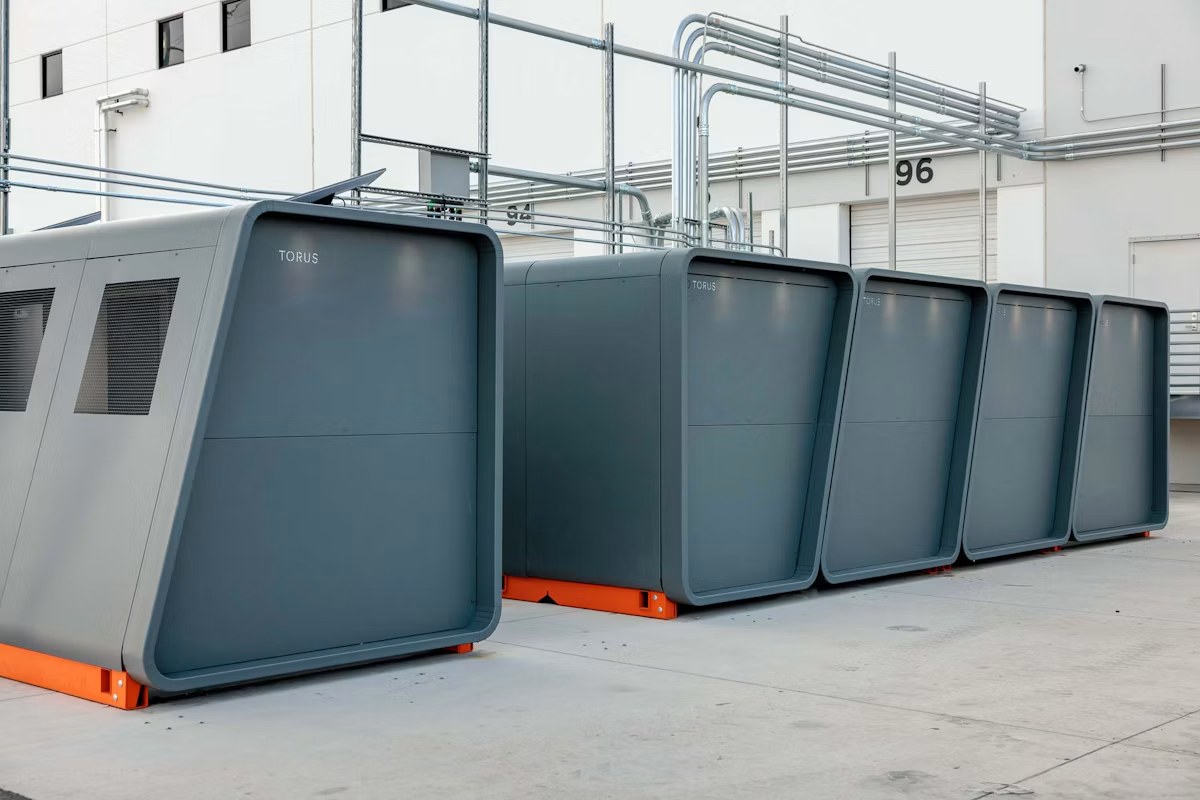
SALT LAKE CITY — The pitch Torus has been making to investors fits inside a shipping container: batteries on one side, servers on the other, wired together before either leaves the factory.
The company said it had raised $500 million in a Series C round led by Magnetar, with Iconiq, Origin and Trinity among the participants. The money goes toward volume production of a product Torus calls Foundry, which puts battery storage and AI computing in the same container. Hydra Host, a builder of infrastructure for AI workloads, is named as a customer.
The case for building it that way begins with a shift in what limits AI construction. The scarce item a year ago was the accelerator. The harder problems now sit around it: a grid connection with enough capacity, a cooling system that can carry away the heat of a dense rack, and a site that can be permitted and wired before the model it serves is out of date. Each is a separate trade, with its own supplier, its own queue and its own delay.
Torus proposes to collapse them into one purchase order. Rather than buy batteries from one vendor, containers from another and integration from a third, a customer buys the assembled unit and sets it down on a concrete pad. The battery does two jobs in that arrangement. It smooths the load the site draws from the grid, and it carries the computing through the interruptions that utilities impose on large new connections while transmission is upgraded.
The second job is the commercial core of the offer. A data centre that can run at full load for only part of the day earns less from the same silicon, and the silicon is the most expensive thing on the site. Pairing it with storage lets the operator take cheap power when it is available, hold it, and release it against the load curve. It also gives the utility a reason to say yes, because a site that behaves like a smaller customer is easier to connect than one that behaves like a new town.
Packaging the two together changes who carries the risk. In a conventional build the developer carries it: he signs a long lease, commits to a power contract and hopes the interconnection date holds. In the Torus version the vendor carries more of it, because the product is a unit that can be shipped elsewhere and sold to another buyer if the first site stalls. That is a familiar trade in industrial equipment, and it is why the company frames its product as a standard rather than a project.
Containerised capacity has become the industry’s answer to speed. Modules built in a factory can be tested before they leave, financed as equipment rather than as construction, and moved. The approach has limits. A container is a small unit, and a customer with hundreds of megawatts of demand will still build conventionally. But much of the market is not hundreds of megawatts. It is the operator who needs twenty or fifty, quickly, and who cannot wait years for a substation.
The investor list says something about where the money believes the bottleneck sits. A lead cheque from Magnetar alongside Iconiq, Origin and Trinity is a syndicate assembled in the size and shape that manufacturing demands. Batteries, enclosures, thermal systems and power electronics are capital-intensive goods bought in volume and installed, not licensed per user. Half a billion dollars is a factory number, not an app number.
The one disclosed customer points the same way. Hydra Host sits in the layer that rents capacity to companies training and serving models, a business that lives or dies on the utilisation of the hardware it operates. A supplier that delivers power and computing as one item removes a variable from that business, and it removes a schedule risk that has sunk more than one expansion plan.
Competition is forming along the same seam. Equipment makers, battery suppliers and the large engineering contractors all see the gap between the grid and the rack, and several have begun selling prefabricated power blocks to data-centre developers. Torus’s distinction is the combination of storage and computing in one box, which is a narrower claim and a harder one to defend, because either half can be bought elsewhere.
What the round does not settle is whether the economics survive contact with utilities. Rules for connecting storage vary by state and by country, and many tariffs written for stand-alone batteries assume the asset exists to serve the grid rather than a single building. A container that both draws and discharges behind the meter can fall between categories, and the paperwork alone can add months.
There is also the question of who services the unit. A battery and a rack of accelerators fail in different ways and on different clocks, and a customer with one warranty covering both will expect one truck and one technician. Building that organisation is slower than building the product, and it is the part of the business that a Series C does not automatically buy.
Torus is betting that the next phase of AI construction is decided by whoever can deliver a working site fastest, not by whoever can assemble the largest cluster. The company now has the money to test that. Whether the market agrees will show up in orders from operators who, until now, have bought power and computing from separate suppliers and accepted the delay that comes with it.
That delay is the product’s reason to exist, and it is also the easiest thing for a competitor to copy. The period in which a container sold as a single unit is unusual will be short.