NASHVILLE, Tenn. — The east bank of the Cumberland River has spent most of the past decade as a planning document: renderings of parks and towers, roadwork that has not finished in years, acres of gravel where the city’s industrial riverfront used to be.
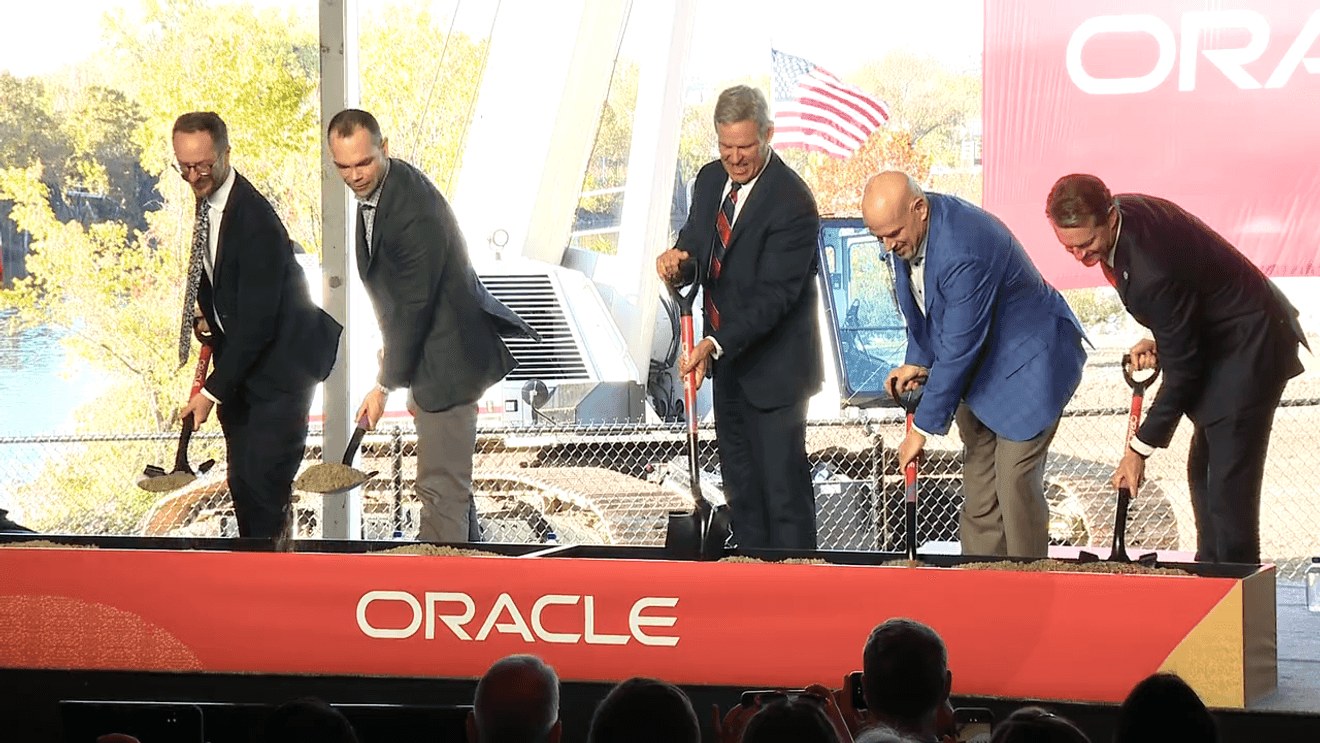
On Nov. 10, Oracle put shovels into the gravel.
The company broke ground on a campus it calls its global headquarters, budgeted at $4.5 billion and carrying a pledge of 8,500 jobs by 2031. The design includes an amphitheater, a hotel and a pedestrian bridge across the river. Local officials approved the arrangement more than five years ago. Construction of the first buildings is only now beginning.
The delay is not a scandal. It is what a project of this size looks like when a company, a city and a river have to agree on where the roads, the storm drains and the flood protection go. Nashville has been rebuilding the east bank’s infrastructure for years, and a corporate campus cannot open before the streets that reach it exist.
What makes the timing conspicuous is everything else Oracle is building.
Over the past three years the company has become one of the largest buyers of graphics processors and data-center capacity in the world, chasing cloud contracts from customers who want to train and run artificial intelligence models. That spending is enormous, and it is paid up front — in servers, in power agreements, in shells that take years to fill.
A headquarters campus is a different kind of money. It produces no compute and no cloud revenue. What it produces is a recruiting story, a relationship with a state government and a piece of real estate that will sit on the balance sheet for decades.
Oracle is carrying both at once. The company has told investors that demand for its cloud infrastructure exceeds what it can supply, and it has funded the build-out partly with debt and leases that will be repaid from revenue that has not arrived yet. Finance costs rise when a company borrows against future contracts. So does the scrutiny.
The jobs figure is the part that will be audited. Commitments of this size are typically tied to incentives and released in phases, as payroll thresholds are crossed and verified. A pledge of 8,500 positions by 2031 is a statement about the labor market as much as about Oracle: whether Nashville can supply that many engineers, accountants and salespeople without bidding wages up so far that the campus costs more to run than a coastal one.
Nashville has been answering that question for other employers for a decade. The city’s technology and health-care payrolls have grown fast enough that office rents in the urban core rose through the last cycle, and apartment construction has followed the crane permits. Traffic has not kept pace with either. Neither has transit, which remains a political argument rather than a system.
The east bank plan was sold as a public benefit as well as a private one, with parks and river access paid for by the development around them. Oracle’s campus is the largest private piece of that plan, which means the company inherits part of the argument. Residents have pressed the city over housing costs and over what a new district does to the neighborhoods behind it.
None of that is unusual for a corporate relocation. What is unusual is the moment.
The artificial intelligence trade has moved from enthusiasm to arithmetic. Investors now ask what a data center costs to build, what it earns per quarter and how long the depreciation schedule runs. Companies that spent 2024 and 2025 signing leases are being asked in 2026 to show the revenue those leases produce. Oracle’s answer has been a growing contracted backlog, which is a promise, and rising capital spending, which is a bill.
Against that backdrop, a $4.5 billion headquarters is a bet on permanence. It says the company expects to need the people, the sales force and the political capital that a campus in a state capital provides. It also says the company expects to be able to afford them.
There is a version of this story in which the campus fills on schedule. Nashville’s universities keep producing graduates, the cost of living stays below the coasts, and Oracle ends up with a second center of gravity that makes it less dependent on a single talent pool in California. The amphitheater becomes a venue the city actually uses, and the pedestrian bridge becomes the way people get to work.
There is another version. The buildings open in phases; hiring slips behind the incentive schedule; the company concentrates its engineers in fewer, denser sites because that is what the cloud business rewards; and the campus becomes a very expensive sales office with good acoustics.
The difference will show up in payroll filings, which are public, and in how much of the campus Oracle occupies versus leases out. Until then, the most concrete fact in Nashville is a stretch of riverfront that has stopped being a rendering.