
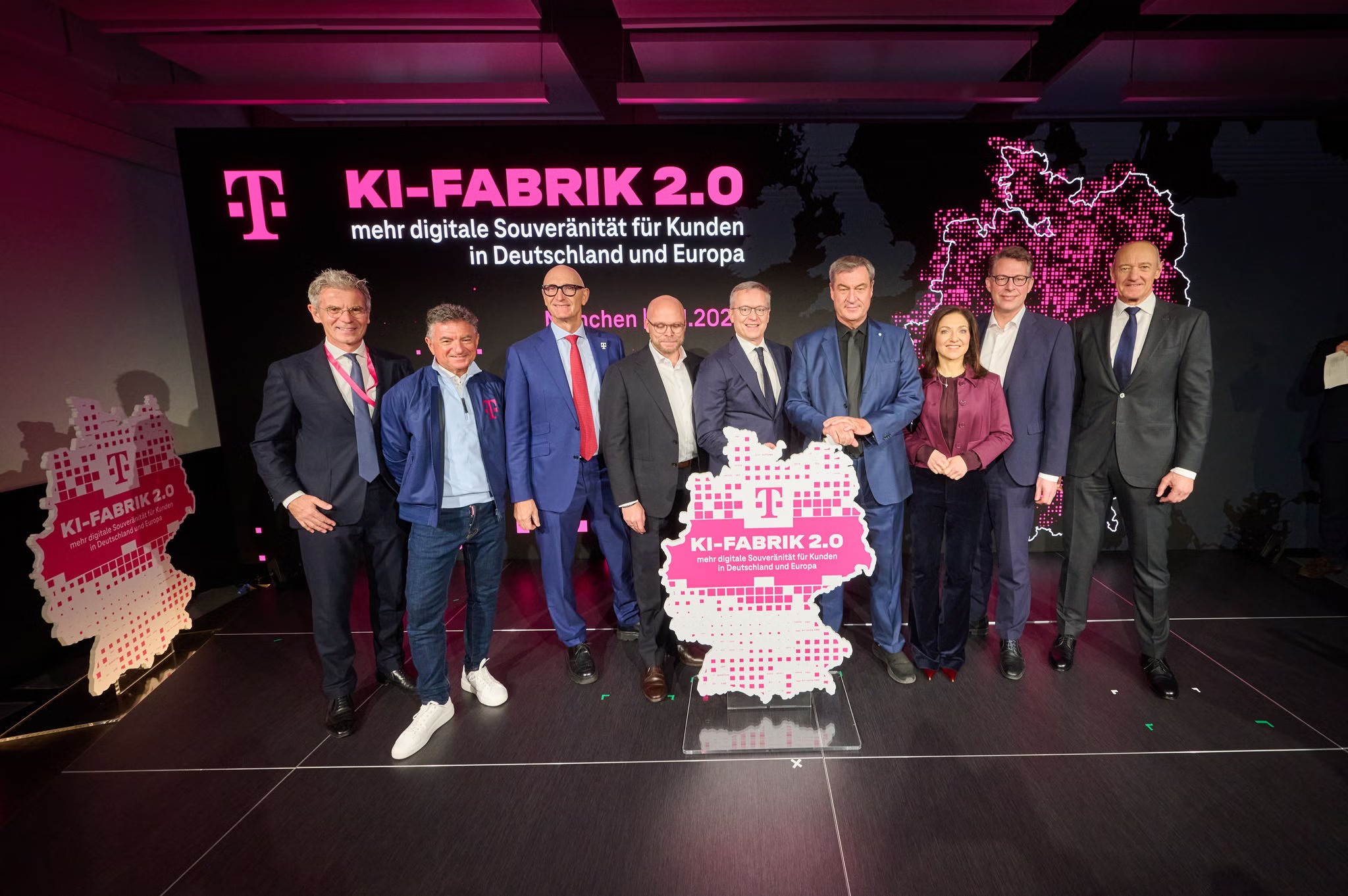
Deutsche Telekom will put roughly €250 million more into the AI campus it is building in Munich and has signed microagi as a tenant, the company said on November 22. The announcement came without a utilisation figure, a building timetable or a stated target return for the site. No financial detail beyond the capital figure was released.
For a group of its size the sum is modest. What carries weight is the model being tested: an incumbent carrier renting out artificial intelligence capacity the way it once rented out copper lines, on German soil, under German contract law. That distinction is the whole investment case.
The Munich site has been assembled as an industrial campus rather than a general-purpose data centre. The pitch targets manufacturers and regulated firms that want training and inference to run inside the country, on terms that do not change when a supplier revises a policy in California. Industrial tenants bring load profiles that are easier to forecast.
That preference now has a name in Berlin and Brussels. Sovereign AI, in the version carriers sell, means data that stays under European law and compute that does not depend on a foreign supplier’s willingness to keep serving European customers. Residency is a procurement requirement before it is a technical one.
Demand exists, but it is uneven. Banks, insurers and public agencies want the residency guarantee and can pass the cost to their own customers. Many of the same buyers also want the lowest price per accelerator hour, and that price is set in Virginia and Oregon. Those two demands rarely arrive from the same procurement office.
Deutsche Telekom’s answer is to sell adjacency rather than raw capacity. A tenant gets connectivity, private network access, colocation and a contract in German law, priced as a package. Carriers have sold bundles for a century, and the habit survives the shift to compute.
The group has spent two years assembling the pieces. It signed compute partnerships with chip and cloud suppliers, converted exchange space into machine halls, and argued in Brussels that Europe needs a network operator standing underneath the models rather than renting them from abroad. The strategy depends on that argument landing with regulators.
Competition is crowded. Hyperscalers are building in Germany, French and Spanish carriers want the same tenants, and newer entrants with fresher silicon can undercut anyone still amortising equipment bought at the top of the market two years ago.
The customer base is narrower than the marketing implies. Sovereign compute sells to regulated industries and public bodies whose procurement rules favour European suppliers. A mid-sized logistics firm with a working cloud contract is a harder sale, and there are far more of those firms than there are banks. Volume sits with the mid-market and margin with the regulated few.
Tenancy also changes the operator’s job. A carrier that fills a hall with its own equipment controls the roadmap. One that rents floor space to someone else’s models inherits their power profile, their cooling demand and their schedule, plus counterparty risk that no network upgrade can hedge.
Power is the binding constraint. Bavarian grid connections take years to secure, and the campus can grow only as fast as substations and cooling permits allow. Accelerators arrive in quarters; transmission lines arrive in decades, if the planning process cooperates.
The first tenant is a proof point, not a market. One name does not fill a hall, and the announcement discloses neither the size of the commitment nor whether the capacity is reserved for that tenant or sold through the same pool as everyone else. The second tenant matters more than the first, and nobody has named one.
Revenue recognition will be slow. Data centre contracts run for years, capital goes out up front, and returns appear only once utilisation climbs past the point where fixed costs are covered. Carriers know that arithmetic from mobile networks, which is why they keep trying.
Operators hold an advantage they rarely mention. They own the fibre, the buildings and the customer relationships, and can bundle compliance with connectivity. What they lack is the software layer and the sales motion that AI buyers expect from a cloud provider.
The risk is timing. If European demand for domestic compute grows more slowly than the building schedule, the campus becomes a cost line that analysts ask about every quarter. If it grows faster, the constraint moves to power and to export rules. Neither outcome appears in the announcement, which counts only the money going out.
Watch the tenant list rather than the headline cheque. A second and third anchor tenant would say more about European demand for sovereign compute than €250 million does, and their absence by the middle of 2027 would say something too.



