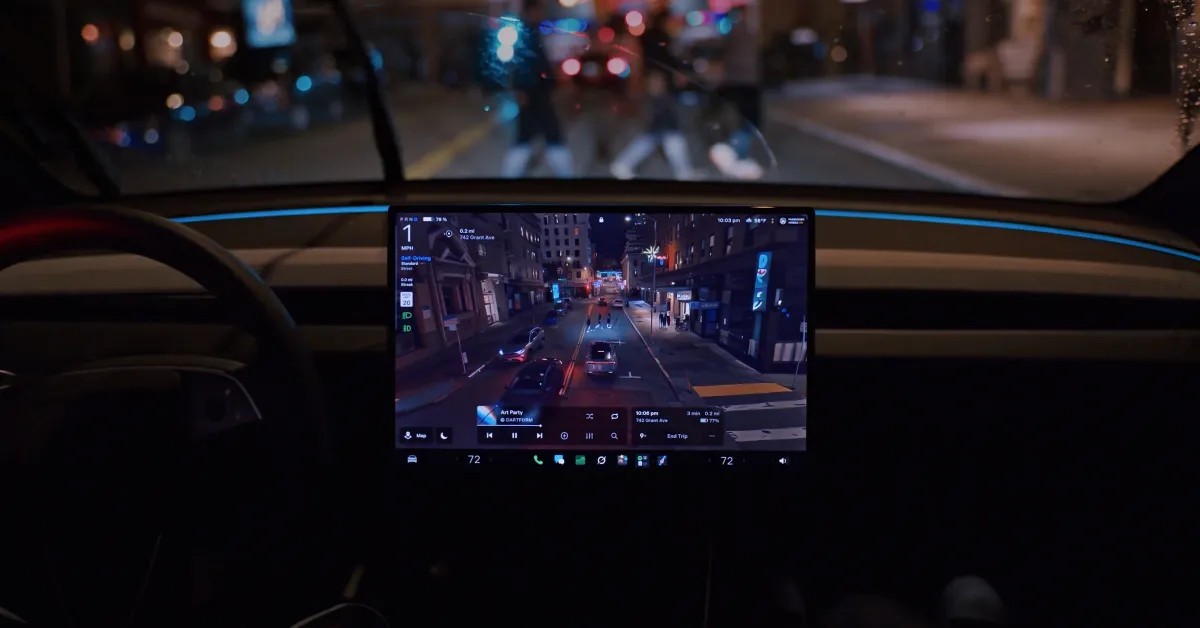
Tesla began sending version 15 of Full Self-Driving to a subset of its cars on Nov. 21, and the first change owners will notice has nothing to do with how the car behaves. It is what the screen shows them: the world around the vehicle is no longer drawn from a model of the scene, it is generated.
The decision was Elon Musk’s, and he described it in his own terms within hours of the release. The display, he said, is real-time AI video generation, produced without game engines. That sentence is the whole product change stated as an engineering claim.
The previous interface came from the FSD beta build rolled out in 2021: a cartoon car, lane markings, and coloured boxes for other vehicles. It looked like a developer tool, which is roughly what it was. The new one is aimed at the person in the passenger seat.
The motive is legible. A driver judging an assistance system has two sources of information, what the car does and what the screen says it is doing. Tesla has spent years arguing that its display is a window into the network’s understanding of the road. A photoreal feed makes that argument visually, in a way a wireframe never could.
Technically the pipeline is a reconstruction. Cameras feed the network, the network produces a scene, and a generator renders it at frame rate on hardware in the car, alongside the driving task. Every watt spent on that picture is a watt not spent on inference for steering, and the thermal budget of a computer in a parked car in summer is not generous.
The rollout is staged, which is normal for Tesla and also convenient. Software reaches a subset of the fleet first, so problems surface in public before they reach everyone. Owners outside the first group will spend weeks reading other people’s screenshots.
Tesla says the new version handles risk scenarios about 25 times better than the one it replaces. That figure is a company claim and has not been independently verified. The useful question is what counts as a risk scenario in the test set, and whether the same scenarios appear in the release notes as fixed.
The rest of the industry went the other way. Waymo’s in-car display is deliberately schematic: coloured boxes, lane lines, a rendered path showing intent. It is built to tell a passenger what the car is about to do, not to look like a photograph. Nvidia sells simulation tools that build photoreal worlds for training, where nobody watches the screen at seventy miles an hour.
The commercial logic runs through subscriptions. Full Self-Driving is sold as software, priced separately, and renewed monthly in some markets. Anything that makes the option feel more advanced at purchase affects take rate, and a striking visual is the cheapest demonstration Tesla has.
Tesla’s position is that the display should reflect the network’s perception rather than an artist’s approximation of it. That is defensible as engineering honesty and hazardous as interface design, because a generated image looks like a camera feed and carries the authority of one.
Validation is where the cost lands first. A wireframe that is wrong looks wrong. A generated frame that is wrong looks real, and a reviewer watching a replay cannot easily tell whether an object came from a camera or from the generator. Every mile of footage used to train or audit the system now has to be checked for synthetic content.
Regulators have already shown interest in how Tesla describes the system. The gap between the name Full Self-Driving and the documented capability produced inquiries before, and a convincing display widens it. Critics make a simple argument: a driver who sees a smooth, detailed world is likelier to assume the car understands it.
There is also the failure mode nobody has priced. A generative renderer can invent an object that is not there, or drop one that is. Tesla does not steer from the picture, so a missing pedestrian on screen would not directly cause a crash, but it would mislead the person responsible for monitoring the car.
Owners read the display the way passengers read a flight map. Its accuracy was never the point; its reassurance was. Changing the renderer changes the reassurance without changing the driving stack, which is the move a company makes when the software underneath improves slowly and the perception of it does not.
The trade is between a display that shows what the software knows and one that shows what the software wishes it knew. Owners will judge it on how it looks; engineers will judge it on whether the picture and the driving decisions ever disagree in public. Disengagement numbers and the first regulator letters will settle which reading holds.