
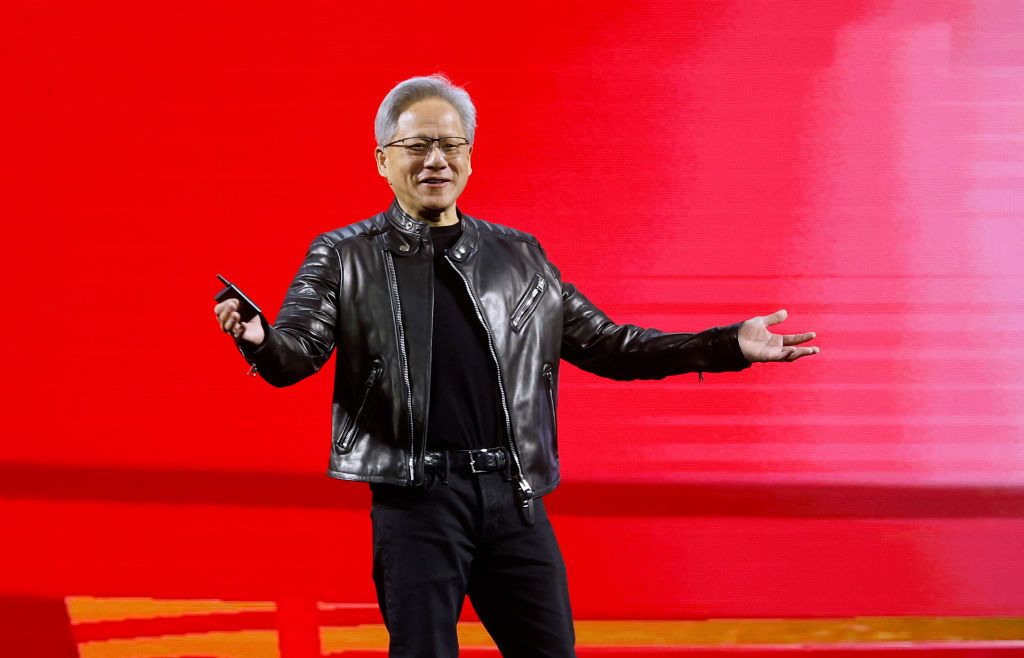
Nvidia’s board voted unanimously to restore Jensen Huang as president, chief executive and a member of the board, effective immediately, the company said on Nov. 23. The announcement ran to a few sentences: a series of discussions and meetings, a unanimous vote, and satisfaction with his candor and his capacity to keep leading the company.
That language settles a personnel question. It does not settle the questions that made the personnel question urgent, and the gap between the two will define the next several months for the most important supplier in the AI supply chain.
Huang resigned on Nov. 12 after an extramarital relationship became public, and the shares have fallen about 50% from their high. The board’s chair, Harvey Jones, told analysts on the earnings call that the company would not bring him back. That position lasted roughly a week, and the company has not explained what changed between the call and the vote.
The mechanics of the original exit are also unresolved in public. Huang’s name came off the executive roster before any filing explained the change, and the disclosure that followed described a resignation rather than a termination. Directors have not said whether they asked him to stay.
Boards do reverse themselves, but rarely this quickly and rarely without a reason they are willing to describe. The statement attributes the decision to discussions with Huang and to confidence in his leadership. It does not mention the investigation, the stock, customers or the political pressure that arrived in the same week.
The governance question is narrower than it looks. A board can hire, fire and rehire an officer. It cannot close an inquiry, and it cannot make a regulator’s case go away by passing a resolution. Restoring a chief executive who resigned over a personal matter is a decision about management. The criminal referral from California’s attorney general is a decision about something else.
What independent directors had to weigh is the cost of a vacuum. Nvidia’s roadmap, its allocation of manufacturing capacity and its relationships with the largest cloud customers run through one person, and a company in that position does not have a deputy who can absorb the role in a fortnight. Analysts said the risk of leaving the seat empty through a quarter of contract negotiations was the argument that carried the vote.
There is a commercial logic to the timing. The fourth quarter is when annual supply agreements are settled and when the largest buyers commit to next year’s clusters. A supplier that cannot answer a question about delivery schedules in December is a supplier whose customers start qualifying a second source.
Suppliers face the same calculation from the other side. Memory makers and foundries allocate capacity months ahead, and allocation follows forecasts signed by executives. A change at the top does not void those forecasts, but it does make counterparties ask who is accountable for them.
The board’s statement also has to survive a market test. Index funds will hold the stock regardless. Active managers will decide whether a unanimous vote by a board that reversed itself within days is strong governance or weak governance, and the answer will show up in how much of a discount they apply to the multiple.
Proxy advisers will ask a question the company has not addressed: whether the vote was unanimous among the independent directors as well as in the full board, and whether any director recused himself. Those details usually surface months later, in a filing nobody reads until a shareholder meeting.
The political layer is harder to ignore. A day before the vote, President Trump wrote on Truth Social that he hoped the board would rehire Huang and called it the best outcome for the company and the country. Treasury Secretary Scott Bessent, in a television interview the same day, declined to rule the possibility out. The board says the decision was its own, and there is no public evidence to contradict that, but the sequence will be remembered.
Customers will read the vote as stability, which is what they needed. Investors will read it as an admission that the company has no succession plan, which is what they feared. Both readings can be correct at once, and neither is resolved by a press release. What the market prices now is the probability of a second exit, and that probability has not fallen.
The remaining risk is legal rather than managerial. California’s attorney general has expanded an inquiry into state criminal statutes, and the Justice Department has opened a case against a Singapore distributor and its principal. If either produces charges that name company officers, the board will face the same vote again with worse facts.
That is the open question, and it concerns disclosure rather than strategy: whether Nvidia publishes the review that preceded the vote, or leaves shareholders to infer its scope from a sentence about candor. A board that restores a chief executive in a week owes the market a longer explanation than it has given.



