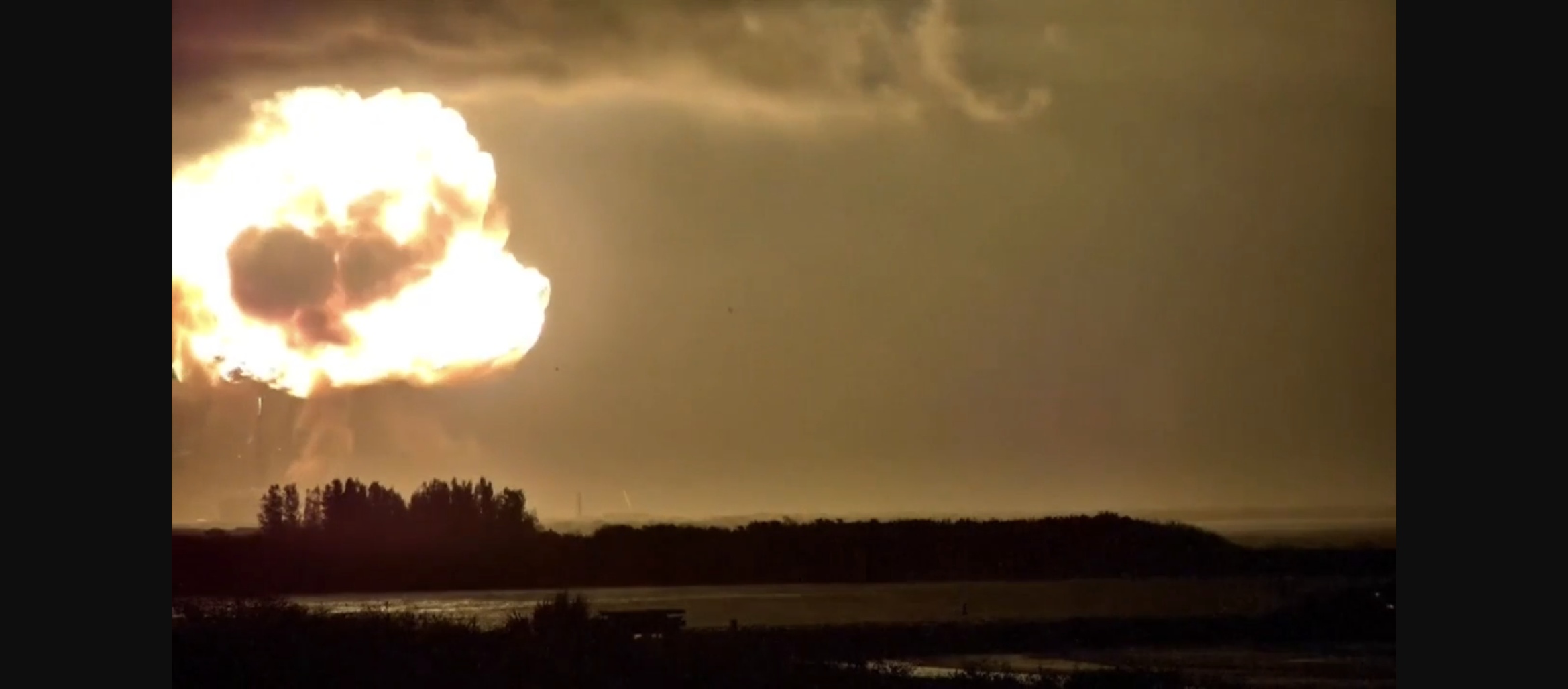
The explosion was audible 15 miles away. Witnesses along Florida’s Space Coast saw a fireball rise above the tree line at Cape Canaveral just after 9 p.m. Thursday, as Blue Origin’s New Glenn rocket erupted on its launch pad during a routine pre-flight test.
The company confirmed that a static-fire test, in which the rocket’s engines are ignited while the vehicle is held down on the pad, went wrong and destroyed the vehicle. All personnel were accounted for and no injuries were reported, Blue Origin said. “We experienced an anomaly during today’s hotfire test,” the company said in a statement.
The blast appeared to destroy the rocket’s first stage and its upper stage, toppled one of two lightning-protection towers at Launch Complex 36 and severely damaged the transporter-erector that moves the vehicle to the pad, according to video and reports from space journalists on site. Fires continued to burn at the pad after nightfall.
Video from the scene showed a mushroom cloud punching through the low cloud deck, visible across the Space Coast, with streaks of debris arcing away from the pad as pressurized tanks ruptured. Brevard County emergency officials issued a public notice describing the incident as an anomaly posing no threat to the public. The company warned that debris could wash ashore on nearby beaches in the coming days.
The loss is a severe setback for Blue Origin, the rocket company founded by Jeff Bezos, which had just been cleared to resume flights. The Federal Aviation Administration gave New Glenn the green light on May 22, ending a grounding that followed an in-flight failure in which the rocket’s upper stage malfunctioned while carrying a satellite for AST SpaceMobile. The FAA said the May 27 mishap report identified a cryogenic leak that froze a hydraulic line during the second-stage burn.
Thursday’s test was meant to clear the vehicle for its fourth flight, scheduled for as early as June 4, carrying 48 satellites for Amazon’s Project Kuiper broadband network, the first of 24 launches Amazon has booked with Blue Origin. That mission is now in doubt, along with the broader Kuiper schedule.
The pad is Blue Origin’s only orbital launch site, and the damage will take time to repair. A pad explosion of this scale typically means months of rebuilding and a full accident investigation before flights resume. In 2016, a similar failure destroyed a SpaceX Falcon 9 on a nearby pad at Cape Canaveral, and it took SpaceX more than a year to return to launching from the site.
The accident also complicates Blue Origin’s position in the national security and civil space markets. NASA Administrator Jared Isaacman said the agency was “aware of the anomaly” and would assess impacts on the Artemis program and the Moon Base initiative, for which Blue Origin has won contracts. The company had recently been awarded major NASA work, and the loss of a flight vehicle will test its ability to meet those commitments.
Amazon, for its part, has been preparing for disruption. It spread its Kuiper launches across multiple providers, including SpaceX, United Launch Alliance and Arianespace, precisely to avoid a single point of failure. But New Glenn was designed for the heaviest Kuiper batches, and the first of 24 contracted launches now slips. A person familiar with Amazon’s planning said the company would evaluate the impact once Blue Origin completes its assessment.
The explosion also lands amid a broader reckoning for American launch infrastructure. Commercial launches from Cape Canaveral have become routine, and the industry has grown used to the idea that rockets fly, not fail. Thursday offered a plain lesson in the physics of rocketry: the vehicles that carry satellites are still, at their core, controlled explosions that must be detonated only in the right direction.
The timing is awkward in another way. Blue Origin has been positioning New Glenn as a workhorse for the commercial launch market, competing with SpaceX’s Falcon 9 and Falcon Heavy. Amazon, which owns Blue Origin’s parent, had diversified its launch contracts across multiple providers in part to reduce dependence on SpaceX. Thursday’s explosion leaves those plans exposed.
Investigators will focus on what went wrong during ignition. Static fires are designed to catch problems while the rocket is still on the ground, and industry engineers said the test had done its job in that narrow sense, however painful the outcome. The question is whether the failure points to a systemic issue or a one-off defect in a component.
For Bezos, the explosion is the latest in a series of hard lessons in orbital rocketry. Blue Origin spent two decades building suborbital tourism before New Glenn’s first flight, which succeeded in January 2025 after years of delays. The company has described the program as a marathon, not a sprint, and its chief executive, Dave Limp, has emphasized iteration over perfection.
Still, the economics of the launch industry are unforgiving. Every grounded month costs Blue Origin revenue and customers, and Amazon’s Kuiper constellation faces its own regulatory deadlines for deploying satellites. The company said it will provide updates as the investigation proceeds.
“We will work with our partners to support a thorough investigation of this anomaly, assess near-term mission impacts, and get back to launching rockets,” Isaacman said. For Blue Origin, the road back to the pad begins with figuring out what happened, then rebuilding a launch site that was, until Thursday night, the centerpiece of its orbital ambitions.