
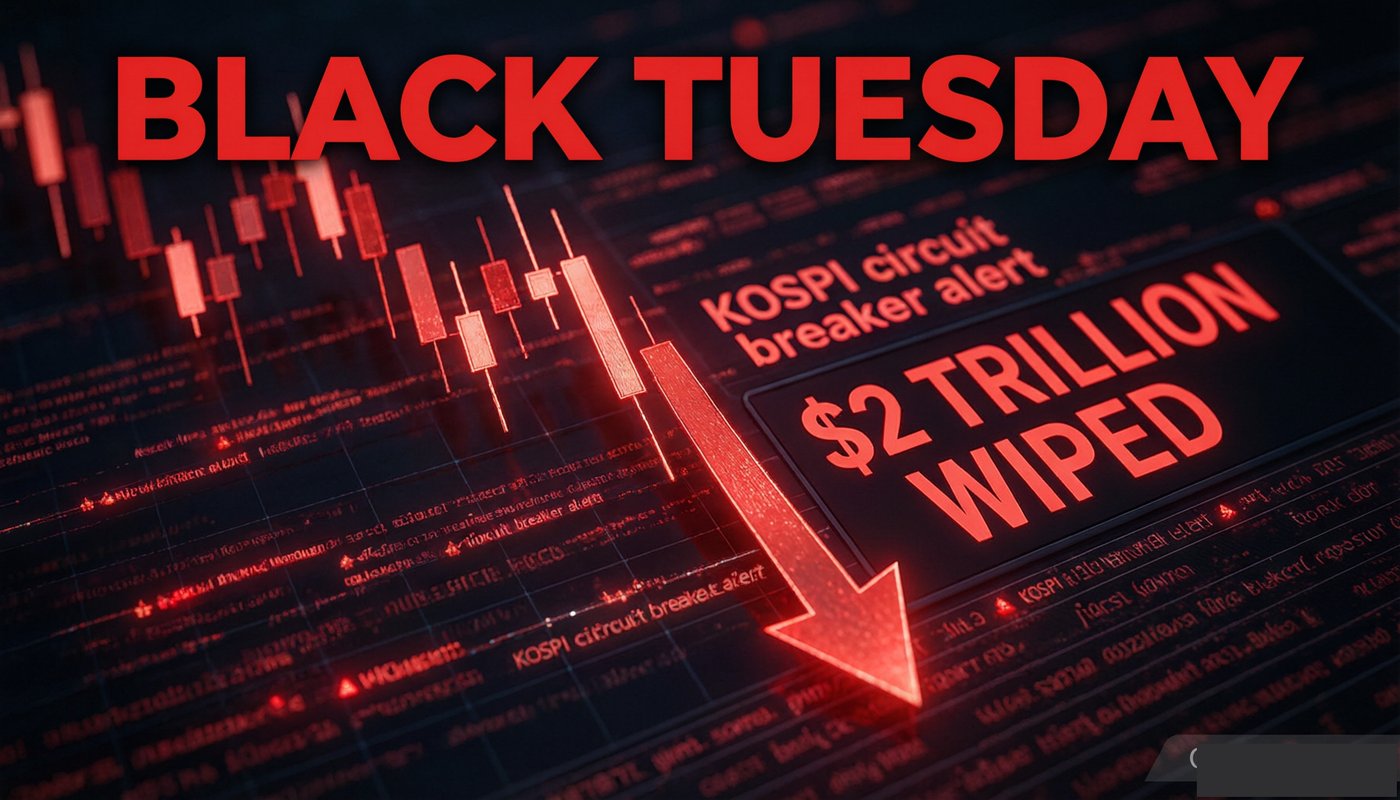
SEOUL — The second circuit breaker of the day froze the Korea Exchange at 10:03 a.m., halting trade in the KOSPI for 15 minutes while traders in Seoul’s Yeouido financial district stared at rows of red terminals. It was the benchmark’s second halt in a single session, a distinction it had not earned since the panic of March 2020.
When trading resumed, the selling resumed with it. SK Hynix closed down 12%, Samsung Electronics fell more than 10%, and the KOSPI logged its steepest one-day drop in years. Within hours the rout crossed the Pacific: the Nasdaq 100 slid 5%, erasing roughly $1.5 trillion in market value, and Nvidia, the bellwether of the artificial-intelligence trade, fell as much as 15% before trimming losses, shedding about $350 billion in a single session.
Moneycontrol, the Indian financial news service, captured the mood in a phrase that spread across trading floors: “the wholesale unwinding of South Korea’s hottest AI trade.”
Two forces set the selloff in motion, analysts said. The first is a thickening doubt about whether the enormous sums committed to AI infrastructure — data centers, accelerators, networking gear — will keep producing the returns that justify them. The second is a sudden shift in Federal Reserve expectations: traders began pricing the possibility of two rate increases this year, upending the assumptions that dominated the first half of 2026.
The pairing proved lethal for the stocks that led the global rally. Chip makers and their suppliers had been priced for a flawless execution of the AI buildout, analysts said, and any stumble in either the demand story or the interest-rate story was bound to hit them hardest. High-multiple technology names fell in sympathy, and the selling spilled into currencies, with the won weakening against the dollar as foreign investors headed for the exits.
South Korea’s memory giants carried the heaviest weight. SK Hynix, the world’s largest producer of high-bandwidth memory used in AI accelerators, had roughly quadrupled in a year, and Samsung had more than tripled before Tuesday’s declines. Retail investors, who hold a large share of both companies’ free float, bore the brunt; brokers reported a spike in margin calls among individual accounts.
The question now is whether the day marks a repricing or a reversal. Bullish investors note that memory contract prices remain firm and that hyperscale customers have not cut orders. Skeptics point to the rhythm of past technology cycles, in which supply catches up with demand faster than anyone expects, and note that the market for standard DRAM was in shortage long before the AI boom began.
For South Korea, the stakes are national. Semiconductors account for roughly a fifth of the country’s exports, and the AI boom has been the main engine behind its record trade surplus this year. Goldman Sachs said this week that the AI-driven chip cycle has been stronger and longer-lasting than the bank expected, with exports on track to top $1 trillion for 2026.
The selloff also laid bare a split between short-term panic and long-term planning. Hours after the KOSPI’s second halt, Taiwan Semiconductor Manufacturing Co. told investors it expects the global chip market to double to $1.5 trillion by 2030. ASML, the Dutch maker of lithography machines, said its order book runs through 2027. Neither company changed its spending plans, and both pointed to AI demand as the reason.
Executives at Korean chip makers struck a similar note. In a briefing after the close, SK Hynix said it would reallocate resources from high-bandwidth memory to commodity DRAM, where shortages have pushed prices sharply higher, a move that signals confidence in the broader cycle rather than a retreat from it.
What happens next depends on data that has not yet arrived, analysts said. Nvidia reports quarterly earnings next month, hyperscale operators publish fresh capital-expenditure guidance through the summer, and the Fed’s next meeting will test the new rate expectations. Until those numbers land, volatility is likely to stay elevated and the two-halt session will hang over the market.
The rout has a history behind it. Korean stocks have suffered days like this before, most notably during the Asian financial crisis of 1997 and the global panic of 2008, and in each case the market eventually recovered once the trigger of the moment passed. What is different this time is the source of the selling: the country’s biggest companies rose on the AI boom, and the question of whether that boom can support their valuations is now the question hanging over the entire index. Authorities in Seoul said they are monitoring the market closely, a standard formulation that investors read as a warning that intervention is possible if the selling accelerates. Foreign investors, who had poured record amounts into Korean chip stocks this year, were net sellers on Tuesday, according to exchange data.
The parallels to past technology cycles cut both ways. In 2000, the collapse of the dot-com boom erased trillions in market value and took years to recover from, but it also produced the companies that dominated the next two decades. In 2021, the memory industry’s downcycle followed a period of panic buying, and the companies that survived it emerged with stronger balance sheets and more disciplined capacity plans. Tuesday’s selloff is the first serious test of the current cycle, and the outcome will depend on whether the demand that built the AI trade was real, as the order books of TSMC and ASML suggest, or a speculation that the market is now unwinding.
The morning after, Seoul’s financial press asked whether the flagship trade of the AI era can recover. Traders offered a more practical answer: watch the order books. As long as the companies paying for AI capacity keep paying, the memory makers’ earnings will eventually catch up with their share prices — and if they stop, Tuesday’s halt was only the first.



