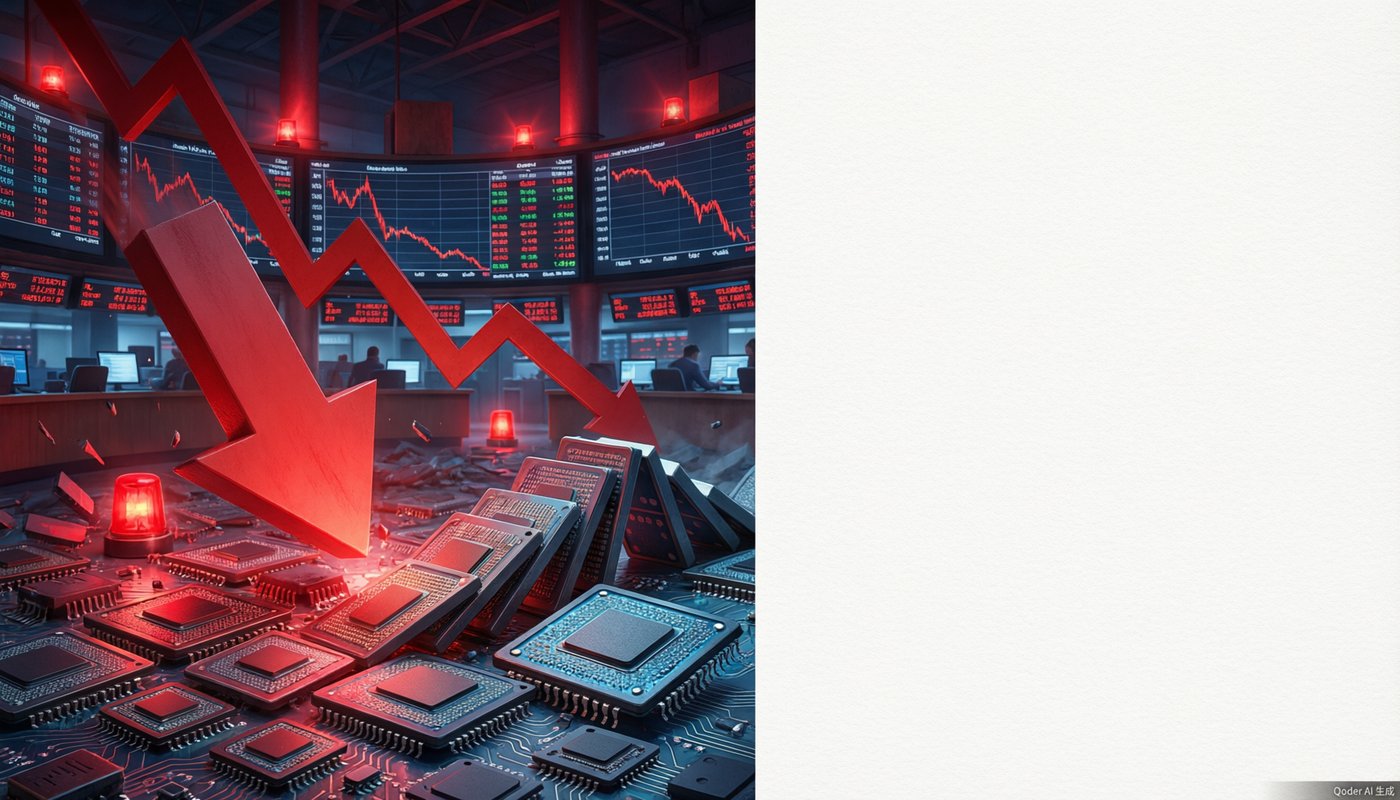
The selling began in Seoul and spread across the region: by the close of trading on Thursday, South Korea’s KOSPI had fallen nearly 8%, its worst single-day loss in years, with Samsung Electronics and SK Hynix leading the decline. The rout extended across Asia’s chip markets, and Wall Street’s semiconductor shares were feeling the same pressure for a third consecutive session. The selloff, investors said, was a collision of worries that had been building for weeks — fears that AI chip orders are slowing, that global economic data is weakening, and that the memory-price rally that powered the sector’s gains is losing momentum.
The scale of the move is what set Thursday apart. Chip stocks have been volatile all year, swinging with every data point about AI spending, but the KOSPI’s drop was the deepest single-day correction the semiconductor complex has suffered in 2026, and it came without a single triggering event. The absence of an obvious catalyst made the selloff more unsettling: investors were repricing the sector’s outlook all at once, based on a cumulative reassessment rather than a specific piece of news.
Samsung and SK Hynix bore the brunt because their fortunes are tied directly to the memory market, and memory has been the AI trade’s most crowded bet. The two companies control the bulk of the world’s high-bandwidth memory production, the specialized chips that AI accelerators consume in vast quantities, and their shares had risen sharply on the strength of that franchise. The selloff reflects a growing concern that the memory shortage, which has driven prices to record levels, may be approaching its peak — that new capacity coming online will meet demand that is growing more slowly than the bulls assumed.
The AI order question is the deeper worry. The entire semiconductor rally of the past two years has been built on the belief that AI computing demand would grow without interruption — that data centers would keep buying accelerators, that cloud providers would keep expanding, that the models would keep getting bigger. That belief has been tested repeatedly, and each test has passed. Thursday’s selloff suggests a growing number of investors believe the next test will be different: that some of the largest buyers of AI chips are reaching the limits of what they can absorb, and that order growth, while still positive, will decelerate.
The macro backdrop amplified the move. Economic data released this week pointed to slower growth in several major economies, and investors have been paring risk across markets in response. Chip stocks, as the most visible expression of the AI trade, bore the brunt of the rotation. The combination — decelerating orders, weakening macro data, and fading pricing momentum — is the configuration that has ended every semiconductor boom in history, and the market’s behavior on Thursday suggested investors are starting to price that possibility.
The industry’s response has been to point at the fundamentals. Semiconductor executives, including the leaders of the equipment makers and foundries, have insisted that demand remains strong — ASML raised its full-year guidance this week, and the major foundries report full order books. The gap between what the industry says and what the market believes is the defining feature of the current moment: the companies building the capacity see boom conditions, while the investors trading the shares see the end of a cycle.
History offers little comfort. Semiconductor stocks have corrected deeply during previous AI-enthusiasm phases, only to recover when the underlying demand proved real. But the pattern of corrections has also been brutal, with drawdowns of 30% or more common during the cycle’s rougher passages. Whether Thursday’s move was the start of such a correction or a shakeout within a continuing boom depends on the data that follows — the earnings reports from the chipmakers, the order numbers from the equipment suppliers, and the capital-spending plans of the AI companies themselves.
For the governments and investors who have tied their fortunes to the semiconductor industry, the selloff is a test of conviction. South Korea’s economy is deeply dependent on the chip sector, and a sustained decline in Samsung and SK Hynix shares would have consequences beyond the stock market. The memory companies, for their part, have signaled they will defend prices by keeping capacity disciplined, a strategy that supports the industry’s economics but does nothing for the share prices that have already repriced.
The coming weeks will determine whether Thursday was an event or the beginning of a trend. The chipmakers’ earnings season begins soon, and the numbers — revenue, guidance, order commentary — will give investors a data point to trade against. Until then, the market is left with the arithmetic of the selloff: a nearly 8% drop in a single day, three days of pressure on Wall Street, and a sector whose story has not changed, only its price.