On the same earnings call where Intel reported its fastest revenue growth in 15 years, executives delivered another piece of news that has been years in the making: the company’s next-generation 14A manufacturing process will begin risk production in the second half of 2027, a full year earlier than previously planned, with mass production to follow in 2028. Market research firm TrendForce confirmed the accelerated timeline.
14A is the node after 18A, Intel’s current leading-edge process, and it is the company’s clearest shot at matching TSMC’s most advanced manufacturing. The acceleration matters because Intel’s foundry business, its bet on making chips for other companies, rises or falls on whether its process roadmap keeps pace with the industry leader.
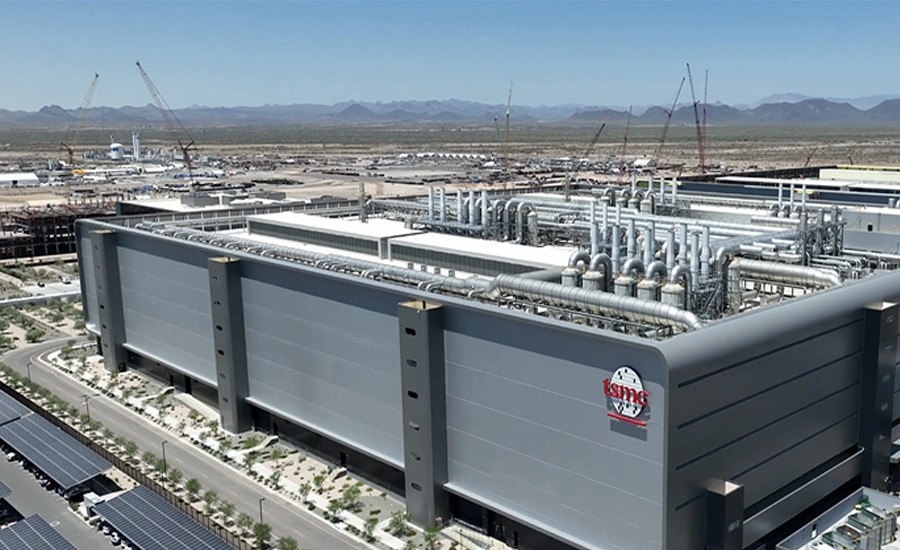
The new timeline puts Intel’s 14A in a race with TSMC’s 2-nanometer node and its successors. TSMC began volume production of its 2nm process in 2025, and its roadmap extends into subsequent refinements that Intel’s new schedule is designed to answer. Samsung, the third competitor at the leading edge, is chasing both companies with its own 2nm efforts. The contest is now a three-way race where schedules are measured in quarters.
The pull-forward is a signal about Intel’s confidence in the technology. 14A is expected to use High-NA EUV lithography, the next generation of extreme ultraviolet tools that print the smallest features on a chip. Intel was the first chipmaker to install High-NA equipment, at its Oregon research fab, and using the tools in volume production is ambitious: they are expensive, the process is unproven at scale, and the supply of machines from ASML, the Dutch manufacturer, is limited.
The economics of High-NA are part of the bet. The machines cost hundreds of millions of dollars each, and a fab needs many of them, which means the decision to accelerate 14A is also a decision to spend. Intel has said it will fund the ramp through the revenue growth it is now reporting, and that the foundry’s capital intensity will decline as utilization improves.
Analysts said pulling 14A forward a year implies Intel believes its yields and equipment readiness are ahead of internal expectations. “You do not accelerate a leading-edge node unless the data supports it,” one analyst said. “Intel is signaling that its biggest technical risk, the transition to High-NA, is going better than planned.”
Why it matters to customers: foundry decisions are made years in advance. Chip designers choose a manufacturing partner based on the roadmap, and a faster 14A timeline gives Intel a competitive pitch: a leading-edge node available to external customers on a schedule closer to TSMC’s. Intel has signed external customers for 18A, including major U.S. technology companies, and 14A is the node that could broaden that list.
The financial logic is straightforward. A foundry with the leading process can charge premium prices; a foundry that trails must discount. Intel’s foundry business has lost money for years, and the path to profitability runs through winning leading-edge customers, which in turn requires a roadmap that keeps pace with TSMC.
The risks are the same risks that have burned Intel before. The company’s 10nm process slipped for years, and its 7nm program fell behind schedule, giving TSMC an opening it never relinquished. The lessons are embedded in Intel’s cautious language: executives called the new schedule risk production in the second half of 2027, a term that leaves room for slippage without admitting it in advance.
The connection to 18A is direct. 14A’s pull-forward depends on what Intel learns ramping 18A, and executives said the company will apply the same manufacturing discipline to both nodes. The 18A ramp is the immediate priority; 14A is the proof that the lessons stuck.
The two announcements on the earnings call, financial results and process roadmap, reinforce each other. Revenue growth funds the research and development; the roadmap gives the foundry business a story to sell. Chief Executive Lip-Bu Tan has said the foundry will be judged on execution, not announcements, and the 14A schedule is now part of that record.
TrendForce’s confirmation adds external validation. The research firm tracks semiconductor manufacturing plans across the industry, and its sign-off on the accelerated timeline suggests the schedule is credible beyond Intel’s own claims. The firm said Intel’s 14A timeline has been shortened by a year relative to its earlier plans.
The 14A news drew less attention than the earnings themselves, but chip-industry analysts said it may matter more in the long run. A foundry that can match TSMC’s schedule changes the economics of the entire industry, which has paid a premium for Taiwanese manufacturing for two decades.
What’s at stake: 14A is the node where Intel aims to lead rather than follow. If the company hits risk production in the second half of 2027 and mass production in 2028, it will offer a node competitive with TSMC’s most advanced, a position Intel has not held since the early 2010s. If the schedule slips, the foundry story loses its edge, and customers who signed on for 18A will have seen the pattern before.
The company that spent a decade catching up is now promising to pull ahead on a schedule that leaves no room for the delays that once defined it. The market will believe it when the wafers ship.