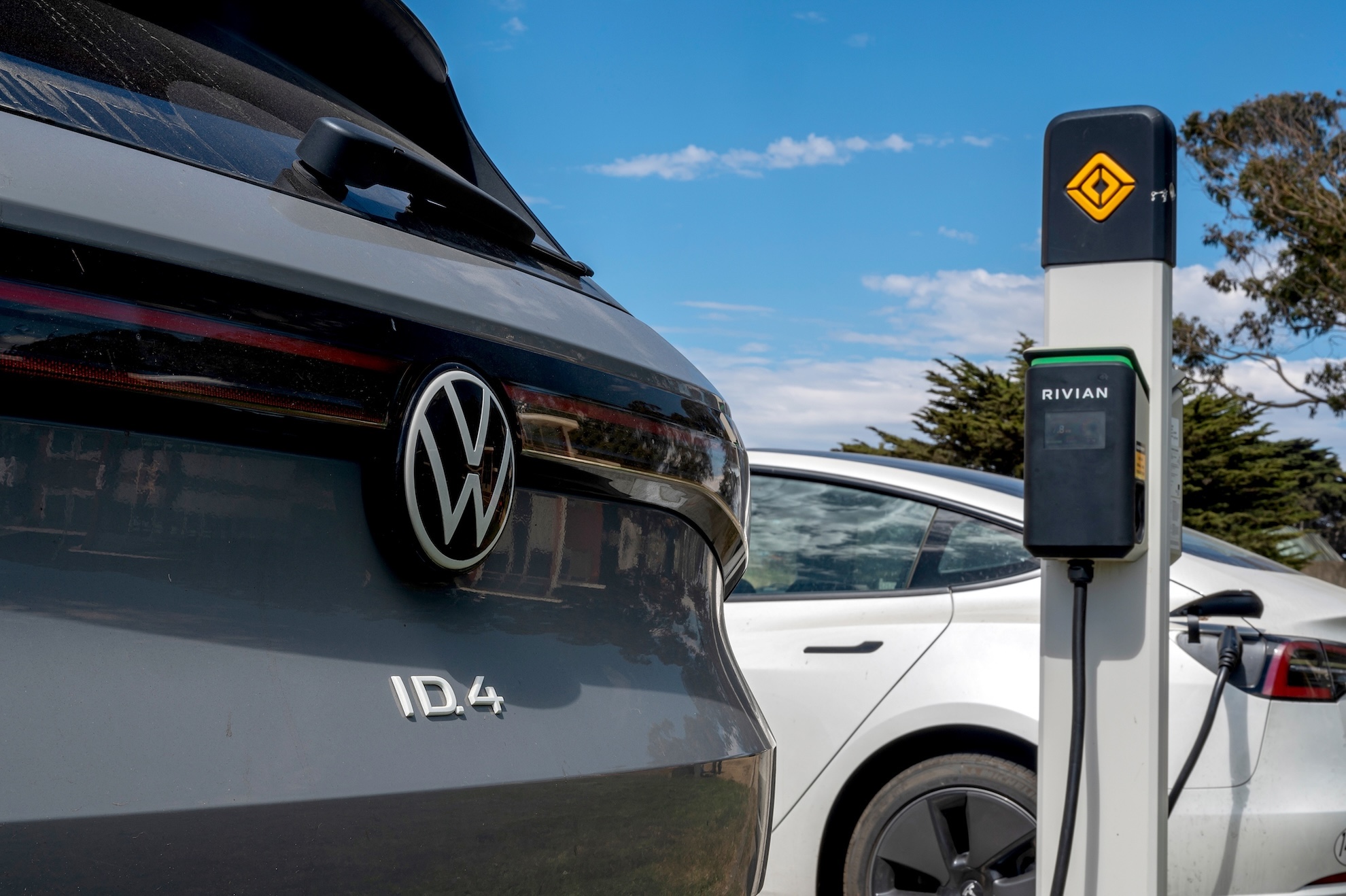
The trades were placed quietly, in accounts that did not attract immediate attention, but their timing was too precise to be coincidence. The U.S. Department of Justice has charged two former Volkswagen engineers with using inside information about the automaker’s joint venture with Rivian Automotive to trade stocks, according to a Bloomberg report. The case is one of the largest insider trading actions in the auto industry in years.
The charges stem from the run-up to one of the industry’s most consequential deals. In June 2024, Volkswagen announced plans to invest up to $5 billion in Rivian, the electric truck maker, and to form a joint venture to share vehicle software and electrical architecture. Rivian’s shares surged on the news, rewarding investors who were positioned ahead of the announcement.
Prosecutors allege the two engineers, who worked for Volkswagen, learned of the impending deal in the course of their work and traded in Rivian securities before the public announcement, according to the Bloomberg report. The transactions were described as multiple, precise and high-value, with the timing matching the deal’s internal development.
Insider trading cases require proving intent: that the defendants knew the information was material and non-public, and that they acted on it. The government’s case rests on the pattern of the trades — their size, their timing and their proximity to the announcement — along with the communications trail that typically accompanies such conduct.
The case has drawn attention for its scale. Auto industry insider trading actions are rare, in part because few people have the combination of access and inclination to trade. When they do occur, they usually involve a single individual with a family member or associate. A two-defendant case tied to one of the biggest deals in the industry’s recent history is unusual.
The deal itself was a defining moment for both companies. For Volkswagen, the investment was a bet that Rivian’s software and electrical architecture could help modernize a lineup that lagged in electric vehicle technology. For Rivian, the capital injection came at a moment of financial strain, extending its runway as it scaled production of its R1 trucks and SUVs.
The engineers’ access was a function of the deal’s structure. Volkswagen’s deep integration with Rivian — engineers from both companies working side by side on the joint venture — meant that a wide circle of employees knew the contours of the deal before it was public. That breadth of access is precisely what makes deal-related insider trading hard to prevent and relatively rare to prosecute.
The charges follow a pattern of enforcement that has accelerated in recent years. The DOJ and the Securities and Exchange Commission have brought a series of cases against individuals who traded on confidential information about mergers and partnerships, with a particular focus on technology deals where share prices move sharply on news.
Penalties can be severe. Insider trading convictions carry prison sentences of up to 20 years per count, and the SEC routinely seeks civil penalties equal to the profits gained or losses avoided. The government’s parallel civil and criminal approaches mean the engineers face both the threat of imprisonment and the near-certainty of financial forfeiture.
The case also sends a message to the broader industry. Cross-company collaborations — joint ventures, strategic investments, technology partnerships — have multiplied in the automotive sector as the industry reorganizes around software and electrification. Each partnership creates a new class of insiders, and the enforcement agencies have made clear they are watching.
The joint venture itself remains central to both companies. Volkswagen has staked its software strategy on the partnership, folding its own development plans into the Rivian-built platform, and the two companies have expanded the scope of their cooperation since the investment was announced. That deep integration is what made the insider information valuable — and what made the alleged trades possible.
Legal experts said the prosecution will hinge on the evidence trail. Insider trading cases are built on phone records, messages and trading patterns, and the government’s ability to show a direct connection between the engineers’ knowledge and their trades will determine the outcome. Defense lawyers typically argue that the trades were based on public information or general market optimism.
Volkswagen has said it is cooperating with the authorities, according to the Bloomberg report. Rivian declined to comment. The two companies have continued to deepen their partnership since the investment, with the joint venture now central to both companies’ technology roadmaps.
For the engineers, the case is the end of careers that were presumably built over decades. For the industry, the case underlines a simple fact: the confidential information flowing through every partnership carries a price — and the government is prepared to collect it.
The trial, if it reaches court, will offer a rare public look at how deal information moves through a corporate partnership, and at the boundaries of what employees can do with what they know. In a year of record enforcement activity, the auto industry has just become the newest front.