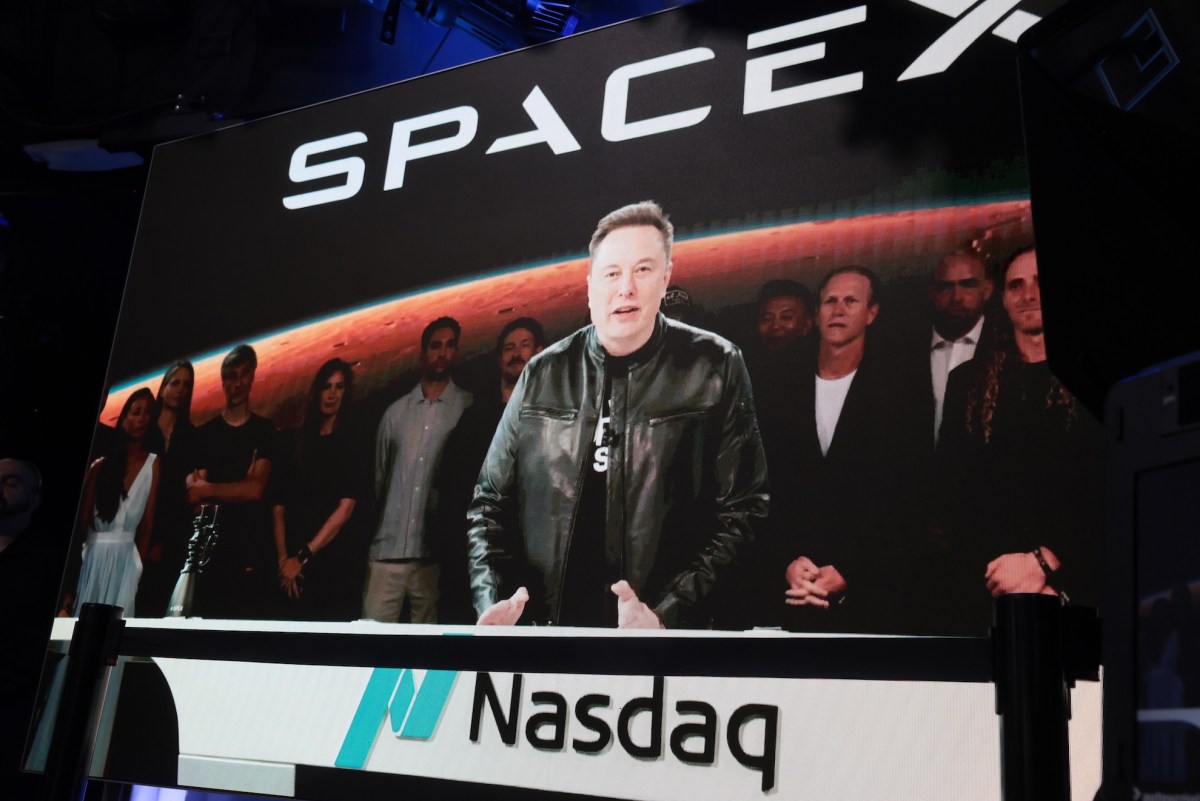
Ron Baron has spent the better part of a decade telling anyone who would listen that SpaceX would one day be the most valuable company on the planet. On Monday, the founder of Baron Capital put another $1 billion behind that prediction, buying shares in the rocket maker’s initial public offering and lifting his firm’s total position to roughly $25 billion.
The purchase came as SpaceX finished its first full trading day on the Nasdaq Stock Market. Shares closed up about 10% at $183, extending the 19% jump from Friday’s debut. Measured against the $135 offering price, the stock has climbed roughly 36% in two sessions, a run that has pushed the company’s market value above $2 trillion and made Elon Musk the first person on record with a fortune exceeding $1 trillion, according to the Bloomberg Billionaires Index.
The rally has left many professional investors watching from the sidelines, not because they doubt the business but because they cannot buy enough stock. Only about 4% of SpaceX’s shares are publicly traded, according to people familiar with the matter. The rest sits with Musk, early employees and a small circle of private funds that held stakes before the listing. Index funds that track the Nasdaq-100 and the S&P 500 will have little choice but to accumulate whatever shares come to market, traders said, and that mechanical demand is colliding with a float that will stay thin for months.
Baron knows the setup better than most. He first invested in SpaceX in 2017, when the company was valued at less than $22 billion, and has described the position as the largest single bet of his career. In investor letters and television appearances over the years, he argued that Starlink, SpaceX’s satellite-internet business, would one day generate more revenue than the entire global telecom industry. That claim drew eye rolls when he first made it. After the launch business signed up a stream of government and commercial customers and Starlink’s subscriber base kept compounding, the math has begun to look less fanciful.
Baron’s bet is not a bet on rockets alone. Starlink now counts its subscribers in the tens of millions and has become the company’s cash engine, generating recurring revenue that launch contracts never could. Analysts estimate the satellite business accounts for the majority of SpaceX’s revenue, and its growth has made the company’s financials look more like a telecom operator’s than a defense contractor’s. That mix is why the valuation debate, at its core, is a debate about whether one company can own both the launch monopoly and the global internet.
The IPO itself was engineered for scarcity. SpaceX priced at $135 a share, a level that bankers said was deliberately conservative given an order book that ran several times oversubscribed. Allocation skewed toward long-only funds and Baron-style believers rather than the hedge funds that typically flip first-day pops, according to people involved in the offering. The company wanted owners, not traders.
Friday’s debut was, by any measure, a success. The stock opened well above the offering price and finished its first session up 19%, handing early investors a paper gain of billions in a single day. Monday’s follow-through suggested the demand was not a one-day phenomenon, even as some traders warned that a stock this thinly held can move as easily down as up.
The next catalyst, investors said, is likely to be the company’s first earnings report as a public company, which will give outsiders their first clean look at the books. Until then, the market will be trading on narrative: Musk’s promises, the launch manifest and the order books that bankers keep privately. That is a recipe for volatility, and the people who built the deal know it.
The listing caps a remarkable stretch for Musk, who has watched Tesla’s valuation swing violently while SpaceX’s launch manifest filled and Starship completed a series of test flights that brought the company closer to full reusability. SpaceX, Tesla, his social platform X and his AI venture xAI now account for the bulk of his fortune, which crossed the trillion-dollar mark when SpaceX’s stock closed above $180.
Not everyone on Wall Street is convinced the shares are worth $183. Target prices published since the listing range from $63 to $165, according to analysts’ notes, a spread that reflects genuine disagreement about how fast Starlink can grow and how much of the space economy SpaceX can capture. Bears point to the thin float as an artificial support, arguing that when employee lockups begin to expire, a wave of supply will test the valuation. Bulls counter that revenue visibility at SpaceX is better than at any comparable company at a similar stage of its life.
Musk has said on X that the company could reach $1 trillion in annual revenue by 2030, a forecast that even some supporters describe as heroic, and one that will be the subject of its own debate on Wall Street in the weeks ahead. For now, the stock is being priced on faith in the network, faith in the launch franchise and faith in a founder who has spent the past two years proving doubters wrong at every turn.
For Baron, the bet is already half won. His $25 billion position, built at an average cost far below the offering price, is his firm’s largest holding by a wide margin, and his conviction has not wavered since 2017, when he told clients the investment would take a decade to prove itself. The public market is now delivering the verdict, trade by trade, and the man who waited nine years for Monday is in no hurry to leave.