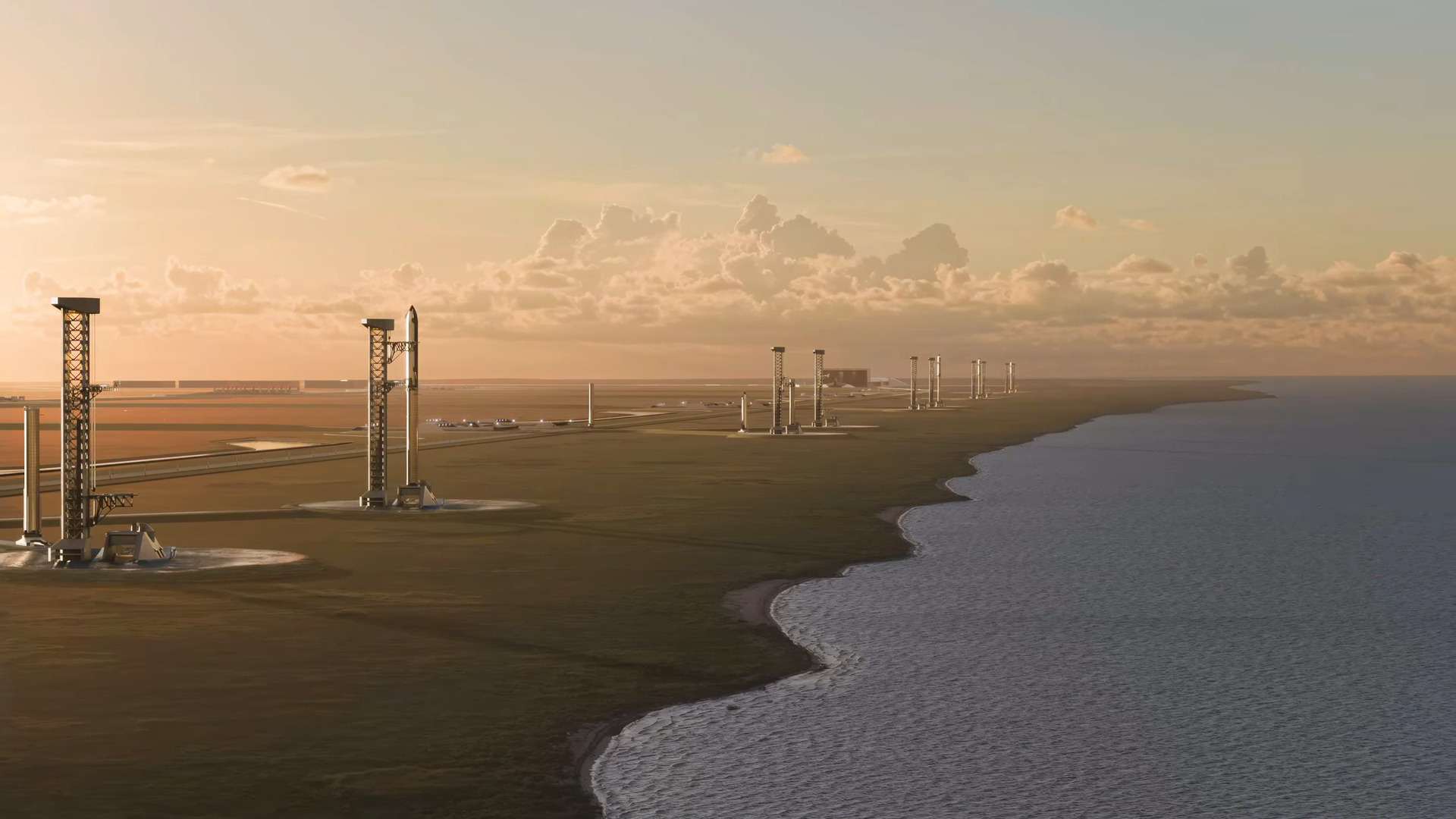
The gravel roads around Pecan Island, a low strip of marsh and fishing camps on Louisiana’s Gulf Coast, usually lead to boats, not rockets. On Aug. 25, they led to an announcement that could turn the remote parish into the busiest launch site on the planet. SpaceX said it will build a new Starship launch complex near Pecan Island with an investment of $100 billion, a figure the state’s economic development department confirmed.
No private infrastructure project of this scale exists. The sum exceeds the combined annual budgets of several federal agencies and rivals the cost of the Apollo program in today’s dollars. SpaceX described the site as a multi-pad complex designed for the repeated launch and landing of Starship, the giant stainless-steel rocket that is the centerpiece of its plans for satellite deployment, deep-space missions, and eventually crewed flights to Mars.
Louisiana won the project after a quiet competition among Gulf states, according to people familiar with the site-selection process. The state offered a package of tax incentives, port access, and a workforce trained in shipbuilding and offshore energy, industries that have shaped the region’s economy for decades. Gov. Jeff Landry’s office called the project “generational,” and local officials have already begun planning for an influx of engineers, welders, and construction crews into a corner of the state better known for crawfish and oil rigs.
The timing is deliberate. SpaceX is winding down the Falcon 9 era at its Florida facilities, where the final Falcon 9 Starlink mission lifted off days before the announcement. The workhorse rocket, launched more than 400 times over a decade, carried the bulk of the company’s Starlink constellation into orbit. Now the company is shifting its center of gravity to Starship, a vehicle roughly twice the power of the Saturn V that first carried humans to the Moon.
Starship’s test campaign has been turbulent. Early prototypes exploded on landing, and regulators at the Federal Aviation Administration have repeatedly paused flights for safety reviews. But recent missions have succeeded in catching the booster with mechanical arms at the launch tower, a feat the company calls “chopsticks,” and SpaceX has moved into a cadence of faster, more routine test flights. The Louisiana site is designed for the production phase: dozens of launches a year, each carrying the next tranche of Starlink satellites or the payloads of commercial customers.
The choice of Pecan Island carries environmental and political risk. The site sits in a hurricane corridor, and the region’s wetlands are among the fastest-eroding in the United States. Environmental groups have already filed preliminary objections, warning about noise, debris, and the impact on bird habitats. SpaceX has pledged to restore wetlands as part of the project, and state officials note that the launch complex itself will occupy relatively little of the surrounding marsh.
For Musk, the Louisiana investment is the latest step in a broader industrial strategy that has scattered his companies across the country. His electric-vehicle plant in Texas, his tunneling operation in Nevada, and his data centers in the Midwest all followed a similar pattern: land a big footprint, build vertically, and lean on state incentives. The Starship site extends that playbook to the Gulf Coast, where SpaceX already operates a rocket factory in Texas and a launch site at Boca Chica.
The economics of the project depend on Starship reaching full flight rate, which remains unproven. Each Starship launch could eventually cost as little as a few million dollars at scale, a fraction of the price of rival heavy-lift systems, but the fixed costs of building the Louisiana complex are enormous. Analysts said the $100 billion figure likely includes manufacturing capacity, ground infrastructure, and years of operating losses absorbed during the ramp-up.
Competitors are watching closely. United Launch Alliance and Blue Origin are building their own heavy-lift vehicles, and NASA has contracted Starship to serve as the lander for crewed Moon missions. If Starship delivers the flight rates SpaceX promises, the Louisiana site could become the anchor of a logistics network that moves both satellites and people into orbit, reshaping who controls access to space.
State and local officials are already thinking about the second order. They expect suppliers to cluster near the launch complex, from fuel providers to component fabricators, recreating the industrial ecosystem that grew up around NASA’s facilities in Florida and Texas decades ago. The parish’s school system, long dependent on oil-and-gas tax revenue, is bracing for a wave of new students and new construction.
The project’s first concrete steps are months away. Site surveys, environmental reviews, and permitting will occupy the rest of the year, with groundbreaking expected in 2027 if approvals hold. The first launches from Pecan Island would come later, after the Texas site has proven the vehicle’s production maturity.
For now, the announcement has already changed the region’s arithmetic. Land values near Pecan Island are climbing, hotels in nearby towns are booking engineers, and the state’s development office has posted job listings for a workforce that did not exist there a week ago. Louisiana has bet on oil, on gas, and on petrochemicals before. Its newest bet is a rocket that has not yet flown a paying customer, backed by the largest private check in the history of spaceflight.