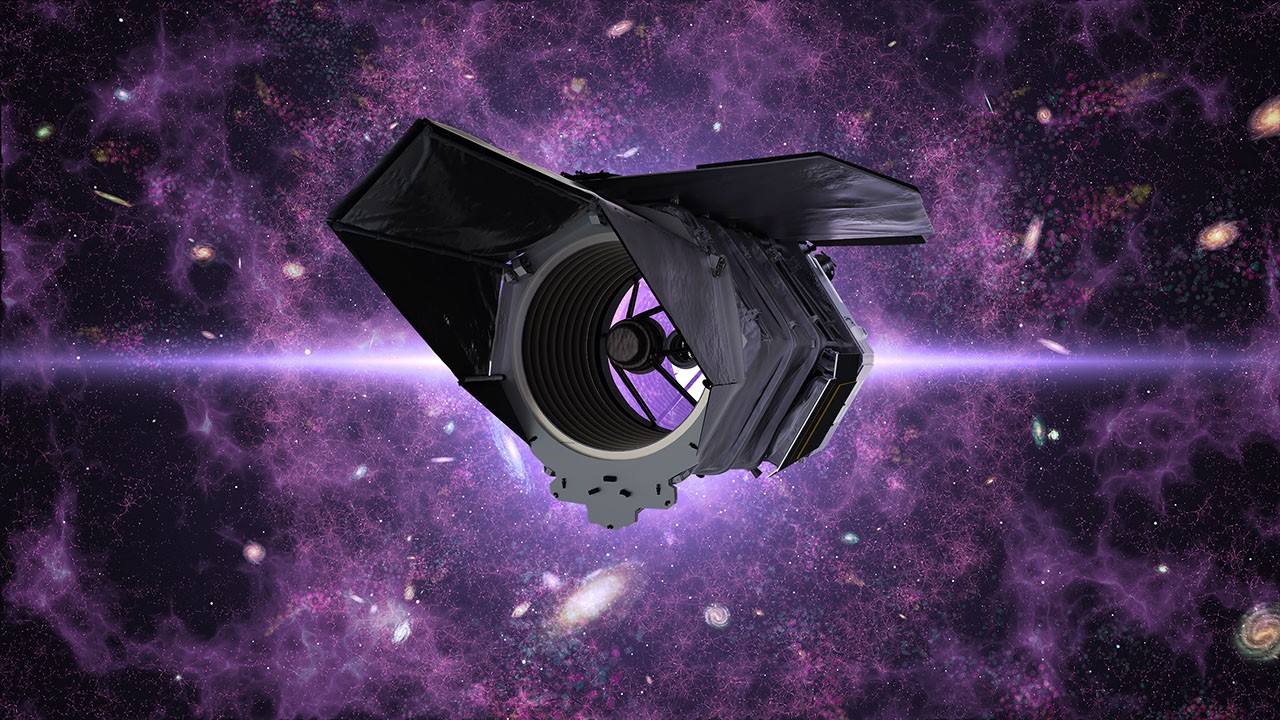
The Falcon Heavy lifted off at 7:26 a.m. Eastern time from Launch Complex 39A at the Kennedy Space Center, carrying a telescope built to survey the universe at a scale no observatory has attempted before. NASA’s Nancy Grace Roman Space Telescope separated from the rocket and entered its intended orbit, the agency said, beginning a mission expected to study roughly a billion galaxies.
Roman is named for Nancy Grace Roman, NASA’s first chief astronomer, who spent decades pushing the agency to build a space telescope capable of seeing farther and wider. The observatory’s field of view is about 100 times larger than the Hubble Space Telescope’s, a design choice that trades narrow, deep views for broad survey power. Astronomers plan to use it for three priorities: mapping dark energy, counting planets beyond the solar system, and studying the infrared sky.
The launch makes Roman the third of NASA’s great observatories to fly, after Hubble and Webb, and the first to ride a commercial rocket. The launch contract went to SpaceX under NASA’s program for buying rides from private providers, part of a broader shift in which the agency increasingly relies on commercial partners for access to space. A mission that cost billions of dollars to build now depends on a company that also launches satellites, capsules and test rockets for its own customers.
The dark energy work is the headline science. Roman will measure how the expansion of the universe has changed over time by surveying supernovae and mapping how galaxies cluster, data that could confirm the standard model of cosmology or expose where it falls short. Dark energy, the force thought to be accelerating that expansion, is one of the biggest open questions in physics, and Roman’s wide field lets it capture the large-scale structure of the cosmos in a way earlier telescopes could not.
The exoplanet survey will use a technique called microlensing, which finds planets by the way their gravity bends and brightens the light of background stars. The method works best with millions of stars watched at once, which makes Roman’s wide field a natural fit. Astronomers expect the survey to turn up thousands of new worlds, including some at distances and in configurations that other planet-hunting methods cannot reach.
The infrared capabilities round out the mission. Dust blocks visible light across much of the galaxy, but infrared passes through it, letting Roman see star-forming regions and the centers of galaxies that are invisible to optical telescopes. The same sensitivity will let it study objects at the edge of the observable universe, where the expansion of space has stretched their light into long wavelengths.
The launch came after years of delays and rising costs, a familiar story for flagship science missions. Roman was conceived as a dedicated dark energy probe and grew into a general-purpose observatory, with the price tag and schedule moving in the same direction. The telescope now faces weeks of commissioning, unfolding its instruments, cooling them to operating temperature and calibrating the detectors, before science observations begin. Astronomers said the first images could come within months.
For SpaceX, the launch is another step into government science work. The Falcon Heavy, first flown in 2018, has carried military payloads and planetary missions, including NASA’s Psyche asteroid probe. Roman is among the largest and most expensive science payloads yet assigned to a commercial launcher, and its success will be cited by both sides in the debate over whether private companies should carry the government’s most valuable instruments.
The broader shift is visible in the launch manifest. NASA has been turning to commercial providers for crew, cargo and now deep-space science, trading its own rockets for a market it helped create. Roman’s ride on a Falcon Heavy is one more data point in that transition, and a signal that the commercial launch industry has reached the frontier of space science.
For the scientists waiting on Roman’s data, the launch ends a decade of waiting and begins another kind of patience. The survey will accumulate data for years, and the catalog of galaxies, planets and transient events it produces will outlive the mission itself. Astronomy is built on archives, and Roman’s will be one of the largest ever assembled from a single telescope.
The science community’s expectations are high. Roman’s survey will produce catalogs of billions of objects, and the data will be public, which means thousands of researchers will begin mining it almost as soon as it arrives. The telescope’s wide field also makes it a discovery machine for things no one is looking for, the kind of instrument that reshapes a field not by answering questions but by changing what can be asked. If the first year of observations matches the design goals, Roman will spend the rest of the decade doing for dark energy and exoplanets what Hubble did for the deep universe in the 1990s.