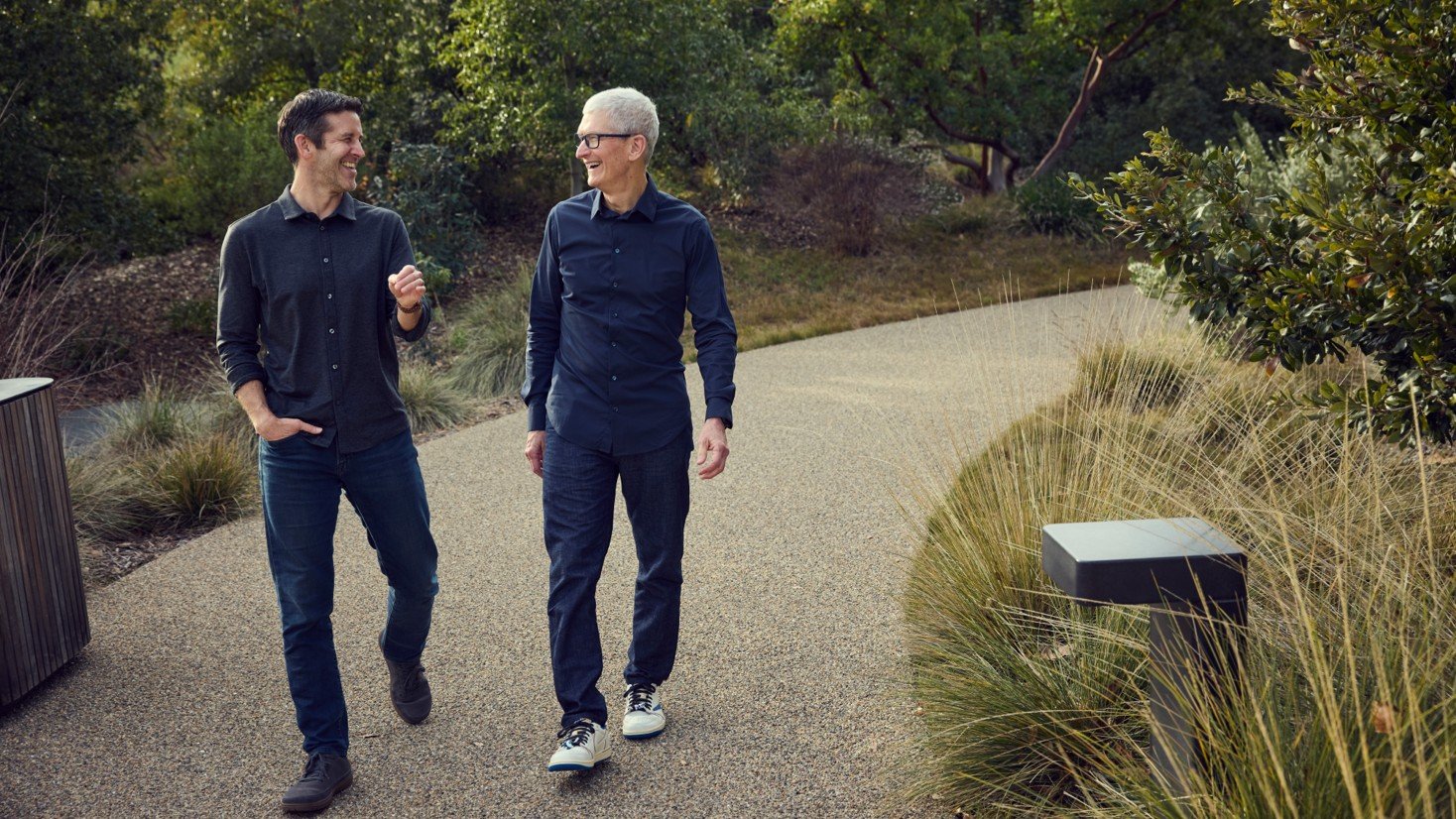
Tim Cook spent his last day as Apple’s chief executive the way he spent so many of the previous fifteen years: on the move, in meetings, doing the work. He steps down Monday, ending a run that began on August 24, 2011, when he took the job from a dying Steve Jobs, and that turned Apple into the most valuable company on earth. John Ternus, the hardware engineering veteran, takes over Tuesday.
The arithmetic of Cook’s tenure is difficult to exaggerate. Apple’s market value has grown from roughly $350 billion to several trillion dollars, making it, at various points, the first company in history to trade above $3 trillion and $4 trillion. Under his watch Apple shipped the Apple Watch, the AirPods, the transition to Apple Silicon, the Vision Pro and the Apple Intelligence software effort, and built a services business that now generates revenue on the scale of a Fortune 100 company by itself.
Cook becomes executive chairman, a role that keeps him inside the company without operational authority. The transition has been planned for months, according to people familiar with the board’s process, and Ternus was the board’s choice in part because he represents continuity: he has spent his career inside Apple’s hardware organization, and he inherits a company whose fortunes still rest on the products he helped engineer.
His first public test comes quickly. On September 9, Apple holds its fall product event, and it will be Ternus’s debut on the stage that has served as the company’s principal stage since Jobs returned. The event is expected to include the new iPhone lineup and, more importantly for the company’s trajectory, a detailed look at Apple’s AI plans and the rebuilt Siri that the company has promised for years.
Fortune’s question, posed as the transition was announced, was blunt: can a low-key engineer win the AI fight for Apple? The question captures the central tension of the handover. Cook’s Apple was defined by operational excellence, supply-chain mastery and disciplined capital returns. The next phase of the industry is being defined by software intelligence, and the company’s record there is its weakest.
The gap is measurable. Siri, launched in 2011 as the industry’s first mainstream assistant, has spent most of the intervening years losing ground. Apple settled a $250 million class action over Siri advertising just days before Cook’s departure, a reminder of how far the assistant’s reputation has fallen. The company’s chatbots arrived late, and its first AI features were rolled out cautiously, in contrast to rivals that shipped aggressively and fixed problems in public.
What Ternus brings to the fight is the part of Apple that still dominates: the silicon. The M-series chips, developed during his years running hardware engineering, are widely regarded as the industry’s best-balanced processors, and the new 2-nanometer Mac mini shows the cadence has not slowed. Apple Intelligence runs on those chips, and the company’s argument, that on-device AI with private processing is a different and better product than cloud-only AI, depends on hardware that no one else makes.
Ternus took over hardware engineering in 2021, succeeding Dan Riccio, and oversaw the Mac’s transition from Intel chips to Apple Silicon, the development of the Vision Pro’s displays and sensors, and the internal modem effort aimed at reducing Apple’s dependence on Qualcomm. Colleagues describe him as direct, unsentimental and allergic to the kind of theatrics that defined the company’s earlier era, which is precisely the temperament the board says it wants for the AI fight.
The handover differs from the last one in a fundamental way. The Jobs-to-Cook transition was a founder’s succession, freighted with symbolism and doubt about whether anyone could follow the company’s creator. The Cook-to-Ternus transition is a management change between two operating executives, both of whom came up through the company’s systems. The board’s choice of continuity over disruption signals that Apple’s directors believe the company’s problems are execution problems, not direction problems.
The challenges awaiting Ternus are substantial. Regulators on three continents are pressing Apple’s app-store economics and its control of the iPhone ecosystem. China, Apple’s second-largest market, has become a geopolitical and competitive risk. And the AI race is being fought by companies with vastly larger clouds and, so far, more convincing software. Ternus’s answer, to the extent he has given one, is to lean into what Apple does best: chips, devices and the integration between them.
At Apple Park on Monday, the mood was described by people present as businesslike rather than sentimental, in keeping with Cook’s own temperament. He leaves behind a company that is financially stronger than any in its history, and a successor whose first event is eight days away. Cook’s departure closes the longest successful chief executive run in modern American business. Ternus’s begins with a product event, a rebuilt assistant to sell, and a question no engineer can avoid: where does Apple’s AI go from here.