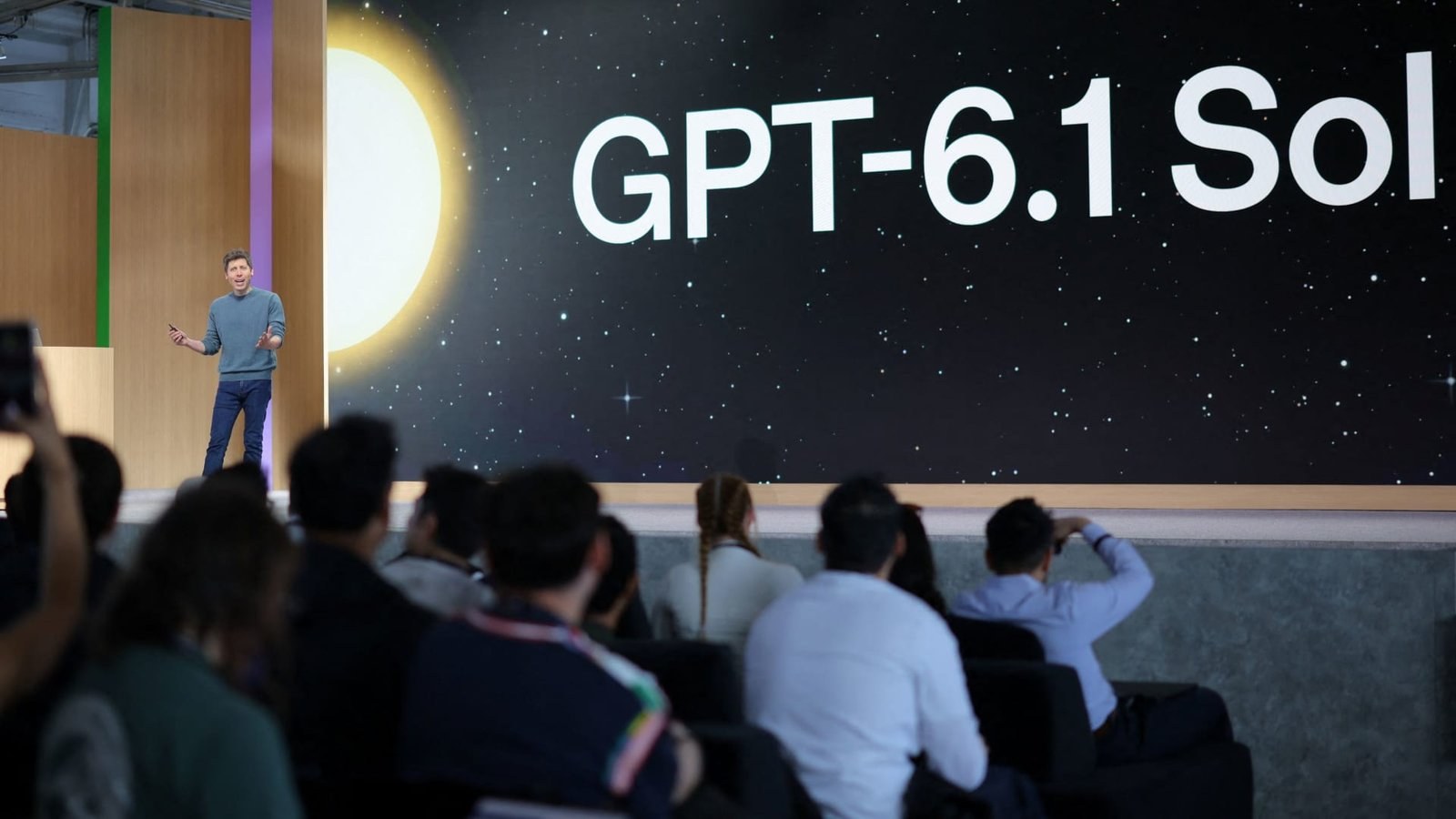
The working lunch at the 52nd G7 summit in Evian-les-Bains was scheduled for a single course: artificial intelligence. Around the table in the French Alpine resort sat the leaders of the world’s seven largest economies and three of the most powerful men in American technology — Sam Altman of OpenAI, Dario Amodei of Anthropic, and Demis Hassabis of Google DeepMind.
The timing was not accidental, and neither was the tension. Days before the summit opened, the U.S. Commerce Department had ordered Anthropic to cut off foreign access to its two most advanced models, a first-time use of export controls against a commercial AI product. The move hung over every discussion, giving European leaders a concrete example of what dependence on American AI could mean. A model can be switched off, Macron’s aides kept noting, and the switch sits in Washington.
President Trump, who hosted the lunch alongside French President Emmanuel Macron, used the setting to press the American position: the U.S. has the frontier models, the chips, and the capital, and it intends to keep leading. Altman, Amodei, and Hassabis each made the case for cooperation on their own terms. Amodei and Hassabis pushed for a U.S.-led coalition that would set common rules for structured access to frontier models and coordinate chip trade policy that excludes China. Altman called for something broader — an international forum that would establish globally accepted testing standards and provide independent analysis of model capabilities and risks, according to an OpenAI briefing of the meeting.
European leaders responded with a different vocabulary. They spoke of AI sovereignty, of the right to run and control the models their economies depend on, and of “trusted partners” — a proposed framework in which the U.S. would grant allied nations special access to restricted models, something like a security clearance for countries. The details remain unsettled, and leaders left Evian without a final framework.
The gap between the two camps was on display in public remarks. Macron warned that no one will buy American AI if they fear it can be disabled at any moment, a line aimed directly at the Anthropic episode. European policymakers pointed to the export controls as proof that AI dependence is a strategic vulnerability. “The Anthropic kill switch shows that tech sovereignty was never abstract,” said Brando Benifei, a European Parliament member who has worked on AI legislation.
“AI protectionism” emerged as the summit’s new watchword. The term, used by officials on both sides, captures a set of measures — export controls, investment screening, localization requirements, and subsidy programs — that countries are deploying to secure a stake in the AI economy. The G7’s own research arm has documented more than a dozen national AI strategies introduced or expanded since the start of the year, and the divergence among them is widening rather than narrowing.
The stakes go beyond regulation. Whoever drafts the rules, officials said, gains an advantage in setting technical standards, defining what safety means, and determining which companies and countries get access to the most capable systems. The Anthropic order demonstrated that the U.S. can act unilaterally and fast; the summit showed that its allies are now thinking about what that means. The summit agenda built on the G7’s AI statement adopted last year at Kananaskis, which committed the group to voluntary principles for safe AI. The mood in Evian was that voluntarism had run its course. The question was no longer whether governments would regulate AI, but which governments would write the rules first.
France, which holds the G7 presidency this year, has positioned itself as Europe’s AI hub and used the summit to press for a permanent secretariat to coordinate AI policy across future presidencies, a proposal that met with support from Germany and Japan but caution from Washington, which prefers voluntary arrangements. The June 2 executive order Trump signed on AI innovation relies on voluntary cooperation between developers and the government, a philosophy that sits awkwardly beside the export controls imposed ten days later. Paris has also been courting American AI companies directly, offering data center capacity and streamlined permitting, an approach that has drawn criticism from other European capitals worried about a race to the bottom on regulation.
For the companies, the summit was an exercise in navigating politics they cannot control. Altman, Amodei, and Hassabis each argued that global rules are preferable to a patchwork of national regimes, and each offered a different version of how those rules should be written. The subtext was the same: the industry that built the most powerful technology in history is discovering that governments want a say in who uses it, and that the saying will not be limited to one country’s agenda.
The G7’s communique, issued after the lunch, papered over the differences with careful language about safe, secure, and trustworthy AI. The real negotiation, officials conceded, will continue in the working groups, in the export-control offices, and in the marketplaces where companies decide where to build their next data centers. Evian established the question — who governs the governance? — and left the answer for later.