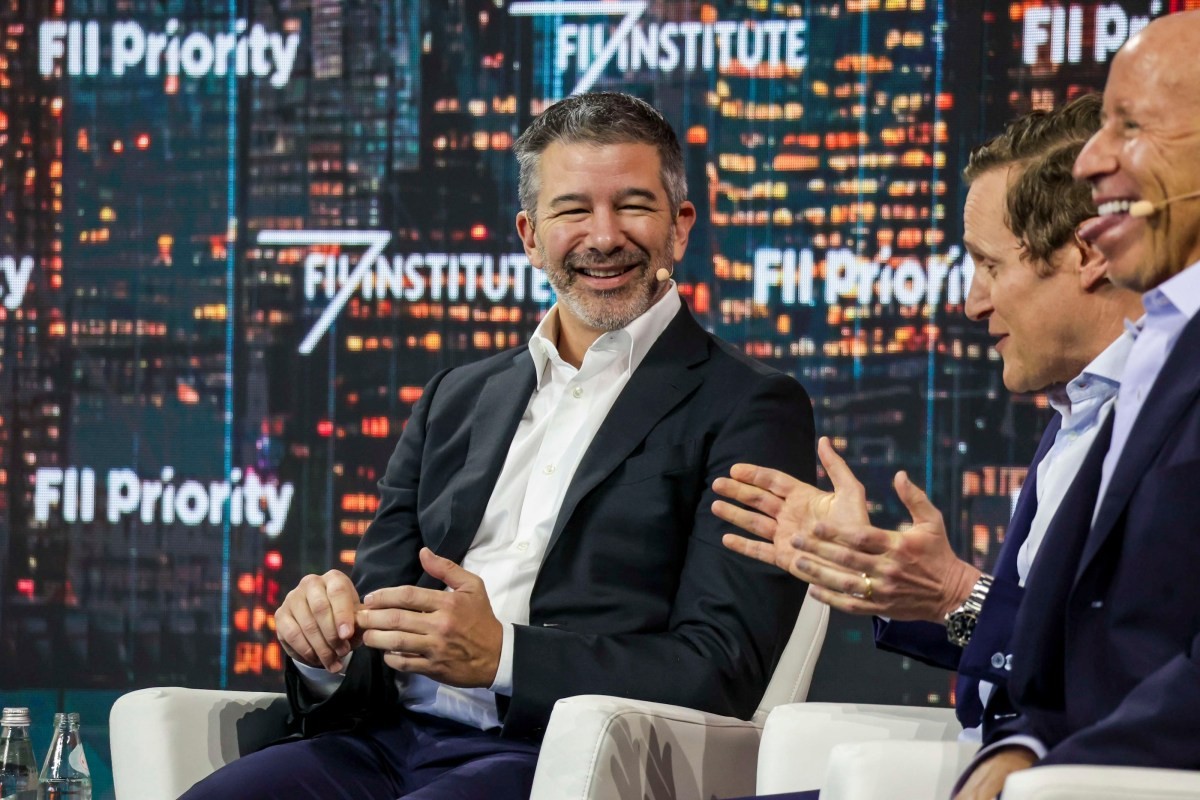
The founder who was pushed out of Uber is building a company that wants to supply it. Travis Kalanick’s startup Atoms is preparing for a hiring spree and a round of acquisitions as it positions itself to become a significant player in autonomous vehicles, the Financial Times reported Sunday, and it has been in talks with Uber about putting its robotaxi technology to work on the ride-hailing giant’s platform. Uber has already invested $100 million in the company, a stake that turns a former rivalry into a commercial relationship.
The turn of events would have been hard to predict a decade ago. Kalanick built Uber into the company that defined ride-hailing, then was forced out in 2017 after a series of scandals, leaving behind a business he had grown from a startup into a global force. His return to the autonomous-vehicle world comes through Atoms, a company he founded quietly and has been funding with the proceeds of his Uber shares.
Atoms raised $1.7 billion this summer in a round led by Andreessen Horowitz, one of the largest investments ever made in a young robotics company, and Kalanick described the funding at the time as unfinished business. The phrase was read as a reference to his interrupted career, and the FT’s reporting suggests he means it literally: the company is preparing to grow quickly, through hiring and through buying other companies, into a contender in a market he was forced to leave.
The acquisition trail has already produced a notable addition. Atoms bought Pronto, an autonomous-mining company founded by Anthony Levandowski, the engineer who once ran Uber’s self-driving program and was later convicted of stealing trade secrets from Google. Levandowski, who was pardoned by President Donald Trump after his conviction, is now part of the Atoms operation, an arrangement that brings together two of the most consequential figures in the industry’s early history.
The Uber connection completes the circle. Kalanick’s original sin, in the eyes of the Uber board that removed him, was a culture of aggressive competition and a self-driving program built on borrowed technology. The company he now runs is in talks to supply robotaxi technology to the platform he created, with Uber holding a $100 million stake in the venture. The competitors of a decade ago have become customer and supplier, investor and investee.
The strategy reflects how the autonomous-vehicle industry has consolidated around a division of labor. The companies that build robotaxi technology, the Waymos and the emerging challengers, have mostly concluded that owning a ride-hailing network is expensive and unnecessary, while the networks, led by Uber, have decided that building their own self-driving systems is too slow and too risky. The result is a market where technology makers partner with platforms, and Atoms is positioning itself on the technology side of that divide.
The industry’s economics give Atoms a reason to move quickly. The leading robotaxi operators have accumulated hundreds of millions of miles of experience and billions of dollars of investment, and the gap between the leaders and everyone else has widened rather than narrowed. A new entrant cannot close that gap by building from scratch, which is why Atoms is hiring aggressively and looking to buy companies with technology already in the field, and why its talks with Uber matter: a deal would give its vehicles access to riders from day one.
The Pronto acquisition fits the pattern of buying capability rather than building it. Pronto’s technology was developed for mining sites, where trucks move over controlled routes in environments without pedestrians or traffic, a simpler problem than city streets but a real one with paying customers. The mining business gives Atoms revenue while its robotaxi ambitions develop, and Levandowski’s engineering experience, whatever the legal history, is among the deepest in the field.
The regulatory climate has shifted in the industry’s favor. Robotaxi services have expanded from test programs into commercial operations in a growing list of American cities, and the federal and state authorities that once treated autonomous vehicles as experimental have grown accustomed to them. For a new entrant, the window is open in a way it was not when Kalanick last tried to build a self-driving program.
The risks are as large as the opportunity. Kalanick’s history raises questions about how he will run a company in an industry that is now regulated, scrutinized and competitive, and Atoms will face the same safety questions that every robotaxi developer faces, with the added burden of its founder’s reputation. The $1.7 billion round gives it time, but the autonomous-vehicle business consumes capital at a rate that makes even that sum a starting point rather than an endowment.
For Uber, the Atoms investment and the talks are part of a broader strategy of spreading bets across the robotaxi field. The company has partnered with most of the leading developers and invested in several, reasoning that the platform that connects riders to whichever technology wins will profit regardless of the outcome. Kalanick’s Atoms is one of those bets, and the irony is not lost on either side: the founder who built Uber to dominate transportation is now working to supply it, and the company that fired him is helping to pay for his return.