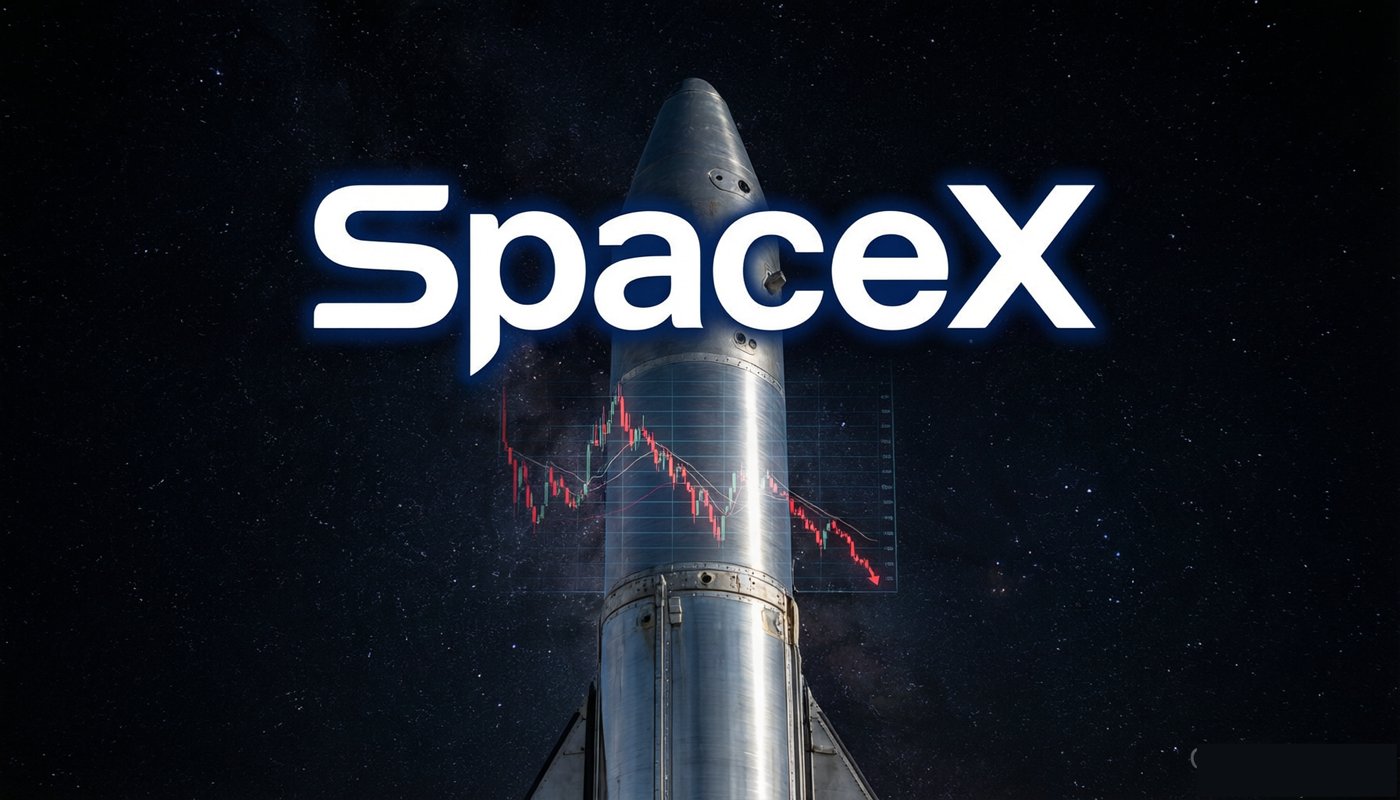
Less than two weeks after the largest initial public offering in history, SpaceX’s stock has fallen below its $445 offering price, a swift reversal of the euphoria that greeted the company’s debut. The shares have slid amid a broad selloff that Al Jazeera reported as a $600 billion wave of selling in the stock, and short interest has been building as traders bet the decline has further to run. The Motley Fool noted the price has fallen to levels that could trigger clauses extending the lockup periods of early investors, a mechanism written into the IPO to protect the company’s long-term holders.
The IPO itself was an event without precedent. SpaceX, the rocket and satellite company founded by Elon Musk, raised capital at a valuation that dwarfed every company that had come before it, and its first-day trading set records for volume and volatility. Retail investors who had waited years for a chance to own a piece of the company that launches Starlink satellites and flies astronauts to orbit piled in; the shares opened far above the offering price and stayed there for days.
The subsequent slide has been almost as remarkable as the debut. What began as profit-taking has turned into a sustained retreat, and the selling has accelerated as the stock broke through successive support levels. The Al Jazeera report described a $600 billion selloff wave — a figure that reflects the sheer size of SpaceX’s market value, which means even modest percentage moves erase enormous sums. Since the IPO, the company has lost roughly $60 billion in market value.
The IPO’s structure has shaped the aftermath. SpaceX sold a limited slice of the company, keeping control tightly concentrated, and the offering price was set after years of private-market trading in which shares changed hands at steadily rising valuations. The public price, $445, was chosen near the top of that private range, which meant the IPO itself offered little discount for the risk of owning a company with SpaceX’s ambitions. When the first-day pop faded, there was no cushion beneath the stock, and the decline has been a search for the price at which new investors feel the risk is fairly rewarded.
The reasons for the decline are varied. Some investors have simply taken profits after the first-day surge, a pattern common to hot IPOs. Others have pointed to the company’s valuation, which prices in years of flawless execution across Starship development, Starlink’s expansion, and a constellation of other ventures. The Motley Fool’s analysis focused on a different risk: if the share price stays below the IPO price, lockup agreements could be extended, delaying the moment when early investors — including employees and venture backers — can sell. Such extensions are designed to protect the stock from a flood of supply, but they also signal distress to the market.
Short sellers have added to the pressure. According to traders familiar with the positioning, borrow costs on SpaceX shares have risen as demand to short the stock has grown, and the failure of the price to rebound has encouraged more bearish bets. The company has not commented on the stock’s trading, and it has no obligation to; its business, which generates revenue from launch services, satellite internet, and government contracts, is unaffected by the secondary-market price of its shares.
The divergence between the business and the stock is at the center of the debate. SpaceX’s operations have rarely looked stronger: Starlink has tens of millions of subscribers, Starship has flown repeatedly, and the company’s launch manifest is full for years. The argument of the bulls is that the stock’s fall is a correction of a bloated valuation, not a judgment on the company. The argument of the bears is that the IPO price itself was set too high, and that the market is repricing what one analyst called the “SpaceX story premium” — the willingness of investors to pay for the company’s mystique as much as its cash flows.
For Musk, the episode is an unusual problem. The entrepreneur has spent years building SpaceX into a company that did not need public markets, and the IPO was structured to give the company flexibility while limiting the influence of outside shareholders. A prolonged decline below the offering price complicates that design: it pressures insiders’ paper wealth, tests the patience of the institutional investors who bought at the IPO, and raises the political temperature around a company whose founder is a central figure in the Trump administration.
The coming weeks will determine whether this is a bump or a trend. Lockup schedules, short-covering rallies, and the general direction of technology stocks will all move the shares. What is already clear is that the biggest IPO in history has produced one of the most dramatic post-debut declines — and that the market’s verdict on the SpaceX story is no longer unanimous. The story premium, it turns out, has a price, and the market is finding it.