
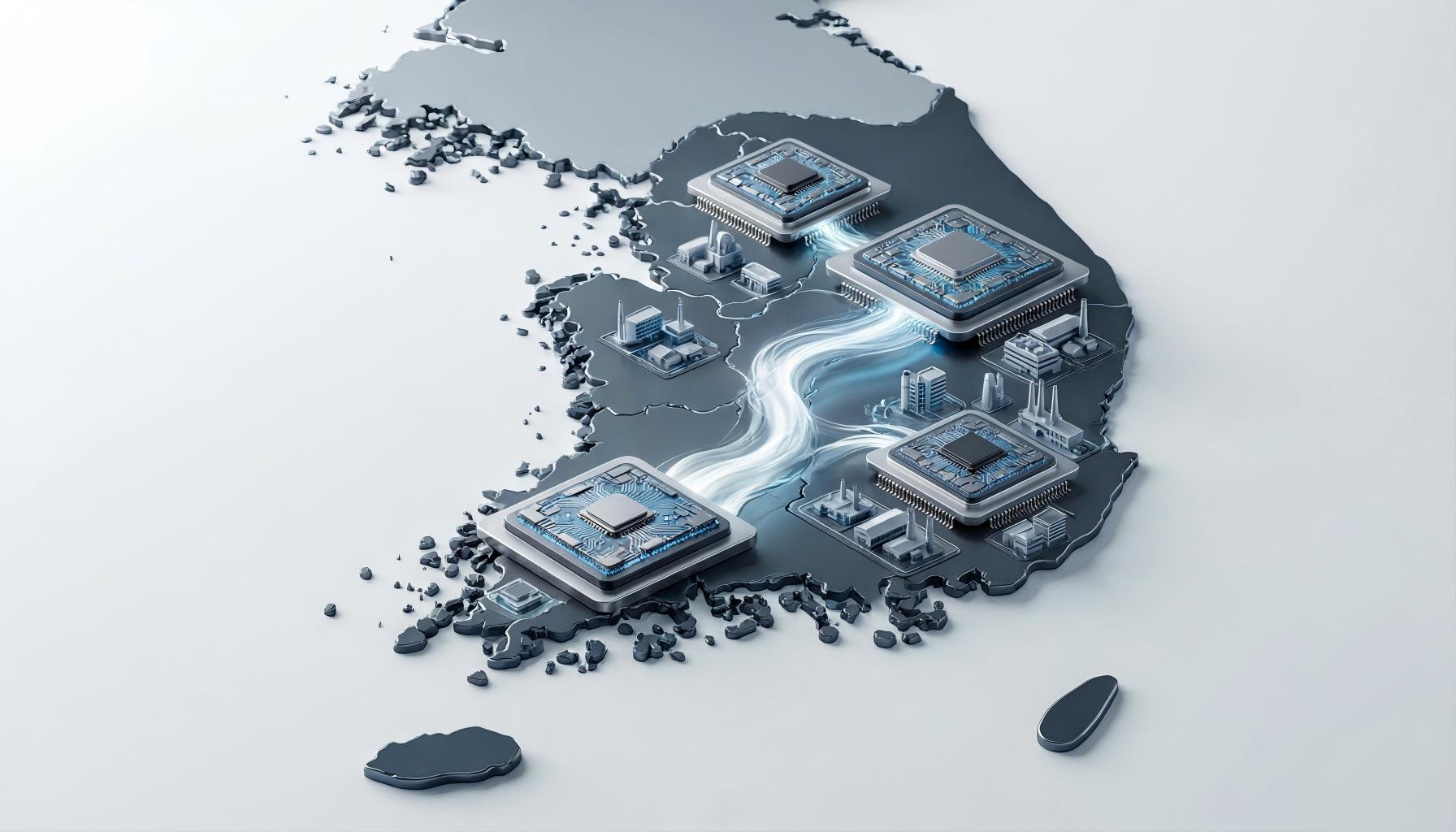
South Korea’s government on Monday laid out a $576 billion investment plan for AI semiconductors, with Samsung Electronics and SK Hynix — the world’s two largest memory-chip makers — tasked with carrying it out. The program is the largest government-corporate joint investment in AI chips by any single country, spanning high-bandwidth memory, advanced packaging and AI data centers.
The announcement, reported by Reuters, formalizes months of discussion in Seoul about how to defend an industry that anchors the country’s exports. Memory chips are Korea’s biggest export category, and the government has made clear it will not cede the field as AI reshapes demand from commodity memory to the specialized, high-priced chips that power AI systems.
The plan’s centerpiece is high-bandwidth memory, the stacked chips that feed data to AI processors. SK Hynix has led the market for HBM, supplying the components to Nvidia, while Samsung has pushed to close the gap after losing ground in early generations. Both companies have said they will direct the bulk of new investment toward HBM capacity.
Advanced packaging is the second pillar. The industry’s next bottlenecks are emerging where chips are assembled, and Korea wants to build capacity for the packaging techniques that AI processors require. The third pillar, AI data centers, reflects a bet that domestic demand for AI computing will grow as the country’s companies adopt the technology.
The investment is a response to pressure from two directions. The United States has poured subsidies into domestic chip manufacturing through the CHIPS Act, and China has invested heavily in its own memory industry. Korean officials argue that only a coordinated national push can keep the country ahead of both.
The market’s reaction has been cautious. Shares of Samsung and SK Hynix have been under pressure in recent weeks, with investors worried about the length of the payback period for a spending program of this scale. CNBC reported that the plan is intended in part to counter that skepticism by making the government’s commitment explicit.
The scale of the numbers invites comparisons. The $576 billion program would dwarf the chip investments announced by most other governments, and it effectively bets the country’s industrial future on the continuation of the AI boom. If demand for AI chips stalls, the overhang of new capacity would hit Korea’s economy hardest.
Analysts said the program’s success will hinge on execution, not announcement. Memory is a cyclical business, and the industry has a long history of building capacity just as prices turn. The government’s challenge is to fund the long-term buildout without repeating the boom-bust cycles that have punished the sector for decades.
The companies’ own positions differ. SK Hynix enters the cycle from a position of strength, with a dominant share of HBM and a valuation that reflects its leadership. Samsung faces a harder task: rebuilding its position in HBM while defending its foundry business, which has lost share to Taiwan’s TSMC.
There is also a geopolitical layer. Korea sits between Washington and Beijing, and the plan walks a line between cooperating with American efforts to restrict advanced chip technology and protecting access to the Chinese market, which remains a major buyer of Korean memory.
For the government, the program is as much about confidence as capacity. Seoul wants to signal to foreign investors and domestic conglomerates that it will back the industry through the cycle, whatever the near-term market says. Officials said they expect the private sector to provide most of the funding, with the state offering tax breaks, infrastructure and loan guarantees.
The timeline is the open question. AI infrastructure buildouts are years in the making, and the returns on this investment would arrive no earlier than the late 2020s. In the meantime, Korean chipmakers must navigate a demand cycle that has already shown signs of cooling in some segments.
For the global industry, the plan raises the stakes. Korea’s commitment adds to a wave of state-backed chip investment from Washington, Tokyo and Beijing, and it increases the odds of excess capacity somewhere down the line. For now, however, the market’s judgment is simple: the money is committed, and the world’s memory supply will be built to match.
Executives at both companies have signaled they will cooperate with the plan while keeping their own capital decisions independent. SK Hynix has said its HBM expansion is already fully subscribed by customer demand, while Samsung has warned that returns will depend on winning back customers it lost in earlier HBM generations.
The program also touches the workforce. Korea faces a shortage of chip engineers, and the plan includes expanded university programs and research institutes to train the talent the buildout will require. Officials acknowledged that capital alone will not be enough; the industry’s constraint in five years may be people, not money.



